



 Chat with AI
Exam 5: Gases

Exam 1: Units of Measurement for Physical and Chemical Change192 Questions
Exam 2: Atoms and Elements174 Questions
Exam 3: Molecules, Compounds, and Nomenclature187 Questions
Exam 4: Chemical Reactions and Stoichiometry261 Questions
Exam 5: Gases163 Questions
Exam 6: Thermochemistry161 Questions
Exam 7: The Quantum-Mechanical Model of the Atom170 Questions
Exam 8: Periodic Properties of the Elements144 Questions
Exam 9: Chemical Bonding I: Lewis Theory155 Questions
Exam 10: Chemical Bonding Ii: Molecular Shapes, Valence Bond Theory, and Molecular Orbital Theory180 Questions
Exam 11: Liquids, Solids, and Intermolecular Forces144 Questions
Exam 12: Solutions167 Questions
Exam 13: Chemical Kinetics170 Questions
Exam 14: Chemical Equilibrium150 Questions
Exam 15: Acids and Bases156 Questions
Exam 16: Aqueous Ionic Equilibrium173 Questions
Exam 17: Gibbs Energy and Thermodynamics134 Questions
Exam 18: Electrochemistry122 Questions
Exam 19: Radioactivity and Nuclear Chemistry116 Questions
Exam 20: Organic Chemistry I: Structures109 Questions
Exam 21: Organic Chemistry Ii: Reactions102 Questions
Exam 22: Biochemistry55 Questions
Exam 23: Chemistry of the Nonmetals50 Questions
Exam 24: Metals and Metallurgy49 Questions
Exam 25: Transition Metals and Coordination Compounds55 Questions
Select questions type


Which of the gases in the graph below has the smallest molar mass? 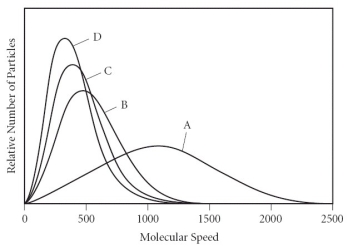
(Multiple Choice)
4.8/5  (71)
(71) Which of the following gases has the highest root mean square velocity at constant temperature?
(Multiple Choice)
4.8/5 (83)
(83) A syringe contains 589 mL of CO at 325 K and 1.2 bar. A second syringe contains 473 mL of N2 at 298 K and 2.6 bar. What is the final pressure if the contents of these two syringes are injected into a 1.00 L container at 273 K?
(Multiple Choice)
4.9/5 (70)
(70) Which of the gases in the graph below has the largest molar mass? 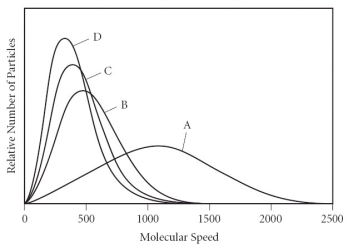
(Multiple Choice)
4.8/5 (80)
(80) Determine the volume of O2 (at STP) formed when 50.0 g of KClO3 decomposes according to the following reaction. The molar mass for KClO3 is 122.55 g mol-1. 2KClO3(s) → 2KCl(s) + 3O2(g)
(Multiple Choice)
4.9/5 (83)
(83) To what volume will a sample of gas expand if it is heated from 50.0 °C and 2.33 L to 500.0 °C?
(Multiple Choice)
4.9/5 (86)
(86) A 0.334 g sample of an unknown halogen occupies 109 mL at 398 K and 1.43 bar. What is the identity of the halogen?
(Multiple Choice)
4.8/5 (78)
(78) According to Avogadro's law, the volume of a gas sample ________ with an increase in the number of moles of gas in the sample. Avogadro's law assumes constant temperature and constant pressure and is independent of the identity of the gas.
(Multiple Choice)
4.9/5 (91)
(91) What volume would 1.02 moles of Kr occupy at a pressure of 1.65 bar and a temperature of 281.2 K?
(Multiple Choice)
4.9/5 (77)
(77) You have three cylinders containing O2 gas at the same volume and pressure. Cylinder A is at -15 °C, cylinder B is at -5 °F, cylinder C is at 255 K. Which cylinder contains the largest mass of oxygen?
(Multiple Choice)
4.8/5 (84)
(84) Which one of the following gas laws explains the increase in volume of a basketball upon inflating it at constant temperature and constant pressure?
(Multiple Choice)
4.8/5 (95)
(95) A fixed amount of gas at 25.0 °C occupies a volume of 20.0 L when the pressure is 0.8386 bar. Use Charles's law to calculate the volume (L) the gas will occupy when the temperature is increased to  while maintaining the pressure at 0.8386 bar.
 (Multiple Choice)
4.9/5 (94)
(94) A container filled with gas is connected to an open-end manometer that is filled with mineral oil. The pressure in the gas container is 753 mmHg and atmospheric pressure is 724 mmHg. How high will the level rise in the manometer if the densities of Hg and mineral oil are 13.6 g mL-1 and 0.822 g mL-1, respectively?
(Multiple Choice)
5.0/5 (80)
(80) If a sample of 0.29 moles of Ar occupies 3.8 L under certain conditions, what volume will 0.66 moles occupy under the same conditions?
(Multiple Choice)
4.7/5 (70)
(70) 
Filters
- Essay(0)
- Multiple Choice(0)
- Short Answer(0)
- True False(0)
- Matching(0)