



 Chat with AI
Exam 9: Chemical Bonding I: Lewis Theory

Exam 1: Units of Measurement for Physical and Chemical Change192 Questions
Exam 2: Atoms and Elements174 Questions
Exam 3: Molecules, Compounds, and Nomenclature187 Questions
Exam 4: Chemical Reactions and Stoichiometry261 Questions
Exam 5: Gases163 Questions
Exam 6: Thermochemistry161 Questions
Exam 7: The Quantum-Mechanical Model of the Atom170 Questions
Exam 8: Periodic Properties of the Elements144 Questions
Exam 9: Chemical Bonding I: Lewis Theory155 Questions
Exam 10: Chemical Bonding Ii: Molecular Shapes, Valence Bond Theory, and Molecular Orbital Theory180 Questions
Exam 11: Liquids, Solids, and Intermolecular Forces144 Questions
Exam 12: Solutions167 Questions
Exam 13: Chemical Kinetics170 Questions
Exam 14: Chemical Equilibrium150 Questions
Exam 15: Acids and Bases156 Questions
Exam 16: Aqueous Ionic Equilibrium173 Questions
Exam 17: Gibbs Energy and Thermodynamics134 Questions
Exam 18: Electrochemistry122 Questions
Exam 19: Radioactivity and Nuclear Chemistry116 Questions
Exam 20: Organic Chemistry I: Structures109 Questions
Exam 21: Organic Chemistry Ii: Reactions102 Questions
Exam 22: Biochemistry55 Questions
Exam 23: Chemistry of the Nonmetals50 Questions
Exam 24: Metals and Metallurgy49 Questions
Exam 25: Transition Metals and Coordination Compounds55 Questions
Select questions type


Rank the following molecules in decreasing bond energy. Cl2 Br2 F2 I2
(Multiple Choice)
4.7/5  (65)
(65) Place the following elements in order of decreasing electronegativity. S Cl Se
(Multiple Choice)
4.8/5 (81)
(81) Draw the best Lewis structure for CH3+. What is the formal charge on the C?
(Multiple Choice)
4.8/5 (76)
(76) Using periodic trends, place the following bonds in order of increasing ionic character. Si-P Si-Cl Si-S
(Multiple Choice)
5.0/5 (70)
(70) Draw the Lewis structure for NO2⁻, including any valid resonance structures. Which of the following statements is TRUE?
(Multiple Choice)
4.9/5 (71)
(71) Place the following elements in order of increasing electronegativity. Sr N Na
(Multiple Choice)
4.9/5 (81)
(81) Describe the difference between a pure covalent bond and a polar covalent bond.
(Essay)
4.9/5 (88)
(88) Use the data given below to construct a Born-Haber cycle to determine the heat of formation of KCl. ΔH°(kJ mol-1)
K(s) → K(g) 89
K(g) → K⁺(g) + e⁻ 418
Cl2(g) → 2Cl(g) 244
Cl(g) + e⁻ → Cl⁻(g) -349
KCl(s) → K⁺(g) + Cl⁻(g) 717
(Multiple Choice)
4.9/5 (87)
(87) Identify the compound with the highest magnitude of lattice energy.
(Multiple Choice)
4.9/5 (72)
(72) Which of the following elements can form hypercoordinate compounds?
(Multiple Choice)
4.9/5 (88)
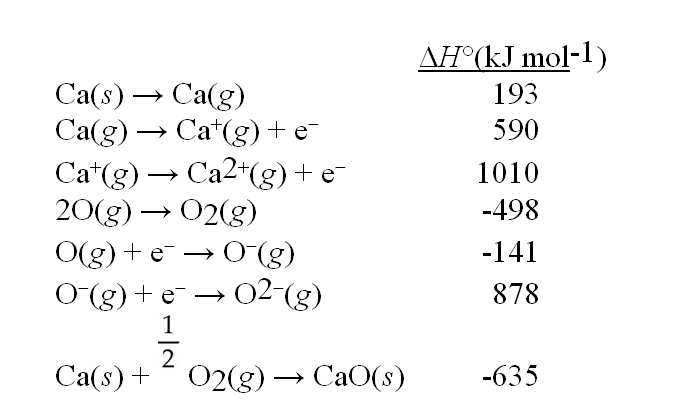
(88) Use the data given below to construct a Born-Haber cycle to determine the lattice energy of CaO.
(Multiple Choice)
4.7/5 (76)
(76) Use Lewis theory to determine the chemical formula for the compound formed between K and I.
(Multiple Choice)
4.9/5 (74)
(74) 
Filters
- Essay(0)
- Multiple Choice(0)
- Short Answer(0)
- True False(0)
- Matching(0)