



 Chat with AI
Exam 19: Radioactivity and Nuclear Chemistry

Exam 1: Units of Measurement for Physical and Chemical Change192 Questions
Exam 2: Atoms and Elements174 Questions
Exam 3: Molecules, Compounds, and Nomenclature187 Questions
Exam 4: Chemical Reactions and Stoichiometry261 Questions
Exam 5: Gases163 Questions
Exam 6: Thermochemistry161 Questions
Exam 7: The Quantum-Mechanical Model of the Atom170 Questions
Exam 8: Periodic Properties of the Elements144 Questions
Exam 9: Chemical Bonding I: Lewis Theory155 Questions
Exam 10: Chemical Bonding Ii: Molecular Shapes, Valence Bond Theory, and Molecular Orbital Theory180 Questions
Exam 11: Liquids, Solids, and Intermolecular Forces144 Questions
Exam 12: Solutions167 Questions
Exam 13: Chemical Kinetics170 Questions
Exam 14: Chemical Equilibrium150 Questions
Exam 15: Acids and Bases156 Questions
Exam 16: Aqueous Ionic Equilibrium173 Questions
Exam 17: Gibbs Energy and Thermodynamics134 Questions
Exam 18: Electrochemistry122 Questions
Exam 19: Radioactivity and Nuclear Chemistry116 Questions
Exam 20: Organic Chemistry I: Structures109 Questions
Exam 21: Organic Chemistry Ii: Reactions102 Questions
Exam 22: Biochemistry55 Questions
Exam 23: Chemistry of the Nonmetals50 Questions
Exam 24: Metals and Metallurgy49 Questions
Exam 25: Transition Metals and Coordination Compounds55 Questions
Select questions type


Determine the identity of the daughter nuclide from the beta decay of  Pb.
Pb. (Multiple Choice)
4.8/5  (82)
(82)  Am.
Which of the following equations shows the correct relationship between the half-life of a nuclide and the radioactive decay rate constant?
(Multiple Choice)
4.9/5 (82)
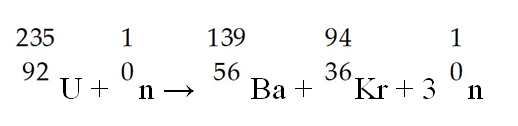
(82) 
The following reaction represents what nuclear process? \
 H +
 H →
 He +
 n
H + H → He + n (Multiple Choice)
4.9/5 (79)
(79) Which of the following nuclides are most likely to decay via beta decay?
(Multiple Choice)
4.7/5 (78)
(78) Determine how many neutrons are produced during the neutron-induced fission of  Pu to form
 Kr and
 Ce.
Pu to form Kr and Ce. (Multiple Choice)
4.9/5 (76)
(76) The following reaction represents what nuclear process?
 Cs +
 e →
 Xe
Cs + e → Xe (Multiple Choice)
4.8/5 (88)
(88) What percentage of a radioactive substance remains after 7.00 half-lives have elapsed?
(Multiple Choice)
4.7/5 (76)
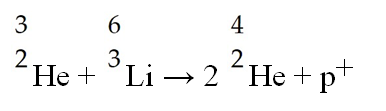
(76) 
The nuclide As-76 has a half-life of 26.0 hours. If a sample of As-76 weighs 344 g, what mass of As-76 remains after 538 minutes?
(Multiple Choice)
4.8/5 (80)
(80) Determine the identity of the daughter nuclide from the positron emission of  O.
O. (Multiple Choice)
4.9/5 (72)
(72) Fluorine-18 undergoes positron emission with a half-life of 1.10 × 10² minutes. If a patient is given a 248 mg dose for a PET scan, how long will it take for the amount of fluorine-18 to drop to 83 mg? (Assume that none of the fluorine is excreted from the body.)
(Multiple Choice)
4.7/5 (89)
(89) Determine the identity of the daughter nuclide from the positron emission of  F.
F. (Multiple Choice)
4.9/5 (77)
(77) 
Filters
- Essay(0)
- Multiple Choice(0)
- Short Answer(0)
- True False(0)
- Matching(0)