



 Chat with AI
Exam 10: The Monetary System

Exam 1: Ten Principles of Economics218 Questions
Exam 2: Thinking Like an Economist231 Questions
Exam 3: Interdependence and the Gains From Trade206 Questions
Exam 4: The Market Forces of Supply and Demand307 Questions
Exam 5: Measuring a Nations Income169 Questions
Exam 6: Measuring the Cost of Living181 Questions
Exam 7: Production and Growth190 Questions
Exam 8: Saving, Investment, and the Financial System214 Questions
Exam 9: Unemployment and Its Natural Rate197 Questions
Exam 10: The Monetary System204 Questions
Exam 11: Money Growth and Inflation195 Questions
Exam 12: Open-Economy Macroeconomics: Basic Concepts219 Questions
Exam 13: A Macroeconomic Theory of the Small Open Economy195 Questions
Exam 14: Aggregate Demand and Aggregate Supply257 Questions
Exam 15: The Influence of Monetary Policy on Aggregate Demand130 Questions
Exam 16: The Influence of Fiscal Policy on Aggregate Demand126 Questions
Exam 17: The Short-Run Tradeoff Between Inflation and Unemployment207 Questions
Exam 18: Five Debates Over Macroeconomic Policy126 Questions
Select questions type


When the Soviet Union began breaking up in the late 1980s, cigarettes began replacing the ruble as the medium of exchange, even though the ruble was legal tender. The cigarettes provide an example of fiat money.
(True/False)
4.9/5  (77)
(77) What does the text mean by, and how does it answer the question, "Where is all the currency?"
(Essay)
4.8/5 (70)
(70) A bank has (in millions): $400 assets, $280 deposits, and $80 debt. If the bank's assets decrease by 10 percent, by how much does the bank's capital change?
(Multiple Choice)
4.9/5 (79)
(79) How does the Bank of Canada conduct open-market transactions?
(Multiple Choice)
5.0/5 (72)
(72) A bank has (in millions): $40 reserves, $160 loans, $80 securities, $240 deposits, and $20 debt. Calculate the bank's reserve ratio, assets, liabilities, capital, and leverage ratio.
(Essay)
4.8/5 (78)
(78) Which statement best describes the consequences of open-market sales conducted by the Bank of Canada?
(Multiple Choice)
4.7/5 (68)
(68) 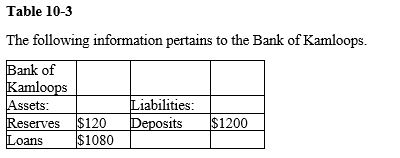 -Refer to Table 10-3. Assume that all other banks hold only the required 5 percent of deposits as reserves and people hold only deposits and no currency. If the Bank of Kamloops decides to hold exactly 5 percent in reserves, by how much would the economy's money supply increase?
 (Multiple Choice)
4.8/5 (75)
(75) If the reserve ratio is 25 percent, how much money can be created from $100 of reserves? Show your work.
(Short Answer)
4.8/5 (86)
(86) 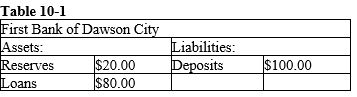 -Refer to Table 10-1. If $1000 is deposited into the First Bank of Dawson City, what will happen?
 (Multiple Choice)
4.9/5 (93)
(93) The money multiplier equals 1 divided by (1 - the reserve ratio).
(True/False)
4.9/5 (67)
(67) At one time, the country of Freedonia had no banks, but had currency of $40 million. Then a banking system was established with a reserve requirement of one-third. The people of Freedonia now keep half their money in the form of currency and half in the form of bank deposits. If banks do not hold excess reserves, how much currency do the people of Freedonia now hold?
(Multiple Choice)
4.8/5 (82)
(82) When the Bank of Canada conducts open-market purchases, how do commercial banks' assets most likely change?
(Multiple Choice)
4.8/5 (76)
(76) In the nineteenth century, when there were often bank runs caused by crop failures, banks would make relatively fewer loans and hold relatively more excess reserves. By itself, which action should the banks have taken?
(Multiple Choice)
4.7/5 (87)
(87) If the Bank of Canada increases reserve requirements, the money supply will increase.
(True/False)
4.9/5 (75)
(75) Which of the following ranks assets from most to least liquid?
(Multiple Choice)
4.7/5 (68)
(68) Explain why banks can influence the money supply if the required reserve ratio is less than 100 percent.
(Essay)
4.8/5 (83)
(83) 
Filters
- Essay(0)
- Multiple Choice(0)
- Short Answer(0)
- True False(0)
- Matching(0)