



 Chat with AI
Exam 12: Open-Economy Macroeconomics: Basic Concepts

Exam 1: Ten Principles of Economics218 Questions
Exam 2: Thinking Like an Economist231 Questions
Exam 3: Interdependence and the Gains From Trade206 Questions
Exam 4: The Market Forces of Supply and Demand307 Questions
Exam 5: Measuring a Nations Income169 Questions
Exam 6: Measuring the Cost of Living181 Questions
Exam 7: Production and Growth190 Questions
Exam 8: Saving, Investment, and the Financial System214 Questions
Exam 9: Unemployment and Its Natural Rate197 Questions
Exam 10: The Monetary System204 Questions
Exam 11: Money Growth and Inflation195 Questions
Exam 12: Open-Economy Macroeconomics: Basic Concepts219 Questions
Exam 13: A Macroeconomic Theory of the Small Open Economy195 Questions
Exam 14: Aggregate Demand and Aggregate Supply257 Questions
Exam 15: The Influence of Monetary Policy on Aggregate Demand130 Questions
Exam 16: The Influence of Fiscal Policy on Aggregate Demand126 Questions
Exam 17: The Short-Run Tradeoff Between Inflation and Unemployment207 Questions
Exam 18: Five Debates Over Macroeconomic Policy126 Questions
Select questions type


Which statement best describes how the Canadian economy has evolved over the past five decades?
(Multiple Choice)
4.7/5  (90)
(90) A country has $120 million of saving and domestic investment of $30 million. What are net exports?
(Multiple Choice)
4.7/5 (71)
(71) Which unit of measurement would be appropriate for a real exchange rate?
(Multiple Choice)
4.9/5 (77)
(77) Between 1981 and 1988, what happened to Canadian net capital outflow as a percent of GDP?
(Multiple Choice)
4.8/5 (75)
(75) A firm in India sells spices to a Canadian chain of culinary stores. Which statement best identifies the effects of this transaction?
(Multiple Choice)
4.9/5 (80)
(80) Suppose that the exchange rate is 50 Bangladesh taka per Canadian dollar, and that a bushel of rice costs 200 taka in Bangladesh and $3 in Canada. Which statement is consistent with these facts?
(Multiple Choice)
4.9/5 (79)
(79) 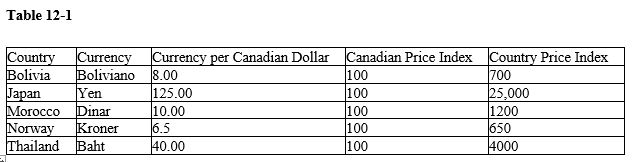 -Refer to Table 12-1. Assume that there are no transportation costs or trade restrictions. With which country can Canadian importers make a profit?
 (Multiple Choice)
4.7/5 (70)
(70) Why does purchasing-power parity theory NOT hold at all times?
(Multiple Choice)
4.9/5 (69)
(69) If the exchange rate changes from 40 Thai baht per dollar to 25 Thai baht per dollar, what has happened to the dollar?
(Multiple Choice)
4.9/5 (82)
(82) Under what circumstances does purchasing-power parity explain how exchange rates are determined and why is it not completely accurate?
(Essay)
4.8/5 (89)
(89) Which of the following would be a Canadian foreign portfolio investment?
(Multiple Choice)
4.9/5 (70)
(70) A Canadian computer maker sells computers to a Czech Republic firm. This company uses all of the revenues from this sale to purchase stock in a Czech Republic company. What happens to Canadian net exports and net foreign investment due to these transactions?
(Multiple Choice)
4.9/5 (88)
(88) How did the real interest rates paid on long-term government debt in Canada and the United States compare with each other over the period from 1984 to 2017?
(Multiple Choice)
4.9/5 (83)
(83) List the factors that might influence a country's exports, imports, and trade balance.
(Essay)
4.8/5 (81)
(81) Healthy Grain Farms, a Canadian manufacturer of dried peas and lentils, sells cases of its product to stores overseas. Which statement best identifies the effects of these transactions?
(Multiple Choice)
4.8/5 (75)
(75) In 2019, Denmark had net exports of $100 billion and sold $700 billion of goods and services abroad. What were Denmark's components of net exports?
(Multiple Choice)
4.9/5 (80)
(80) Jill, a Canadian citizen, uses some previously obtained euros to purchase a bond issued by a French vineyard. How does this transaction affect Canadian net capital outflow?
(Multiple Choice)
4.9/5 (81)
(81) Suppose the price level in Canada was P = 124 last year and it is up by 3 points this year. In the U.S., the price level was 112 last year and it is up by 2 points this year. The exchange rate was US$0.96 per C$1 last year. (For the following calculations, approximate all results to two decimals.)
a. Calculate the inflation rates in Canada and the U.S.
b. Calculate the real exchange rate at the beginning of the period.
c. Calculate the nominal exchange rate at the end of the period, assuming that the real exchange rate has not changed.
d. Compare the rate of change in the exchange rate with the difference between the foreign and domestic inflation rates. Are they equal?
(Essay)
4.9/5 (82)
(82) How does international trade affect the standard of living?
(Multiple Choice)
4.9/5 (86)
(86) A Canadian firm opens a factory that produces climbing equipment in Austria. What are the effects of this transaction?
(Multiple Choice)
4.7/5 (80)
(80) 
Filters
- Essay(0)
- Multiple Choice(0)
- Short Answer(0)
- True False(0)
- Matching(0)