



 Chat with AI
Exam 13: A Macroeconomic Theory of the Small Open Economy

Exam 1: Ten Principles of Economics218 Questions
Exam 2: Thinking Like an Economist231 Questions
Exam 3: Interdependence and the Gains From Trade206 Questions
Exam 4: The Market Forces of Supply and Demand307 Questions
Exam 5: Measuring a Nations Income169 Questions
Exam 6: Measuring the Cost of Living181 Questions
Exam 7: Production and Growth190 Questions
Exam 8: Saving, Investment, and the Financial System214 Questions
Exam 9: Unemployment and Its Natural Rate197 Questions
Exam 10: The Monetary System204 Questions
Exam 11: Money Growth and Inflation195 Questions
Exam 12: Open-Economy Macroeconomics: Basic Concepts219 Questions
Exam 13: A Macroeconomic Theory of the Small Open Economy195 Questions
Exam 14: Aggregate Demand and Aggregate Supply257 Questions
Exam 15: The Influence of Monetary Policy on Aggregate Demand130 Questions
Exam 16: The Influence of Fiscal Policy on Aggregate Demand126 Questions
Exam 17: The Short-Run Tradeoff Between Inflation and Unemployment207 Questions
Exam 18: Five Debates Over Macroeconomic Policy126 Questions
Select questions type


Suppose the market for loanable funds is described by the equations I = 18 - 6r and S = 8 + 4r.
a) Find the relationship between net capital outflow and the world interest rate rw.
b) If net exports are described by NX = 16 - 4X, find the relationship between NX and the world interest rate at the equilibrium exchange rate.
c) For rw = 1.4, what is the elasticity of NX with respect to rw?
d) What is the relationship between the equilibrium exchange rate and the world interest rate? Discuss your result.
(Essay)
4.7/5  (80)
(80) If there is a surplus of loanable funds, what best describes the difference?
(Multiple Choice)
5.0/5 (66)
(66) Suppose that from 1980 to 1987, Canadian net capital outflows decreased. According to the open-economy macroeconomic model, what could have caused this?
(Multiple Choice)
4.9/5 (68)
(68) When a country suffers from capital flight, which statement best explains the effects?
(Multiple Choice)
4.9/5 (68)
(68) Which statement best predicts the effects of an increase in a country's real interest rate?
(Multiple Choice)
4.9/5 (71)
(71) In 2012 and again in 2015, citizens of Greece were reported to be withdrawing their savings from Greek banks because they feared that Greece would leave the European Union. What is consistent with what the open-economy macroeconomic model predicts?
(Multiple Choice)
4.8/5 (82)
(82) According to the open-economy macroeconomic model, if Canada moved from a government budget deficit to a government budget surplus, Canadian real interest rates would increase and the real exchange rate of the Canadian dollar would appreciate.
(True/False)
4.9/5 (82)
(82) Suppose that Canada imposes an import quota on snow blowers. In the open-economy macroeconomic model, which curve would this quota shift?
(Multiple Choice)
4.9/5 (87)
(87) Which of the following is included in the supply of dollars in the market for foreign-currency exchange in the open-economy macroeconomic model?
(Multiple Choice)
4.9/5 (85)
(85) What is the correct way to show the effects of a new import quota?
(Multiple Choice)
4.8/5 (88)
(88) Figure 13-1 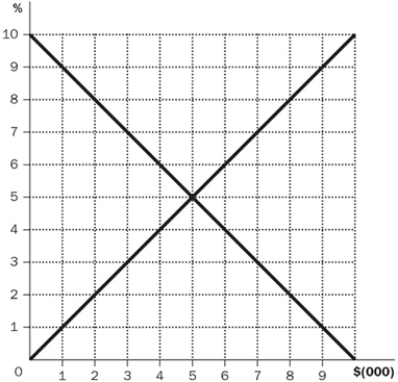 -Refer to Figure 13-1. In the figure shown, if the real interest rate is 7 percent, what is the result?
 (Multiple Choice)
4.9/5 (83)
(83) If Canadian citizens decide to save a larger fraction of their incomes, which statement would best identify the effects?
(Multiple Choice)
4.9/5 (89)
(89) Suppose that in the 1990s, Canadian net capital outflow fell. Which of the following could explain this?
(Multiple Choice)
4.8/5 (88)
(88) What would make both the equilibrium interest rate and the equilibrium quantity of loanable funds decrease?
(Multiple Choice)
4.8/5 (81)
(81) 
Filters
- Essay(0)
- Multiple Choice(0)
- Short Answer(0)
- True False(0)
- Matching(0)