



 Chat with AI
Exam 4: The Market Forces of Supply and Demand

Exam 1: Ten Principles of Economics218 Questions
Exam 2: Thinking Like an Economist231 Questions
Exam 3: Interdependence and the Gains From Trade206 Questions
Exam 4: The Market Forces of Supply and Demand307 Questions
Exam 5: Measuring a Nations Income169 Questions
Exam 6: Measuring the Cost of Living181 Questions
Exam 7: Production and Growth190 Questions
Exam 8: Saving, Investment, and the Financial System214 Questions
Exam 9: Unemployment and Its Natural Rate197 Questions
Exam 10: The Monetary System204 Questions
Exam 11: Money Growth and Inflation195 Questions
Exam 12: Open-Economy Macroeconomics: Basic Concepts219 Questions
Exam 13: A Macroeconomic Theory of the Small Open Economy195 Questions
Exam 14: Aggregate Demand and Aggregate Supply257 Questions
Exam 15: The Influence of Monetary Policy on Aggregate Demand130 Questions
Exam 16: The Influence of Fiscal Policy on Aggregate Demand126 Questions
Exam 17: The Short-Run Tradeoff Between Inflation and Unemployment207 Questions
Exam 18: Five Debates Over Macroeconomic Policy126 Questions
Select questions type


In a competitive market, why does each seller have limited control over the price of his product?
(Multiple Choice)
4.8/5  (84)
(84) Refer to the following:
A. What is the difference between a "change in supply" and a "change in quantity supplied"? (Graph your answer).
B. For each of the following changes, determine whether there will be a change in quantity supplied or a change in supply.
a. a change in the resource cost
b. a change in producer expectations
c. a change in price
d. a change in technology
e. a change in the number of sellers
(Essay)
4.9/5 (74)
(74) Market demand is given as Qd = 400 - 2P. Market supply is given as Qs = 3P + 100. In a perfectly competitive equilibrium, what will be price and quantity?
(Multiple Choice)
4.8/5 (78)
(78) If 50-inch flat screen TVs became cheaper and buyers expected Netflix subscription prices to fall next year, what could we safely conclude would happen to the equilibrium price of a new Netflix subscription?
(Multiple Choice)
4.9/5 (67)
(67) If a decrease in income increases the demand for a good, what is the good called?
(Multiple Choice)
4.8/5 (84)
(84) Suppose that the incomes of buyers in a particular market for a normal good increase and there is also an increase in input prices. What would we expect to occur in this market?
(Multiple Choice)
4.9/5 (76)
(76) Market demand is given as Qd = 80 - 2P. Market supply is given as Qs = 2P. What would result if the market price were $25?
(Multiple Choice)
4.9/5 (84)
(84) Suppose that a decrease in the price of X results in less of good Y sold. What are X and Y called?
(Multiple Choice)
4.7/5 (73)
(73) Figure 4-10  -Refer to the Figure 4-10. What is the movement from point A to point B on the graph called?
 (Multiple Choice)
4.9/5 (84)
(84) A supply curve slopes upward because, all else equal, a higher price means a greater quantity supplied.
(True/False)
4.8/5 (74)
(74) Smart phones are normal goods. What will happen to the equilibrium price and quantity of smart phones if phone plans become more expensive, fewer firms produce smart phones, and smart phone users experience a decrease in income?
(Multiple Choice)
4.8/5 (75)
(75) A dress manufacturer is expecting higher prices for dresses in the near future. What would we expect?
(Multiple Choice)
4.8/5 (69)
(69) Figure 4-2 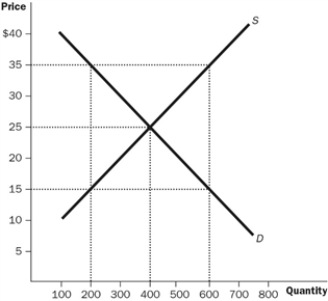 -Refer to the Figure 4-2. What would happen at a price of $35?
 (Multiple Choice)
4.8/5 (75)
(75) The quantity supplied of a good or service is the amount that sellers are willing and able to sell at a particular price.
(True/False)
5.0/5 (75)
(75) Figure 4-4  -Refer to the Figure 4-4. If the price is $25, what would happen?
 (Multiple Choice)
4.9/5 (71)
(71) Why do markets move toward equilibrium of supply and demand?
(Multiple Choice)
4.7/5 (72)
(72) Market demand is given as Qd = 300 - 0.5P. Market supply is given as Qs = 50 + 2P. What would result if the market price were $50?
(Multiple Choice)
4.7/5 (75)
(75) 
Filters
- Essay(0)
- Multiple Choice(0)
- Short Answer(0)
- True False(0)
- Matching(0)