



 Chat with AI
Exam 8: Saving, Investment, and the Financial System

Exam 1: Ten Principles of Economics218 Questions
Exam 2: Thinking Like an Economist231 Questions
Exam 3: Interdependence and the Gains From Trade206 Questions
Exam 4: The Market Forces of Supply and Demand307 Questions
Exam 5: Measuring a Nations Income169 Questions
Exam 6: Measuring the Cost of Living181 Questions
Exam 7: Production and Growth190 Questions
Exam 8: Saving, Investment, and the Financial System214 Questions
Exam 9: Unemployment and Its Natural Rate197 Questions
Exam 10: The Monetary System204 Questions
Exam 11: Money Growth and Inflation195 Questions
Exam 12: Open-Economy Macroeconomics: Basic Concepts219 Questions
Exam 13: A Macroeconomic Theory of the Small Open Economy195 Questions
Exam 14: Aggregate Demand and Aggregate Supply257 Questions
Exam 15: The Influence of Monetary Policy on Aggregate Demand130 Questions
Exam 16: The Influence of Fiscal Policy on Aggregate Demand126 Questions
Exam 17: The Short-Run Tradeoff Between Inflation and Unemployment207 Questions
Exam 18: Five Debates Over Macroeconomic Policy126 Questions
Select questions type


Many economists believe that if the current income tax were replaced with a consumption tax, then saving, investment, economic growth, and the standard of living of Canadians would increase.
(True/False)
4.8/5  (80)
(80) What is the single most important piece of information about a stock?
(Multiple Choice)
4.9/5 (83)
(83) What would NOT result from replacing the income tax with a consumption tax?
(Multiple Choice)
4.8/5 (90)
(90) 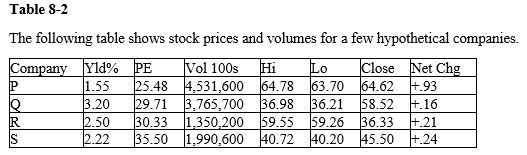 -Refer to Table 8-2. Which company had the highest dollar dividend?
 (Multiple Choice)
4.8/5 (84)
(84) Using a graph representing the market for loanable funds, show and explain what happens to interest rates and investment if a government goes from a deficit to a surplus.
(Essay)
4.9/5 (87)
(87) During the financial crisis of 2008-2009, the risk of lending and borrowing increased significantly.
a) Use the supply and demand for loanable funds model to analyze the effects of increased risk on savings, investment, and the interest rate.
b) Assume the following demand and supply of loanable funds equations: QD = 160 - 10r, and QS = -20 + 20r. How would you modify these equations to include risk?
(Essay)
4.8/5 (91)
(91) Suppose the following equations give the demand and supply for loanable funds in billions of dollars; r is the real interest rate in percentage points :
QD = 160-10r
QS = -20 + 20r
a) How do the demand and supply equations change if the government deficit increased by $5 billion?
b) Calculate the new equilibrium interest rate and quantity of loanable funds. (Compare this to the zero-deficit equilibrium.)
c) Calculate the changes in consumer and producer surplus due to the increase in government deficit. Who gains and who loses from the change in government deficit?
(Essay)
4.9/5 (73)
(73) How does the supply and demand for loanable funds model reflect an increase in the goods and services tax rate?
(Multiple Choice)
4.9/5 (87)
(87) Which term refers to the amount of revenue a firm receives for the sale of its products, minus its costs of production, as measured by its accountants?
(Multiple Choice)
4.9/5 (80)
(80) Which term refers to the sale of stocks and bonds to raise money?
(Multiple Choice)
4.9/5 (87)
(87) Country B has private savings of $70 billion and investment expenditures of $60 billion. How much is Country B's deficit?
(Multiple Choice)
4.9/5 (62)
(62) The country of Meritor uses the merit as its currency. Recent national income statistics shows that it has GDP of 900 million merits, no government transfer payments, taxes of 320 million merits, a budget surplus of 70 million merits, and investment of 300 million merits. What is the sum of its consumption and government expenditures?
(Multiple Choice)
4.9/5 (87)
(87) 
Filters
- Essay(0)
- Multiple Choice(0)
- Short Answer(0)
- True False(0)
- Matching(0)