



 Chat with AI
Exam 9: Volcanoes and Other Igneous Activity

Exam 1: Introduction to Earth Science51 Questions
Exam 2: Minerals: Building Blocks of Rocks59 Questions
Exam 3: Rocks: Materials of the Solid Earth86 Questions
Exam 4: Weathering, Soil, and Mass Wasting87 Questions
Exam 5: Running Water and Groundwater93 Questions
Exam 6: Glaciers, Deserts, and Winds95 Questions
Exam 7: Plate Tectonics: a Scientific Theory Unfolds75 Questions
Exam 8: Earthquakes and Earths Interior62 Questions
Exam 9: Volcanoes and Other Igneous Activity97 Questions
Exam 11: Geologic Time77 Questions
Exam 12: Earths Evolution Through Geologic Time108 Questions
Exam 13: The Ocean Floor64 Questions
Exam 14: Ocean Water and Ocean Life59 Questions
Exam 15: The Dynamic Ocean79 Questions
Exam 16: The Atmosphere: Composition, Structure, and Temperature99 Questions
Exam 17: Moisture, Clouds, and Precipitation89 Questions
Exam 18: Air Pressure and Wind78 Questions
Exam 19: Weather Patterns and Severe Weather71 Questions
Exam 20: Climate82 Questions
Exam 21: Origin of Modern Astronomy91 Questions
Exam 22: Touring Our Solar System81 Questions
Exam 23: Light, Astronomical Observations, and the Sun62 Questions
Exam 24: Beyond Our Solar System69 Questions
Select questions type


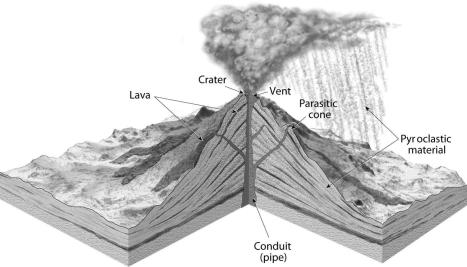
Which tabular, discordant igneous rock body intrudes along a crack or fissure?
(Short Answer)
5.0/5  (80)
(80) 
Which of the following factors help determine whether a volcanic eruption will be violent or relatively quiescent?
(Multiple Choice)
4.9/5 (88)
(88) Briefly discuss volcanic hazards. Although commonly thought to be associated with most volcanic eruptions (by the general public), lava is rarely responsible for the loss of life. Which hazards would tend to be more deadly? Finally, indicate those hazards that are a direct result of volcanic activity as well as those hazards that are indirectly linked.
(Essay)
4.9/5 (85)
(85) Which of the following statements best describes the big Hawaiian volcanoes?
(Multiple Choice)
4.8/5 (81)
(81) Magma generation at depth almost always involves partial melting, not complete melting of the source rock.
(True/False)
4.9/5 (82)
(82) Which type of basaltic lava flow has a fairly smooth, unfragmented, ropy surface?
(Multiple Choice)
4.9/5 (92)
(92) ________ tend to increase the explosive potential of a magma body beneath a volcano.
(Multiple Choice)
4.9/5 (83)
(83) Which of the following is NOT considered pyroclastic debris?
(Multiple Choice)
4.8/5 (66)
(66) Which kind of volcanism is typical of mid-oceanic ridge systems?
(Multiple Choice)
4.8/5 (77)
(77) Matching. Please choose from one of the following answers.
-the volcanoes of southwestern Alaska and the Aleutian Islands
(Multiple Choice)
4.8/5 (82)
(82) Which of the following best describes Shiprock, a famous volcanic feature in New Mexico?
(Multiple Choice)
4.8/5 (95)
(95) A ________ is a near surface, intrusive igneous rock body that results from local inflation of a horizontal sill.
(Multiple Choice)
4.9/5 (85)
(85) Which statement about the May, 1980, eruption of Mount St. Helens is false?
(Multiple Choice)
4.8/5 (79)
(79) The most violent volcanic activity is associated with ________.
(Multiple Choice)
4.9/5 (83)
(83) Which kind of eruptive activity is most likely to be highly explosive?
(Multiple Choice)
4.9/5 (85)
(85) Vents that emit only hot gases and vapors are called ________.
(Short Answer)
4.9/5 (77)
(77) 
Filters
- Essay(0)
- Multiple Choice(0)
- Short Answer(0)
- True False(0)
- Matching(0)