



 Chat with AI
Exam 14: Ocean Water and Ocean Life

Exam 1: Introduction to Earth Science51 Questions
Exam 2: Minerals: Building Blocks of Rocks59 Questions
Exam 3: Rocks: Materials of the Solid Earth86 Questions
Exam 4: Weathering, Soil, and Mass Wasting87 Questions
Exam 5: Running Water and Groundwater93 Questions
Exam 6: Glaciers, Deserts, and Winds95 Questions
Exam 7: Plate Tectonics: a Scientific Theory Unfolds75 Questions
Exam 8: Earthquakes and Earths Interior62 Questions
Exam 9: Volcanoes and Other Igneous Activity97 Questions
Exam 11: Geologic Time77 Questions
Exam 12: Earths Evolution Through Geologic Time108 Questions
Exam 13: The Ocean Floor64 Questions
Exam 14: Ocean Water and Ocean Life59 Questions
Exam 15: The Dynamic Ocean79 Questions
Exam 16: The Atmosphere: Composition, Structure, and Temperature99 Questions
Exam 17: Moisture, Clouds, and Precipitation89 Questions
Exam 18: Air Pressure and Wind78 Questions
Exam 19: Weather Patterns and Severe Weather71 Questions
Exam 20: Climate82 Questions
Exam 21: Origin of Modern Astronomy91 Questions
Exam 22: Touring Our Solar System81 Questions
Exam 23: Light, Astronomical Observations, and the Sun62 Questions
Exam 24: Beyond Our Solar System69 Questions
Select questions type


The open ocean, regardless of depth, where animals swim or float freely is called the abyssal zone.
(True/False)
4.8/5  (77)
(77) Salinity in the ocean is highest in regions where ________ is high and ________ is low.
(Multiple Choice)
4.8/5 (79)
(79) Most marine animals live near the surface of the ocean because of ________, which supports photosynthesis by marine algae that form the basis of the food chain.
(Multiple Choice)
5.0/5 (80)
(80) Animals capable of moving independently of the ocean currents, by swimming or other means of propulsion, are called ________.
(Multiple Choice)
4.8/5 (84)
(84) ________ level refers to each of the feeding stages in the food chain.
(Short Answer)
4.8/5 (76)
(76) Desalination is currently our most productive and efficient source of fresh water.
(True/False)
4.8/5 (90)
(90) The aphotic zone is the near-surface zone of the ocean where light is strong enough for photosynthesis to occur.
(True/False)
4.9/5 (89)
(89) The speed of sound in the ocean has been measured to determine changes in ________ of the ocean.
(Multiple Choice)
4.8/5 (79)
(79) Desalination is not a viable source for producing large amounts of fresh water because of ________.
(Multiple Choice)
4.7/5 (83)
(83) The upper part of the ocean into which sunlight penetrates is called the ________ zone.
(Multiple Choice)
4.8/5 (74)
(74) The ________ zone refers to the area where the land and ocean meet and overlap.
(Short Answer)
4.8/5 (83)
(83) The dissolved materials in seawater are thought to originate from chemical weathering of rocks on the continents and also from ________.
(Multiple Choice)
4.8/5 (85)
(85) ________ refers to the total amount of dissolved materials in water.
(Short Answer)
4.8/5 (86)
(86) Clams, sponges, and crabs are all examples of ________ organisms.
(Short Answer)
4.8/5 (70)
(70) The proportion of dissolved substances in seawater is expressed as 0/00 which is the same as ________.
(Multiple Choice)
4.9/5 (82)
(82) What is the relationship of marine life zones to the distance from a given shoreline? Briefly discuss the factors that control or cause these different zones. Where are these factors on Figure 14.12 below and is one factor more important than the others? 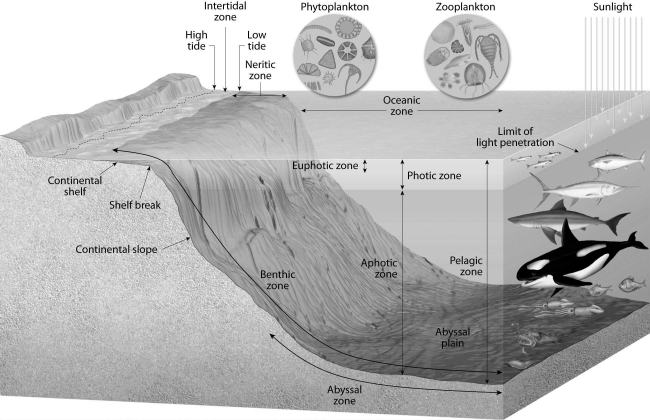
(Not Answered)
This question doesn't have any answer yet

Filters
- Essay(0)
- Multiple Choice(0)
- Short Answer(0)
- True False(0)
- Matching(0)