



 Chat with AI
Exam 20: Climate

Exam 1: Introduction to Earth Science51 Questions
Exam 2: Minerals: Building Blocks of Rocks59 Questions
Exam 3: Rocks: Materials of the Solid Earth86 Questions
Exam 4: Weathering, Soil, and Mass Wasting87 Questions
Exam 5: Running Water and Groundwater93 Questions
Exam 6: Glaciers, Deserts, and Winds95 Questions
Exam 7: Plate Tectonics: a Scientific Theory Unfolds75 Questions
Exam 8: Earthquakes and Earths Interior62 Questions
Exam 9: Volcanoes and Other Igneous Activity97 Questions
Exam 11: Geologic Time77 Questions
Exam 12: Earths Evolution Through Geologic Time108 Questions
Exam 13: The Ocean Floor64 Questions
Exam 14: Ocean Water and Ocean Life59 Questions
Exam 15: The Dynamic Ocean79 Questions
Exam 16: The Atmosphere: Composition, Structure, and Temperature99 Questions
Exam 17: Moisture, Clouds, and Precipitation89 Questions
Exam 18: Air Pressure and Wind78 Questions
Exam 19: Weather Patterns and Severe Weather71 Questions
Exam 20: Climate82 Questions
Exam 21: Origin of Modern Astronomy91 Questions
Exam 22: Touring Our Solar System81 Questions
Exam 23: Light, Astronomical Observations, and the Sun62 Questions
Exam 24: Beyond Our Solar System69 Questions
Select questions type


Köppen believed that the distribution of natural ________ was an excellent expression of the totality of climate.
(Short Answer)
4.9/5  (76)
(76) The Köppen classification has been the best known and most used climate classification system for more than 70 years.
(True/False)
4.8/5 (73)
(73) Köppen believed that the distribution of solar radiation was an excellent expression of the totality of climate.
(True/False)
4.8/5 (92)
(92) Earth's low-latitude deserts and steppes coincide with the ________ pressure belts.
(Short Answer)
4.8/5 (93)
(93) Earth's middle-latitude deserts exist principally because of their positions in the deep interiors of large landmasses, far removed from the oceans.
(True/False)
4.9/5 (81)
(81) The two types of dry climates are ________ or desert and ________ or steppe.
(Short Answer)
5.0/5 (76)
(76) The five parts of the climate system are the ________, ________, ________, ________, and ________.
(Essay)
4.8/5 (70)
(70) Observe the desert and steppe climates on Figure 20.8 below. How are these climates distributed relative to latitude? What is the relationship of dry climates to global circulation discussed in chapter 18? 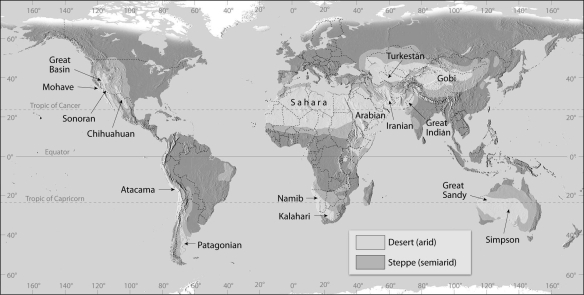
(Essay)
4.8/5 (90)
(90) The two main types of A climates are wet tropical climates and tropical wet and dry climates.
(True/False)
4.8/5 (86)
(86) Köppen believed that the distribution of ________ was an excellent expression of the totality of climate.
(Multiple Choice)
4.8/5 (77)
(77) ________ climate is summer-less with the average temperature of the warmest month below 10˚C.
(Short Answer)
4.9/5 (72)
(72) Which climate group has precipitation as its primary criterion?
(Multiple Choice)
4.9/5 (76)
(76) Within the A group of climates, the two main types are wet tropical climates and tropical ________.
(Multiple Choice)
4.9/5 (83)
(83) The leeward sides of mountains are typically dry and are often arid enough to be referred to as ________.
(Multiple Choice)
4.8/5 (84)
(84) The boundaries of the Köppen climates are largely based on the limits of certain ________ associations.
(Short Answer)
4.9/5 (78)
(78) Altitude and precipitation are the two most important elements in a climatic description.
(True/False)
4.9/5 (82)
(82) The ________ west coast climate is situated on the western (windward) side of continents from about 40 to 65 degrees north and south latitude.
(Multiple Choice)
4.8/5 (67)
(67) The climate system involves only Earth's atmosphere and solid surface.
(True/False)
4.9/5 (78)
(78) The Köppen climate classification system uses mean monthly and annual values of ________ and ________.
(Short Answer)
4.9/5 (96)
(96) 
Filters
- Essay(0)
- Multiple Choice(0)
- Short Answer(0)
- True False(0)
- Matching(0)