



 Chat with AI
Exam 21: Origin of Modern Astronomy

Exam 1: Introduction to Earth Science51 Questions
Exam 2: Minerals: Building Blocks of Rocks59 Questions
Exam 3: Rocks: Materials of the Solid Earth86 Questions
Exam 4: Weathering, Soil, and Mass Wasting87 Questions
Exam 5: Running Water and Groundwater93 Questions
Exam 6: Glaciers, Deserts, and Winds95 Questions
Exam 7: Plate Tectonics: a Scientific Theory Unfolds75 Questions
Exam 8: Earthquakes and Earths Interior62 Questions
Exam 9: Volcanoes and Other Igneous Activity97 Questions
Exam 11: Geologic Time77 Questions
Exam 12: Earths Evolution Through Geologic Time108 Questions
Exam 13: The Ocean Floor64 Questions
Exam 14: Ocean Water and Ocean Life59 Questions
Exam 15: The Dynamic Ocean79 Questions
Exam 16: The Atmosphere: Composition, Structure, and Temperature99 Questions
Exam 17: Moisture, Clouds, and Precipitation89 Questions
Exam 18: Air Pressure and Wind78 Questions
Exam 19: Weather Patterns and Severe Weather71 Questions
Exam 20: Climate82 Questions
Exam 21: Origin of Modern Astronomy91 Questions
Exam 22: Touring Our Solar System81 Questions
Exam 23: Light, Astronomical Observations, and the Sun62 Questions
Exam 24: Beyond Our Solar System69 Questions
Select questions type


Word Analysis. Examine the words and/or phrases for each question below and determine the relationship among the majority of words/phrases. Choose the option which does not fit the pattern.
(Multiple Choice)
4.7/5  (90)
(90) Who wrote the book entitled Of the Revolutions of Celestial Spheres (De Revolutionibus)?
(Multiple Choice)
4.8/5 (90)
(90) The period of time required for the Moon to complete a revolution is called the ________ month.
(Multiple Choice)
4.8/5 (89)
(89) Patterns or configurations of stars named in honor of mythological characters are called perturbations.
(True/False)
4.8/5 (77)
(77) Which astronomer developed the three laws of planetary motion?
(Short Answer)
4.7/5 (78)
(78) Briefly discuss the various motions of Earth. What motion is often mistakenly credited for causing seasons here on Earth? How are these motions related (if at all) to the modern calendar that we use today?
(Not Answered)
This question doesn't have any answer yet
An eclipse of the Moon can be seen by anyone on the side of Earth facing the Moon.
(True/False)
4.8/5 (71)
(71) The proposal that contends that Earth is in the center of the universe is called the ________ view.
(Short Answer)
4.9/5 (95)
(95) This scientist wrote a book that compared the Earth-centered system with the Sun-centered system entitled Dialogue of the Great World Systems.
(Multiple Choice)
4.8/5 (79)
(79) The ________ is at the point in the sky where the Sun crosses the celestial equator at the onset of spring.
(Short Answer)
5.0/5 (77)
(77) The belt of constellations through which all the planets move is called the ________.
(Short Answer)
4.8/5 (80)
(80) The diagram below illustrates the relationship of the Moon and the Earth during a lunar eclipse. Based on the illustration, would you expect lunar eclipses to occur more or less frequently than solar eclipses? Also, which type of eclipse would be seen by a larger portion of the Earth (and therefore potentially more people)? 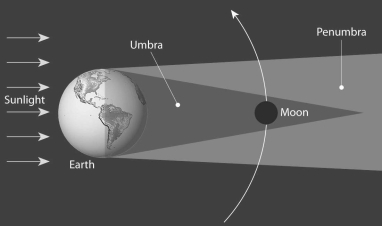
(Essay)
4.9/5 (98)
(98) The true shape of the planetary orbits was discovered by ________.
(Multiple Choice)
4.9/5 (69)
(69) This astronomer is credited with "opening the door" to the era of modern astronomy.
(Multiple Choice)
4.7/5 (83)
(83) 
Filters
- Essay(0)
- Multiple Choice(0)
- Short Answer(0)
- True False(0)
- Matching(0)