



 Chat with AI
Exam 8: Interest Rate Risk I

Exam 1: Why Are Financial Institutions Special111 Questions
Exam 2: Financial Services: Depository Institutions109 Questions
Exam 3: Financial Services: Finance Companies85 Questions
Exam 4: Financial Services: Securities Brokerage and Investment Banking127 Questions
Exam 5: Financial Services: Mutual Funds and Hedge Funds123 Questions
Exam 6: Financial Services: Insurance129 Questions
Exam 7: Risks of Financial Institutions134 Questions
Exam 8: Interest Rate Risk I123 Questions
Exam 9: Interest Rate Risk II130 Questions
Exam 10: Credit Risk: Individual Loan Risk121 Questions
Exam 11: Credit Risk: Loan Portfolio and Concentration Risk69 Questions
Exam 12: Liquidity Risk105 Questions
Exam 13: Foreign Exchange Risk107 Questions
Exam 14: Sovereign Risk97 Questions
Exam 15: Market Risk111 Questions
Exam 16: Off-Balance-Sheet Risk114 Questions
Exam 17: Technology and Other Operational Risks104 Questions
Exam 18: Fintech Risks94 Questions
Exam 19: Liability and Liquidity Management137 Questions
Exam 20: Deposit Insurance and Other Liability Guarantees114 Questions
Exam 21: Capital Adequacy141 Questions
Exam 22: Product and Geographic Expansion160 Questions
Exam 23: Futures and Forwards127 Questions
Exam 24: Options, Caps, Floors, and Collars125 Questions
Exam 25: Swaps109 Questions
Exam 26: Loan Sales97 Questions
Exam 27: Securitization122 Questions
Select questions type


The following information is from First Yaupon Savings Association. Assets Par Amount Rate Liabilities Par Amount Rate 2-year commercial loans \6 00 million 10\% 1-year CDs \9 00 million 7\% 1-year Treasury bills \4 00 million Net Worth \1 00 million [Reference: 8-99]
-What is the repricing gap over the 1-year maturity bucket?
(Multiple Choice)
4.9/5  (88)
(88) For a given change in interest rates, fixed-rate assets with long-term maturities will have smaller changes in price than assets with shorter maturities.
(True/False)
4.7/5 (77)
(77) When interest rates increase, banks are more likely to be forced to increase rate-sensitive liabilities to replace decreased balances in demand deposits and savings accounts.
(True/False)
4.8/5 (80)
(80) Few DIs consider demand deposits to be "core" or long-term sources of funds.
(True/False)
4.9/5 (84)
(84) The liquidity premium theory of the term structure of interest rates
(Multiple Choice)
4.8/5 (79)
(79) What is the weighted average maturity of the liabilities of the FI?
(Multiple Choice)
4.8/5 (77)
(77) The economic insolvency of many thrift institutions during the 1980s was due, at least in part, to unexpected increases in interest rates.
(True/False)
4.7/5 (77)
(77) The risk that the returns on funds to be reinvested will fall below the cost of the funds is:
(Multiple Choice)
4.7/5 (84)
(84) Which of the following describes the condition known as runoff in the repricing model approach to measuring interest rate risk of an FI?
(Multiple Choice)
4.8/5 (71)
(71) If the chosen maturity buckets have a time period that is too long, the repricing model may produce inaccurate results because
(Multiple Choice)
4.9/5 (85)
(85) What is the repricing gap if a 1-year maturity gap is used if runoffs are also considered?
(Multiple Choice)
4.9/5 (91)
(91) When repricing all interest-sensitive assets and all interest-sensitive liabilities in a balance sheet, the cumulative gap will be
(Multiple Choice)
4.9/5 (89)
(89) Of the following institutions, which will be subject to reinvestment risk within a particular reprice bucket?
(Multiple Choice)
4.8/5 (79)
(79) What is the impact on the FI's equity of a 2 percent overall increase in market interest rates on all fixed-rate instruments?
(Multiple Choice)
4.8/5 (85)
(85) A method of measuring the interest rate or gap exposure of an FI is
(Multiple Choice)
4.8/5 (69)
(69) The repricing gap approach calculates the gaps in each maturity bucket by subtracting the
(Multiple Choice)
4.9/5 (80)
(80) The following information details the current rate sensitivity report for Gotbucks Bank, Inc.($ million). 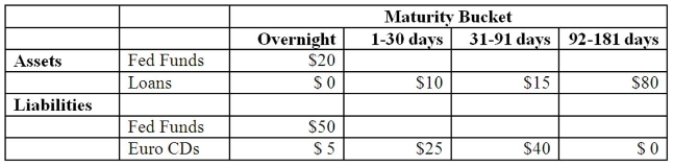 [Reference: 8-93]
-Calculate the funding gap for Gotbucks Bank using (a) a 30 day maturity period and (b) a 91 day maturity period?
[Reference: 8-93]
-Calculate the funding gap for Gotbucks Bank using (a) a 30 day maturity period and (b) a 91 day maturity period? (Multiple Choice)
4.9/5 (87)
(87) All FIs tend to mismatch the maturities of their assets and liabilities to some extent.
(True/False)
4.9/5 (76)
(76) Because of its simplicity, smaller depository institutions still use this model as their primary measure of interest rate risk.
(Multiple Choice)
4.8/5 (64)
(64) The market value of a fixed-rate liability will increase as interest rates rise, although the market value of a fixed-rate asset will decrease as interest rates rise.
(True/False)
5.0/5 (72)
(72) 
Filters
- Essay(0)
- Multiple Choice(0)
- Short Answer(0)
- True False(0)
- Matching(0)