



 Chat with AI
Exam 5: Macroeconomics: the Big Picture

Exam 1: Economics: the Study of Choice145 Questions
Exam 3: Demand and Supply251 Questions
Exam 4: Applications of Supply and Demand113 Questions
Exam 5: Macroeconomics: the Big Picture145 Questions
Exam 6: Measuring Total Output and Income161 Questions
Exam 7: Aggregate Demand and Aggregate Supply166 Questions
Exam 8: Economic Growth136 Questions
Exam 9: The Nature and Creation of Money224 Questions
Exam 10: Financial Markets and the Economy175 Questions
Exam 11: Monetary Policy and the Fed178 Questions
Exam 12: Government and Fiscal Policy177 Questions
Exam 13: Consumption and the Aggregate Expenditures Model219 Questions
Exam 14: Investment and Economic Activity138 Questions
Exam 15: Net Exports and International Finance199 Questions
Exam 16: Inflation and Unemployment132 Questions
Exam 17: A Brief History of Macroeconomic Thought and Policy123 Questions
Exam 18: Inequality, Poverty, and Discrimination140 Questions
Select questions type


Which one of the following is an example of a frictionally unemployed individual?
(Multiple Choice)
4.8/5  (76)
(76) Use the following to answer questions.
Exhibit: Real GDP Over Time 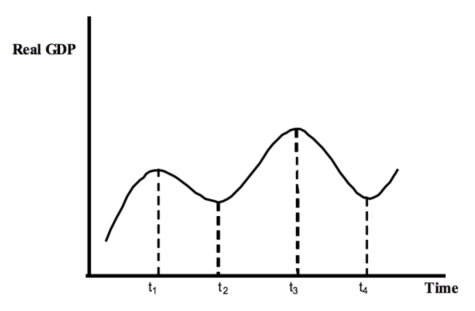 -(Exhibit: Real GDP Over Time) The trough of the business cycle occurs:
 (Multiple Choice)
4.8/5 (89)
(89) When subprime mortgage loans were first sold, they were a profitable investment for the banks that sold them but proved to be a bad deal for home buyers.
(True/False)
4.9/5 (66)
(66) Use the following to answer questions .
Exhibit: Nominal and Real Income
 -(Exhibit: Nominal and Real Income) Calculate the real income for an assistant professor in 1967.
 (Multiple Choice)
4.7/5 (93)
(93) The increased availability of job-related information online has lowered frictional unemployment.
(True/False)
4.8/5 (79)
(79) Consider the following scenario: In January, 8 million people were seeking jobs but did not succeed. In February, 2 million of these people gave up and stopped looking for work. Holding all else constant, what happened to the unemployment rate in February?
(Multiple Choice)
4.9/5 (78)
(78) If the cost of a market basket is $200 in 2006 and $230 in 2007, the price index for 2007 using 2006 as the base year is _____.
(Multiple Choice)
4.8/5 (80)
(80) Over time, _____ has/have been the general trend for most economies.
(Multiple Choice)
4.8/5 (86)
(86) To measure the "core" inflation rate, the Bureau of Economic Analysis uses a price measure that:
(Multiple Choice)
4.9/5 (92)
(92) Nominal GDP of a particular year is calculated as the total value of final goods and services in that year in terms of the base-year prices.
(True/False)
4.8/5 (85)
(85) If the cost of a market basket is $150 in 2004 and $200 in 2005, the price index for 2004 using 2005 as the base year is _____.
(Multiple Choice)
4.9/5 (72)
(72) If the real GDP in 2003 is $12,400 billion and the implicit price deflator is 1.4, what is the approximate value of nominal GDP in 2003?
(Multiple Choice)
5.0/5 (79)
(79) A business cycle is complete when an economy moves from one peak to the next.
(True/False)
4.7/5 (72)
(72) A(n) _____ shows the movement in the average level of prices.
(Multiple Choice)
4.9/5 (73)
(73) Which of the following is true of a price index that uses a fixed market basket?
(Multiple Choice)
4.9/5 (84)
(84) Assuming a constant level of nominal income, the real income of an individual rises:
(Multiple Choice)
4.9/5 (93)
(93) 
Filters
- Essay(0)
- Multiple Choice(0)
- Short Answer(0)
- True False(0)
- Matching(0)