



 Chat with AI
Exam 3: Process Costing

Exam 1: Introduction to Managerial Accounting131 Questions
Exam 2: Job-Order Costing132 Questions
Exam 3: Process Costing128 Questions
Exam 4: Activity-Based Cost Management125 Questions
Exam 5: Cost Behavior and Estimation127 Questions
Exam 6: Cost-Volume-Profit Analysis117 Questions
Exam 7: Incremental Analysis for Short-Term Decision Making125 Questions
Exam 8: Budgeting and Planning125 Questions
Exam 9: Standard Costing and Variances127 Questions
Exam 10: Decentralized Performance Evaluation120 Questions
Exam 11: Capital Budgeting111 Questions
Exam 12: Statement of Cash Flows208 Questions
Exam 13: Financial Statement Analysis145 Questions
Select questions type


Which of the following is a characteristic of process costing?
(Multiple Choice)
4.9/5  (85)
(85) Vista Co. has provided the following information: 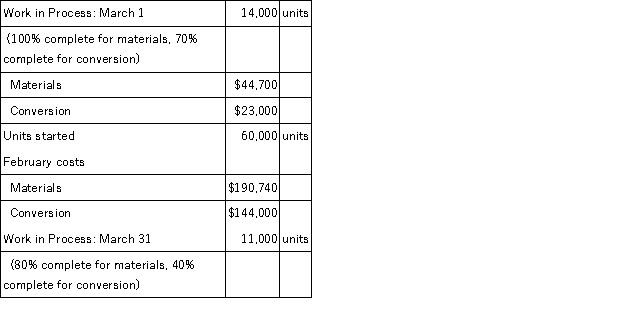 Using the weighted average method of process costing, complete each of the following:
a. How many units were completed and transferred to Finished Goods?
b. Calculate equivalent units.
c. Calculate cost per equivalent unit. Round your answers to four decimal places.
d. What is the dollar amount transferred to Finished Goods? Round your answer to a whole dollar amount.
e. Calculate the cost of the ending Work in Process. Round your answer to a whole dollar amount.
Using the weighted average method of process costing, complete each of the following:
a. How many units were completed and transferred to Finished Goods?
b. Calculate equivalent units.
c. Calculate cost per equivalent unit. Round your answers to four decimal places.
d. What is the dollar amount transferred to Finished Goods? Round your answer to a whole dollar amount.
e. Calculate the cost of the ending Work in Process. Round your answer to a whole dollar amount. (Essay)
4.8/5 (68)
(68) Crador Corp. uses a process costing system in which direct materials are added at the beginning of the process and conversion costs are incurred uniformly throughout the process. Beginning inventory for January consisted of 1,300 units. 13,000 units were started into the process during January. On January 31, the inventory consisted of 650 units. Equivalent units for conversion costs were 14,235. What percentage complete was the ending inventory with respect to conversion costs on January 31?
(Multiple Choice)
4.9/5 (87)
(87) Kenney Co. uses process costing to account for the production of canned energy drinks. Direct materials are added at the beginning of the process and conversion costs are incurred uniformly throughout the process. Equivalent units have been calculated to be 19,200 units for materials and 16,000 units for conversion costs. Beginning inventory consisted of $11,200 in materials and $6,400 in conversion costs. April costs were $57,600 for materials and $64,000 for conversion costs. Ending inventory still in process was 6,400 units (100% complete for materials, 50% for conversion). The cost per equivalent unit for conversion costs using the weighted average method would be
(Multiple Choice)
4.8/5 (64)
(64) Which of the following is not used in the calculation of cost per equivalent unit?
(Multiple Choice)
4.7/5 (76)
(76) Swan Corp. began work on 3,000 units this period. Work in Process Inventory was 500 at the beginning of the period (60% complete) and 1,000 at the end of the period (50% complete). Beginning inventory costs were $3,000 for conversion costs and $7,000 for direct materials. During the period, Swan incurred $75,000 for conversion costs and $52,500 for direct materials. Swan uses the weighted average method of process costing. Direct materials are added at the beginning of the process, and conversion costs are incurred evenly throughout the period.
Required:
Using the weighted average method, compute:
a. How many units were completed during the period?
b. Determine the number of equivalent units for direct materials.
c. Determine the number of equivalent units for conversion costs.
d. Calculate the cost per equivalent unit for direct materials.
e. Determine the cost per equivalent unit for conversion costs.
f. Determine the cost assigned to ending Work in Process Inventory.
g. Determine the cost assigned to goods completed and transferred out.
(Essay)
4.8/5 (79)
(79) The journal entry to record the completion of goods includes:
(Multiple Choice)
4.9/5 (77)
(77) Process costing is used to calculate the cost of homogenous goods or services
(True/False)
4.8/5 (80)
(80) Togo Co. uses process costing to account for the production of picture frames. Direct materials are added at the beginning of the process and conversion costs are incurred uniformly throughout the process. Equivalent units have been calculated to be 12,000 units for materials and 10,000 units for conversion costs. Beginning inventory consisted of $14,000 in materials and $8,000 in conversion costs. April costs were $72,000 for materials and $80,000 for conversion costs. Ending inventory still in process was 4,000 units (100% complete for materials, 50% for conversion). The value of ending inventory using the weighted average method would be closest to:
(Multiple Choice)
4.8/5 (76)
(76) Gatlin Manufacturing adds direct materials at the beginning of the production process, while conversion costs are incurred uniformly throughout the process. At the end of the period, equivalent units for direct materials were 250 more than equivalent units for conversion costs. 1,000 units were started during the period, and 1,000 units were also completed. Ending Work in Process Inventory was 50% complete. How many physical units were in ending Work in Process Inventory?
(Multiple Choice)
4.8/5 (84)
(84) Hager Co. uses process costing to account for the production of bottled energy drinks. Direct materials are added at the beginning of the process and conversion costs are incurred uniformly throughout the process. Equivalent units have been calculated to be 12,000 units for materials and 10,000 units for conversion costs. Beginning inventory consisted of $7,000 in materials and $4,000 in conversion costs. April costs were $36,000 for materials and $40,000 for conversion costs. Ending inventory still in process was 4,000 units (100% complete for materials, 50% for conversion). The value of units completed and transferred out using the weighted average method would be closest to:
(Multiple Choice)
4.8/5 (98)
(98) Prepare the journal entries to record each of the following transactions for Jason Co.
a. Purchased $40,000 of raw materials on credit.
b. Issued $37,600 of raw materials into production.
c. Paid $28,000 cash in production labor costs.
d. Incurred $30,000 of actual overhead costs, paid in cash.
e. Applied $27,000 of overhead cost.
f. Completed 6,600 units with a cost of $13.50 per unit.
g. Sold on account 6,000 units at $18.00 per unit. The cost of the units sold was $(fill in)___________.
h. Disposed of any over- or under-applied overhead cost.
(Essay)
4.9/5 (84)
(84) For a firm that uses the weighted average method of process costing, which of the following must be true?
(Multiple Choice)
4.8/5 (84)
(84) Sierra Co. has provided the following information: 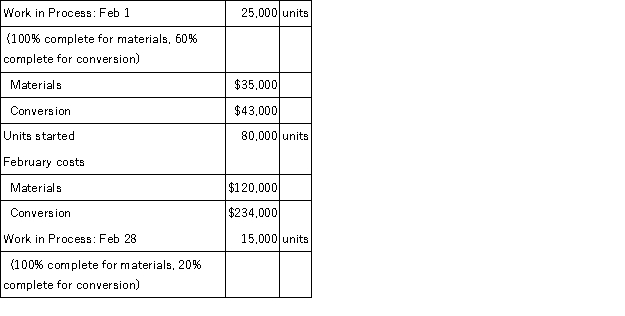 Using the weighted average method of process costing, complete each of the following:
a. How many units were completed and transferred to Finished Goods?
b. Calculate equivalent units.
c. Calculate cost per equivalent unit. Round your answers to four decimal places.
d. What is the dollar amount transferred to Finished Goods? Round your answer to a whole dollar amount.
e. Calculate the cost of the ending Work in Process. Round your answer to a whole dollar amount.
Using the weighted average method of process costing, complete each of the following:
a. How many units were completed and transferred to Finished Goods?
b. Calculate equivalent units.
c. Calculate cost per equivalent unit. Round your answers to four decimal places.
d. What is the dollar amount transferred to Finished Goods? Round your answer to a whole dollar amount.
e. Calculate the cost of the ending Work in Process. Round your answer to a whole dollar amount. (Essay)
4.7/5 (80)
(80) Which of the following companies would most likely use process costing?
(Multiple Choice)
4.9/5 (90)
(90) Which of the following statements is not correct with respect to Fetzer Vineyards's sustainability efforts?
(Multiple Choice)
4.8/5 (72)
(72) Nettle Co. uses process costing to account for the production of rubber balls. Direct materials are added at the beginning of the process and conversion costs are incurred uniformly throughout the process. Equivalent units have been calculated to be 12,000 units for materials and 10,000 units for conversion costs. Beginning inventory consisted of $14,000 in materials and $8,000 in conversion costs. April costs were $72,000 for materials and $80,000 for conversion costs. Ending inventory still in process was 4,000 units (100% complete for materials, 50% for conversion). The total cost per unit using the FIFO method would be closest to:
(Multiple Choice)
4.9/5 (81)
(81) Brody Corp. uses a process costing system in which direct materials are added at the beginning of the process and conversion costs are incurred uniformly throughout the process. Beginning inventory for January consisted of 1,300 units that were 40% completed. 13,000 units were started into the process during January. On January 31, the inventory consisted of 650 units that were 70% completed. What would be the equivalent units for direct materials cost using the weighted average method?
(Multiple Choice)
4.9/5 (75)
(75) Equivalent units are tracked separately for which two categories of costs?
(Multiple Choice)
4.9/5 (79)
(79) Nettle Co. uses process costing to account for the production of rubber balls. Direct materials are added at the beginning of the process and conversion costs are incurred uniformly throughout the process. Equivalent units have been calculated to be 12,000 units for materials and 10,000 units for conversion costs. Beginning inventory consisted of $14,000 in materials and $8,000 in conversion costs. April costs were $72,000 for materials and $80,000 for conversion costs. Ending inventory still in process was 4,000 units (100% complete for materials, 50% for conversion). The cost per unit for conversion costs using the FIFO method would be:
(Multiple Choice)
4.7/5 (71)
(71) 
Filters
- Essay(0)
- Multiple Choice(0)
- Short Answer(0)
- True False(0)
- Matching(0)