



 Chat with AI
Exam 13: Financial Statement Analysis

Exam 1: Introduction to Managerial Accounting131 Questions
Exam 2: Job-Order Costing132 Questions
Exam 3: Process Costing128 Questions
Exam 4: Activity-Based Cost Management125 Questions
Exam 5: Cost Behavior and Estimation127 Questions
Exam 6: Cost-Volume-Profit Analysis117 Questions
Exam 7: Incremental Analysis for Short-Term Decision Making125 Questions
Exam 8: Budgeting and Planning125 Questions
Exam 9: Standard Costing and Variances127 Questions
Exam 10: Decentralized Performance Evaluation120 Questions
Exam 11: Capital Budgeting111 Questions
Exam 12: Statement of Cash Flows208 Questions
Exam 13: Financial Statement Analysis145 Questions
Select questions type


Choose the appropriate letter to match the term and the definition. Not all definitions will be used.
Term
_____ Full Disclosure Principle
_____ Ratio Analysis
_____ Liquidity
_____ Going-Concern Assumption
_____ Profitability
_____ Solvency
_____ Trend Analysis
_____ Vertical Analysis
Definition
A) The ability of a company to meet its short-run financial obligations.
B) A type of analysis that focuses on relationships within a single financial statement.
C) Also known as time-series analysis.
D) The standard that companies should present all relevant information needed to interpret a company's financial position and performance.
E) The standard that expenses should be recognized when incurred.
F) A measure of current earnings performance.
G) A result from comparing a company's results to other companies in the industry.
H) A measure of long-run survivability.
I) The standard that revenue should be recorded when earned, provided payment is reasonably expected.
J) Measures that relate financial variables reported in one or more of the financial statements from the same year.
K) The characteristic that financial information needs to be valuable to decision makers.
L) The standard that takes for granted a company's near term financial survival.
(Short Answer)
5.0/5  (84)
(84) Which of the following ratios is calculated by dividing current assets by current liabilities?
(Multiple Choice)
4.9/5 (80)
(80) In which of the following company attributes would a long-term bond holder be most interested?
(Multiple Choice)
4.8/5 (75)
(75) The general goal of horizontal analyses is to identify significant trends
(True/False)
4.8/5 (73)
(73) Which of the following is calculated by dividing net sales revenue by average net receivables?
(Multiple Choice)
4.9/5 (74)
(74) A condensed balance sheet for Liu Company is presented below: 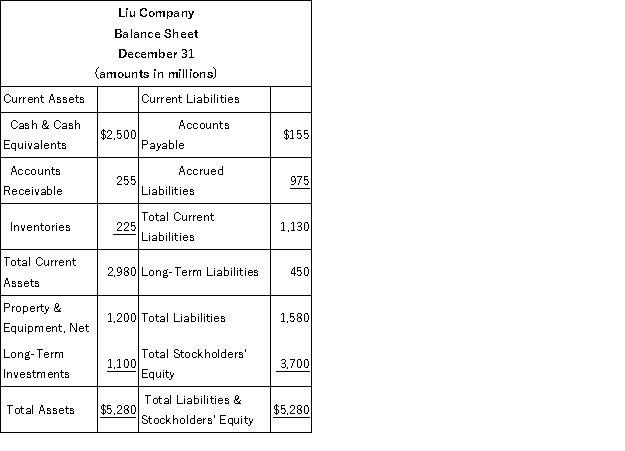 Required:
Part a. Prepare a vertical analysis of the balance sheet above. Round to the nearest whole percent.
Part b. Interpret your analysis. Identify significant items. Comment on key relationships.
Required:
Part a. Prepare a vertical analysis of the balance sheet above. Round to the nearest whole percent.
Part b. Interpret your analysis. Identify significant items. Comment on key relationships. (Essay)
4.9/5 (88)
(88) Company X has net sales revenue of $780,000, cost of goods sold of $343,200, and all other expenses of $327,600. The gross profit percentage is closest to:
(Multiple Choice)
4.8/5 (66)
(66) If an analyst wants to examine a company's current ability to generate income, which of the following would best be considered?
(Multiple Choice)
4.9/5 (80)
(80) The following information is taken from the financial statements of a company for the current year:  The gross profit percentage for the current year rounded to the nearest whole percent is closest to:
 (Multiple Choice)
4.9/5 (84)
(84) If you wish to examine how one aspect of a business is doing relative to other aspects of the business at the current time, you are most likely to use:
(Multiple Choice)
4.9/5 (82)
(82) If an analyst wanted to assess a company's long-run survival, which of the following categories of ratios would most likely be used?
(Multiple Choice)
4.9/5 (80)
(80) The primary objective of financial accounting and reporting is to provide:
(Multiple Choice)
4.7/5 (83)
(83) If a company increases the selling price of the product it sells and all other data on the financial statements remains the same, which of the following ratios will be unaffected?
(Multiple Choice)
4.7/5 (79)
(79) Choose the appropriate letter match each financial performance ratios with the appropriate category.
Ratio
___ Debt-to-assets ratio
___ Receivables turnover ratio
___ Fixed asset turnover ratio
___ Current ratio
___ Return on equity
___ Price earnings ratio
___ Times interest earned ratio
___ Quick ratio
___ Inventory turnover ratio
___ Earnings per share
Category
P - Profitability
L - Liquidity
S - Solvency
(Short Answer)
4.8/5 (70)
(70) Which type of analysis could reveal that a company is relying heavily on debt financing?
(Multiple Choice)
4.9/5 (80)
(80) 
Filters
- Essay(0)
- Multiple Choice(0)
- Short Answer(0)
- True False(0)
- Matching(0)