



 Chat with AI
Exam 24: Growing a Green Thumb: Plant Physiology

Exam 1: Can Science Cure the Common Cold? Introduction to the Scientific Method74 Questions
Exam 2: Are We Alone in the Universe? Water, Biochemistry, and Cells75 Questions
Exam 3: Is It Possible to Supplement Your Way to Better Health?72 Questions
Exam 4: Fat: How Much is Right for You? Enzymes, Metabolism, and Cellular Respiration72 Questions
Exam 5: Life in the Greenhouse: Photosynthesis and Global Warming70 Questions
Exam 6: Cancer: DNA Synthesis, Mitosis, and Meiosis70 Questions
Exam 7: Are You Only as Smart as Your Genes? Mendelian and Quantitative Genetics71 Questions
Exam 8: DNA Detective: Complex Patterns of Inheritance and DNA Fingerprinting71 Questions
Exam 9: Genetically Modified Organisms: Gene Expression, Mutation, and Cloning70 Questions
Exam 10: Where Did We Come From? The Evidence for Evolution70 Questions
Exam 11: An Evolving Enemy: Natural Selection72 Questions
Exam 12: Who Am I? Species and Races66 Questions
Exam 13: Prospecting for Biological Gold: Biodiversity and Classification72 Questions
Exam 14: Is the Human Population Too Large? Population Ecology69 Questions
Exam 15: Conserving Biodiversity: Community and Ecosystem Ecology71 Questions
Exam 16: Where Do You Live? Climate and Biomes73 Questions
Exam 17: Organ Donation: Tissues Organs and Organ Systems70 Questions
Exam 18: Clearing the Air: Respiratory Cardiovascular and Excretory Systems69 Questions
Exam 19: Vaccinations: Protection and Prevention or Peril? Immune System 70 Questions
Exam 20: Sex Differences and Athleticism: Endocrine Skeletal and Muscular Systems73 Questions
Exam 21: Is There Something in the Water? Reproductive and Developmental Biology71 Questions
Exam 22: Attention Deficit Disorder: Brain Structure and Function69 Questions
Exam 23: Feeding the World: Plant Structure and Growth74 Questions
Exam 24: Growing a Green Thumb: Plant Physiology71 Questions
Select questions type


The negative water pressure resulting from water evaporating from the stomata of a leaf creates
(Multiple Choice)
4.9/5  (61)
(61) Florists and horticulturists often cut stems while they're holding a plant underwater in order to
(Multiple Choice)
4.7/5 (83)
(83) The tendency of a plant's uppermost bud to limit the growth of lower buds is called ________ (two words).
(Short Answer)
4.8/5 (83)
(83) The oldest group of plants possessing true xylem and phloem is the
(Multiple Choice)
4.8/5 (77)
(77) The time from the final frost in the spring to the first frost in the fall is called
(Multiple Choice)
4.8/5 (90)
(90) Which of the following are the water-conducting cells in mosses?
(Multiple Choice)
4.9/5 (76)
(76) The overwatering of houseplants and garden plants results in
(Multiple Choice)
4.9/5 (64)
(64) Which of the following occurs when a grapevine wraps around a trellis or another supporting structure?
(Multiple Choice)
4.7/5 (82)
(82) What is the first step in the pressure flow mechanism of translocation?
(Multiple Choice)
4.8/5 (78)
(78) Which of these plants closes its stomata during the day and conducts photosynthesis using chemically stored carbon?
(Multiple Choice)
4.8/5 (94)
(94) 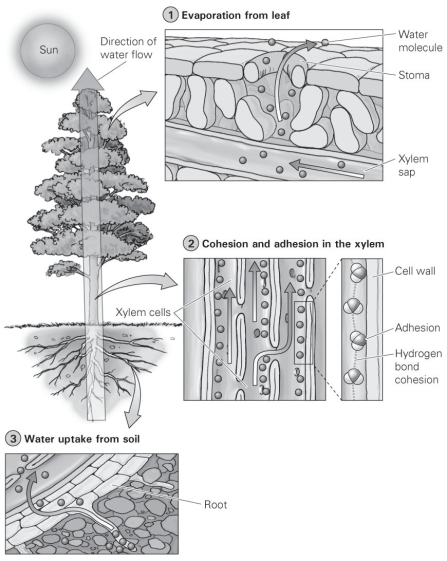 -The overall process illustrated by this diagram is
Many garden plants that are grown for leaves or roots, such as parsley and carrots, produce vegetative growth the first year and reproductive structure growth the second year. Thus, parsley and carrots are
(Multiple Choice)
4.7/5 (79)
(79) The flow of water through a plant, from the soil to the leaves, is due to
(Multiple Choice)
4.8/5 (79)
(79) If the sugary phloem sap in a fruit tree is divided into many sugar sinks, then each individual fruit will be relatively
(Multiple Choice)
4.9/5 (88)
(88) The tendency of water molecules to stick together is called
(Multiple Choice)
4.8/5 (75)
(75) 
Filters
- Essay(0)
- Multiple Choice(0)
- Short Answer(0)
- True False(0)
- Matching(0)