



 Chat with AI
Exam 23: Feeding the World: Plant Structure and Growth

Exam 1: Can Science Cure the Common Cold? Introduction to the Scientific Method74 Questions
Exam 2: Are We Alone in the Universe? Water, Biochemistry, and Cells75 Questions
Exam 3: Is It Possible to Supplement Your Way to Better Health?72 Questions
Exam 4: Fat: How Much is Right for You? Enzymes, Metabolism, and Cellular Respiration72 Questions
Exam 5: Life in the Greenhouse: Photosynthesis and Global Warming70 Questions
Exam 6: Cancer: DNA Synthesis, Mitosis, and Meiosis70 Questions
Exam 7: Are You Only as Smart as Your Genes? Mendelian and Quantitative Genetics71 Questions
Exam 8: DNA Detective: Complex Patterns of Inheritance and DNA Fingerprinting71 Questions
Exam 9: Genetically Modified Organisms: Gene Expression, Mutation, and Cloning70 Questions
Exam 10: Where Did We Come From? The Evidence for Evolution70 Questions
Exam 11: An Evolving Enemy: Natural Selection72 Questions
Exam 12: Who Am I? Species and Races66 Questions
Exam 13: Prospecting for Biological Gold: Biodiversity and Classification72 Questions
Exam 14: Is the Human Population Too Large? Population Ecology69 Questions
Exam 15: Conserving Biodiversity: Community and Ecosystem Ecology71 Questions
Exam 16: Where Do You Live? Climate and Biomes73 Questions
Exam 17: Organ Donation: Tissues Organs and Organ Systems70 Questions
Exam 18: Clearing the Air: Respiratory Cardiovascular and Excretory Systems69 Questions
Exam 19: Vaccinations: Protection and Prevention or Peril? Immune System 70 Questions
Exam 20: Sex Differences and Athleticism: Endocrine Skeletal and Muscular Systems73 Questions
Exam 21: Is There Something in the Water? Reproductive and Developmental Biology71 Questions
Exam 22: Attention Deficit Disorder: Brain Structure and Function69 Questions
Exam 23: Feeding the World: Plant Structure and Growth74 Questions
Exam 24: Growing a Green Thumb: Plant Physiology71 Questions
Select questions type


The emergence of a plant embryo from a seed is called ________.
(Short Answer)
4.9/5  (60)
(60) The roots of monocots are generally ________, whereas the roots of dicots are generally ________.
(Multiple Choice)
4.8/5 (69)
(69) The water in the ________ aquifer in the central United States is apparently being depleted more rapidly that it is being replenished, thus threatening the future of farming in certain regions.
(Multiple Choice)
4.8/5 (70)
(70) Which of the following applications, used by farmers to control weeds, relies upon turning the soil over?
(Multiple Choice)
4.9/5 (81)
(81) Which of the following is the female reproductive organ of a flower?
(Multiple Choice)
4.9/5 (73)
(73) Which of the following is a form of cultural control to minimize pest populations?
(Multiple Choice)
4.8/5 (91)
(91) 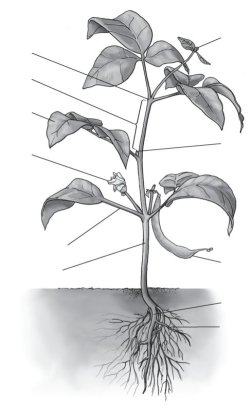 -As shown here, a bean/bean pod is actually a(n)
The triploid cells that make up endosperm of a typical plant contain how many copies of each plant chromosome?
(Multiple Choice)
4.7/5 (70)
(70) Domesticated plants, which make up most of today's crops, are the result of
(Multiple Choice)
4.7/5 (66)
(66) Which of the following are the reproductive organs of a plant?
(Multiple Choice)
4.9/5 (77)
(77) 
Filters
- Essay(0)
- Multiple Choice(0)
- Short Answer(0)
- True False(0)
- Matching(0)