



 Chat with AI
Exam 16: Where Do You Live? Climate and Biomes

Exam 1: Can Science Cure the Common Cold? Introduction to the Scientific Method74 Questions
Exam 2: Are We Alone in the Universe? Water, Biochemistry, and Cells75 Questions
Exam 3: Is It Possible to Supplement Your Way to Better Health?72 Questions
Exam 4: Fat: How Much is Right for You? Enzymes, Metabolism, and Cellular Respiration72 Questions
Exam 5: Life in the Greenhouse: Photosynthesis and Global Warming70 Questions
Exam 6: Cancer: DNA Synthesis, Mitosis, and Meiosis70 Questions
Exam 7: Are You Only as Smart as Your Genes? Mendelian and Quantitative Genetics71 Questions
Exam 8: DNA Detective: Complex Patterns of Inheritance and DNA Fingerprinting71 Questions
Exam 9: Genetically Modified Organisms: Gene Expression, Mutation, and Cloning70 Questions
Exam 10: Where Did We Come From? The Evidence for Evolution70 Questions
Exam 11: An Evolving Enemy: Natural Selection72 Questions
Exam 12: Who Am I? Species and Races66 Questions
Exam 13: Prospecting for Biological Gold: Biodiversity and Classification72 Questions
Exam 14: Is the Human Population Too Large? Population Ecology69 Questions
Exam 15: Conserving Biodiversity: Community and Ecosystem Ecology71 Questions
Exam 16: Where Do You Live? Climate and Biomes73 Questions
Exam 17: Organ Donation: Tissues Organs and Organ Systems70 Questions
Exam 18: Clearing the Air: Respiratory Cardiovascular and Excretory Systems69 Questions
Exam 19: Vaccinations: Protection and Prevention or Peril? Immune System 70 Questions
Exam 20: Sex Differences and Athleticism: Endocrine Skeletal and Muscular Systems73 Questions
Exam 21: Is There Something in the Water? Reproductive and Developmental Biology71 Questions
Exam 22: Attention Deficit Disorder: Brain Structure and Function69 Questions
Exam 23: Feeding the World: Plant Structure and Growth74 Questions
Exam 24: Growing a Green Thumb: Plant Physiology71 Questions
Select questions type


An environment where the plants are low to the ground and many boggy areas are found is called
(Multiple Choice)
5.0/5  (84)
(84) Los Angeles, California, has an average daily temperature between 70° F and 80° F throughout most of the year. There's very little rainfall except for during a rainy season beginning in the fall. This describes the city's
(Multiple Choice)
4.9/5 (84)
(84) Why does Dallas, Texas, have a higher yearly average temperature than Chicago, Illinois?
(Multiple Choice)
5.0/5 (64)
(64) Annual plants germinate, reproduce, and die in one season. These plants often evolved in
(Multiple Choice)
4.9/5 (69)
(69) The typical pattern of temperature and rainfall/snowfall in a region, established over a long period of time, is called
(Multiple Choice)
4.9/5 (84)
(84) The most precipitation is expected on the ________ of a mountain.
(Multiple Choice)
4.8/5 (70)
(70) In the Northern Hemisphere, the summer solstice occurs when
(Multiple Choice)
4.9/5 (89)
(89) Which of the following locations would be expected to exhibit the greatest variation in temperatures throughout the seasons?
(Multiple Choice)
4.9/5 (86)
(86) On a warm summer day in August, you decide to go for a walk through a new housing development that was built near your home a few years ago. As you walk by the pond that's in the center of this development, you notice an unpleasant smell. Then, you see that the pond is full of green algae, and there are dead fish floating on the surface. This is a pond that used to be clean and clear, and you used to play in it as a child. What could have most likely caused this change?
(Multiple Choice)
4.8/5 (88)
(88) France is at almost the same latitude as Nova Scotia. Why is France's climate so much milder?
(Multiple Choice)
4.9/5 (99)
(99) Temperature variation among geographic locations is NOT affected by
(Multiple Choice)
4.8/5 (84)
(84) An adaptation of evergreen trees in boreal forests includes
(Multiple Choice)
4.8/5 (85)
(85) To determine a geographic area's climate, one must take into account the variability of
(Multiple Choice)
4.8/5 (90)
(90) 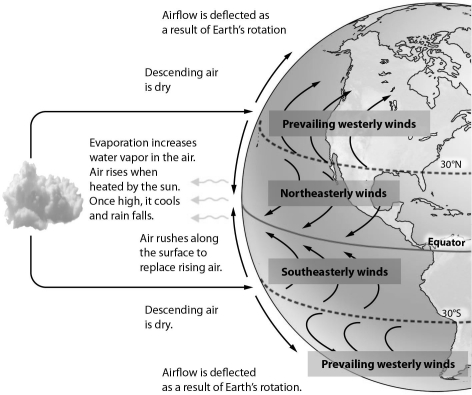 -In which general direction do the prevailing winds blow between 30° North and the equator?
 (Multiple Choice)
4.8/5 (81)
(81) The amount of light received by a given unit area over time is called
(Multiple Choice)
4.9/5 (69)
(69) Valleys are usually ________ than nearby hilltops because ________.
(Multiple Choice)
4.8/5 (79)
(79) A biome that contains few shrubs or trees and has limited rainfall is called
(Multiple Choice)
4.9/5 (79)
(79) Hypothetically, scientists could lower Earth's temperature by ________, in order to combat global warming.
(Multiple Choice)
4.9/5 (86)
(86) 
Filters
- Essay(0)
- Multiple Choice(0)
- Short Answer(0)
- True False(0)
- Matching(0)