



 Chat with AI
Exam 14: Is the Human Population Too Large? Population Ecology

Exam 1: Can Science Cure the Common Cold? Introduction to the Scientific Method74 Questions
Exam 2: Are We Alone in the Universe? Water, Biochemistry, and Cells75 Questions
Exam 3: Is It Possible to Supplement Your Way to Better Health?72 Questions
Exam 4: Fat: How Much is Right for You? Enzymes, Metabolism, and Cellular Respiration72 Questions
Exam 5: Life in the Greenhouse: Photosynthesis and Global Warming70 Questions
Exam 6: Cancer: DNA Synthesis, Mitosis, and Meiosis70 Questions
Exam 7: Are You Only as Smart as Your Genes? Mendelian and Quantitative Genetics71 Questions
Exam 8: DNA Detective: Complex Patterns of Inheritance and DNA Fingerprinting71 Questions
Exam 9: Genetically Modified Organisms: Gene Expression, Mutation, and Cloning70 Questions
Exam 10: Where Did We Come From? The Evidence for Evolution70 Questions
Exam 11: An Evolving Enemy: Natural Selection72 Questions
Exam 12: Who Am I? Species and Races66 Questions
Exam 13: Prospecting for Biological Gold: Biodiversity and Classification72 Questions
Exam 14: Is the Human Population Too Large? Population Ecology69 Questions
Exam 15: Conserving Biodiversity: Community and Ecosystem Ecology71 Questions
Exam 16: Where Do You Live? Climate and Biomes73 Questions
Exam 17: Organ Donation: Tissues Organs and Organ Systems70 Questions
Exam 18: Clearing the Air: Respiratory Cardiovascular and Excretory Systems69 Questions
Exam 19: Vaccinations: Protection and Prevention or Peril? Immune System 70 Questions
Exam 20: Sex Differences and Athleticism: Endocrine Skeletal and Muscular Systems73 Questions
Exam 21: Is There Something in the Water? Reproductive and Developmental Biology71 Questions
Exam 22: Attention Deficit Disorder: Brain Structure and Function69 Questions
Exam 23: Feeding the World: Plant Structure and Growth74 Questions
Exam 24: Growing a Green Thumb: Plant Physiology71 Questions
Select questions type


When a population of spotted salamanders in an area of vernal pools remains stable for many years and the population has stabilized because of resource limits, then
(Multiple Choice)
4.9/5  (76)
(76) When a population grows larger than the carrying capacity, then
(Multiple Choice)
4.8/5 (63)
(63) A population can be clumped at one scale and uniform at another.
(True/False)
4.9/5 (85)
(85) 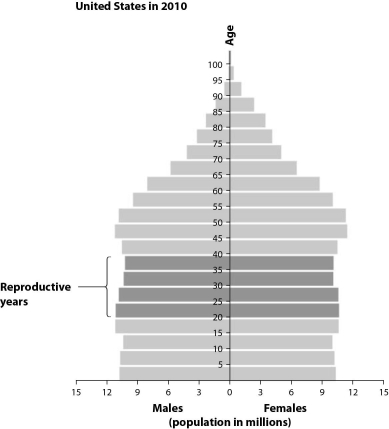 -Based on the population pyramid of the United States in 2010, as seen in this figure, you can predict that the population will
 (Multiple Choice)
4.7/5 (84)
(84) In general, developed countries have lower population growth rates than less developed countries.
(True/False)
4.8/5 (73)
(73) Which of the following is a population unaffected by density-dependent factors?
(Multiple Choice)
4.8/5 (81)
(81) Human populations may surpass the carrying capacity of their environment due to
(Multiple Choice)
4.7/5 (92)
(92) New England salt marshes experience a greater amount of plant growth in a given area in one year than any other temperate ecosystem. These salt marshes have
(Multiple Choice)
4.7/5 (84)
(84) What is the birth rate in a population in which 35 babies are born per every 1000 people in the population each year?
(Multiple Choice)
4.8/5 (86)
(86) 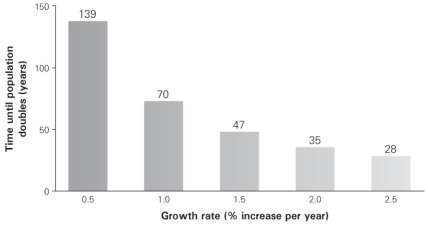 -According to this plot, growth rate and doubling time are
The evenly spaced distribution of stalks of corn planted in an agricultural field is considered
(Multiple Choice)
4.8/5 (79)
(79) Nearly all developed countries in the world are beginning a demographic transition in the 21st century.
(True/False)
4.9/5 (86)
(86) Species of oak trees periodically have years of large acorn production, followed by years of lower acorn amounts. In years of plenty, squirrel populations will experience an increase due to increased food availability of acorns. Then, squirrel populations will decrease after lower acorn abundance. This is an example of
(Multiple Choice)
4.9/5 (77)
(77) Walking along a mile-long path in the woods, you notice a stand of your favorite wildflower, the cardinal flower, three different times. You find each stand of cardinal flower, including many flowers in each stand, on a stream bank. This is an example of a ________ distribution.
(Multiple Choice)
4.8/5 (85)
(85) In a particular county, there are 30 births and 20 deaths for every 1000 residents. What is the annual growth rate of this population?
(Multiple Choice)
5.0/5 (69)
(69) Which of the following explains a uniform distribution of individuals in a population?
(Multiple Choice)
4.8/5 (76)
(76) 
Filters
- Essay(0)
- Multiple Choice(0)
- Short Answer(0)
- True False(0)
- Matching(0)