



 Chat with AI
Exam 3: Temperature

Exam 1: Introduction to the Atmosphere119 Questions
Exam 2: Heating Earths Surface and Atmosphere120 Questions
Exam 3: Temperature121 Questions
Exam 4: Moisture and Atmospheric Stability121 Questions
Exam 5: Forms of Condensation and Precipitation129 Questions
Exam 6: Air Pressure and Winds117 Questions
Exam 7: Circulation of the Atmosphere130 Questions
Exam 8: Air Masses115 Questions
Exam 9: Weather Patterns114 Questions
Exam 10: Thunderstorms and Tornadoes121 Questions
Exam 11: Hurricanes106 Questions
Exam 12: Weather Analysis and Forecasting103 Questions
Exam 13: Air Pollution107 Questions
Exam 14: The Changing Climate107 Questions
Exam 15: World Climates106 Questions
Exam 16: Optical Phenomena of the Atmosphere109 Questions
Select questions type


Below is a diagram of continents observed on a planet identical to the Earth, but which rotates in the opposite direction. Points represent different cities on these continents.
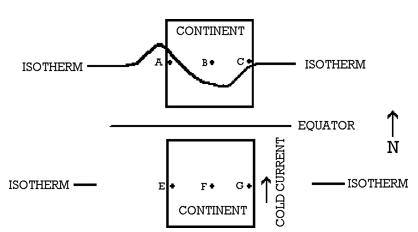 -What season (winter or summer) is the Northern Hemisphere experiencing?
 (Short Answer)
4.8/5  (96)
(96) Below is a diagram of continents observed on a planet identical to the Earth, but which rotates in the opposite direction. Points represent different cities on these continents.
-Is the temperature at City B likely warmer or colder than the temperature at City C?
-Is the temperature at City B likely warmer or colder than the temperature at City C? (Short Answer)
4.8/5 (81)
(81) The seasonal shift of isotherms is greater over the continents than over the ocean.
(True/False)
4.9/5 (73)
(73) Below is a diagram of continents observed on a planet identical to the Earth, but which rotates in the opposite direction. Points represent different cities on these continents.
-If no ocean currents existed and the winds were from the west (left), which City (E or G) would have the lower annual temperature range?
-If no ocean currents existed and the winds were from the west (left), which City (E or G) would have the lower annual temperature range? (Short Answer)
4.7/5 (77)
(77) The annual temperature range at most latitudes in the southern hemisphere is much smaller than in the northern hemisphere. Why?
(Multiple Choice)
4.8/5 (89)
(89) Summer temperatures along the California coast are cooler than along the coast of South Carolina, due to the influence of:
(Multiple Choice)
4.9/5 (75)
(75) If the mean daily temperature is 70°F, then there are 5 heating degree days accumulated.
(True/False)
4.9/5 (71)
(71) On a particular day, a place accumulates 15 heating degree days. What was the daily mean temperature on that day?
(Multiple Choice)
4.7/5 (75)
(75) Overnight temperatures are warmer when the air is humid because:
(Multiple Choice)
4.9/5 (76)
(76) A leeward coastal city will display climate patterns typical of a continental climate, even though they are located on the coast of an ocean.
(True/False)
4.9/5 (79)
(79) The Southern Hemisphere is also referred to as the water hemisphere.
(True/False)
4.7/5 (102)
(102) Thermistors are electrical thermometers commonly used in radiosondes.
(True/False)
4.8/5 (83)
(83) The lag of extreme temperatures with respect to minimum or maximum values of solar radiation is due to:
(Multiple Choice)
4.8/5 (79)
(79) 
Filters
- Essay(0)
- Multiple Choice(0)
- Short Answer(0)
- True False(0)
- Matching(0)