



 Chat with AI
Exam 12: Earths Evolution Through Geologic Time

Exam 1: Introduction to Earth Science108 Questions
Exam 2: Matter and Minerals115 Questions
Exam 3: Rocks: Materials of the Solid Earth120 Questions
Exam 4: Plate Tectonics: a Scientific Revolution Unfolds89 Questions
Exam 5: Earthquakes and Earths Interior90 Questions
Exam 6: Volcanoes and Other Igneous Activity106 Questions
Exam 7: Crustal Deformation and Mountain Building97 Questions
Exam 8: Weathering, Soil, and Mass Movement124 Questions
Exam 9: Running Water and Groundwater134 Questions
Exam 10: Glaciers, Deserts, and Wind100 Questions
Exam 11: Geologic Time102 Questions
Exam 12: Earths Evolution Through Geologic Time129 Questions
Exam 13: The Ocean Floor92 Questions
Exam 14: Ocean Water and Ocean Life74 Questions
Exam 15: The Dynamic Ocean101 Questions
Exam 16: The Atmosphere: Composition, Structure, and Temperature85 Questions
Exam 17: Moisture, Clouds, and Precipitation101 Questions
Exam 18: Air Pressure and Wind97 Questions
Exam 19: Weather Patterns and Severe Storms96 Questions
Exam 20: World Climates and Global Climate Change105 Questions
Exam 21: Origins of Modern Astronomy101 Questions
Exam 22: Touring Our Solar System93 Questions
Exam 23: Light, Telescopes, and the Sun93 Questions
Exam 24: Beyond Our Solar System83 Questions
Select questions type


The waste gas released by plants as they synthesize food sugars from carbon dioxide and water is ______.
(Multiple Choice)
4.9/5  (82)
(82) In the early history of Earth, the solid surface of the earth weathered more rapidly than now because ______ .
(Multiple Choice)
4.8/5 (87)
(87) The Great Oxygen Event marks the time, approximately 2.5 billion years ago, when ______ .
(Multiple Choice)
4.9/5 (89)
(89) Banded Iron Formations are interbedded iron oxides and chert that formed on the sea floor between 3.5 and 2 billion years ago because _______.
(Multiple Choice)
4.8/5 (87)
(87) Bacteria that thrive in oxygen free environments are called ______bacteria.
(Multiple Choice)
4.9/5 (76)
(76) The most common Precambrian fossils are _______ , layered mounds of calcium carbonate.
(Multiple Choice)
4.9/5 (72)
(72) A major site of sediment deposition during the Cenozoic was______.
(Multiple Choice)
4.9/5 (74)
(74) By the late ______period, true air- breathing amphibians with fish- like heads and tails had evolved.
(Multiple Choice)
4.8/5 (91)
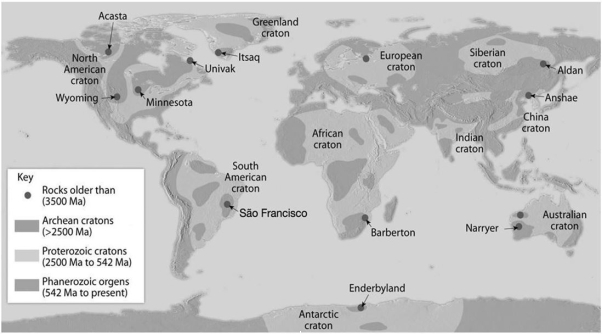
(91) Examine Figure 12.12 below, which illustrates the distribution of cratons and orogens mountain belts. on Earth today. Briefly discuss how have these regions have developed over time using the concept of plate tectonics. Include the relationship between specific types of plate boundaries to the various regions if possible.
(Essay)
4.7/5 (87)
(87) Through repeated collisions, planetesimals grew into eight______ .
(Multiple Choice)
4.8/5 (82)
(82) Human ancestors developed the tendency to walk on two legs instead of four in order to accommodate______ .
(Multiple Choice)
4.8/5 (78)
(78) Due to differentiation, the lighter, gaseous materials escaped Earth's interior and became what is called the ______atmosphere.
(Multiple Choice)
4.9/5 (81)
(81) The largest of the stars are denoted by the letter______ .
(Multiple Choice)
4.8/5 (74)
(74) Why is it important that we have a rigid lithosphere overlying a weak asthenosphere?
(Multiple Choice)
4.8/5 (85)
(85) 
Filters
- Essay(0)
- Multiple Choice(0)
- Short Answer(0)
- True False(0)
- Matching(0)