



 Chat with AI
Exam 20: World Climates and Global Climate Change

Exam 1: Introduction to Earth Science108 Questions
Exam 2: Matter and Minerals115 Questions
Exam 3: Rocks: Materials of the Solid Earth120 Questions
Exam 4: Plate Tectonics: a Scientific Revolution Unfolds89 Questions
Exam 5: Earthquakes and Earths Interior90 Questions
Exam 6: Volcanoes and Other Igneous Activity106 Questions
Exam 7: Crustal Deformation and Mountain Building97 Questions
Exam 8: Weathering, Soil, and Mass Movement124 Questions
Exam 9: Running Water and Groundwater134 Questions
Exam 10: Glaciers, Deserts, and Wind100 Questions
Exam 11: Geologic Time102 Questions
Exam 12: Earths Evolution Through Geologic Time129 Questions
Exam 13: The Ocean Floor92 Questions
Exam 14: Ocean Water and Ocean Life74 Questions
Exam 15: The Dynamic Ocean101 Questions
Exam 16: The Atmosphere: Composition, Structure, and Temperature85 Questions
Exam 17: Moisture, Clouds, and Precipitation101 Questions
Exam 18: Air Pressure and Wind97 Questions
Exam 19: Weather Patterns and Severe Storms96 Questions
Exam 20: World Climates and Global Climate Change105 Questions
Exam 21: Origins of Modern Astronomy101 Questions
Exam 22: Touring Our Solar System93 Questions
Exam 23: Light, Telescopes, and the Sun93 Questions
Exam 24: Beyond Our Solar System83 Questions
Select questions type


Climatic zones are often based on different types of vegetation that result from the prevailing climatic conditions. Considering such zones, what are some of the potential problems when using fossil plant assemblages to interpret ancient climates? What are some of the factors geological or otherwise. that would influence your conclusions?
(Essay)
5.0/5  (84)
(84) The boundaries of the Köppen climates are largely based on the limits of certain ___________ associations.
(Multiple Choice)
4.7/5 (88)
(88) The___________ climate is located on the eastern sides of continents, in the 25- to 40- degree latitude range.
(Multiple Choice)
4.8/5 (73)
(73) Which of these is not one of the three major variables used in the Köppen system to establish the boundary between dry and humid climates?
(Multiple Choice)
4.8/5 (79)
(79) The magnitude of a temperature increase due to greenhouse warming will probably be smallest in the ___________.
(Multiple Choice)
4.8/5 (65)
(65) Winterless climates with all months having a mean temperature above 18°C are called___________ climates.
(Multiple Choice)
4.8/5 (87)
(87) The leeward sides of mountains are typically dry enough to be referred to as ___________.
(Multiple Choice)
4.7/5 (84)
(84) Compared to places at lower elevations, highland climates are usually cooler and ___________ .
(Multiple Choice)
4.8/5 (89)
(89) The humid subtropical climate dominates the ___________United States.
(Multiple Choice)
4.9/5 (83)
(83) The tundra climate is a ___________found almost exclusively in the Hemisphere.
(Multiple Choice)
4.7/5 (73)
(73) Humid continental climates are found between about___________ north latitude
(Multiple Choice)
4.8/5 (69)
(69) As a result of global warming, ___________is expected during the next century.
(Multiple Choice)
4.7/5 (78)
(78) Winterless climates with all months having a mean temperature above 18°C are known as___________ climates.
(Multiple Choice)
4.8/5 (89)
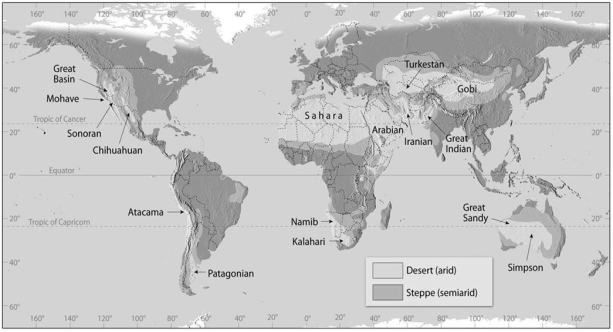
(89) Observe the desert and steppe climates on Figure 20.8 below. How are these climates distributed relative to latitude? What is the relationship of dry climates to global circulation discussed in chapter 20?
(Essay)
5.0/5 (88)
(88) The windward sides of mountains are predominantly___________ climates.
(Multiple Choice)
4.9/5 (85)
(85) 
Filters
- Essay(0)
- Multiple Choice(0)
- Short Answer(0)
- True False(0)
- Matching(0)