



 Chat with AI
Exam 7: Crustal Deformation and Mountain Building

Exam 1: Introduction to Earth Science108 Questions
Exam 2: Matter and Minerals115 Questions
Exam 3: Rocks: Materials of the Solid Earth120 Questions
Exam 4: Plate Tectonics: a Scientific Revolution Unfolds89 Questions
Exam 5: Earthquakes and Earths Interior90 Questions
Exam 6: Volcanoes and Other Igneous Activity106 Questions
Exam 7: Crustal Deformation and Mountain Building97 Questions
Exam 8: Weathering, Soil, and Mass Movement124 Questions
Exam 9: Running Water and Groundwater134 Questions
Exam 10: Glaciers, Deserts, and Wind100 Questions
Exam 11: Geologic Time102 Questions
Exam 12: Earths Evolution Through Geologic Time129 Questions
Exam 13: The Ocean Floor92 Questions
Exam 14: Ocean Water and Ocean Life74 Questions
Exam 15: The Dynamic Ocean101 Questions
Exam 16: The Atmosphere: Composition, Structure, and Temperature85 Questions
Exam 17: Moisture, Clouds, and Precipitation101 Questions
Exam 18: Air Pressure and Wind97 Questions
Exam 19: Weather Patterns and Severe Storms96 Questions
Exam 20: World Climates and Global Climate Change105 Questions
Exam 21: Origins of Modern Astronomy101 Questions
Exam 22: Touring Our Solar System93 Questions
Exam 23: Light, Telescopes, and the Sun93 Questions
Exam 24: Beyond Our Solar System83 Questions
Select questions type


Use the figure below to answer the following questions.
 -Which letter in the figure corresponds to a "fault"?
 (Multiple Choice)
4.8/5  (78)
(78) Any accreted crustal fragment that has a geologic history distinct from that of the adjoining fragments is termed an______ .
(Multiple Choice)
4.9/5 (79)
(79) The_______ is are characterized by terrane accretion that has been active throughout most of Mesozoic and Cenozoic time.
(Multiple Choice)
4.8/5 (92)
(92) Use the figure below to answer the following questions.
 -The concepts of "stress" and "strain" are related because_______ .
 (Multiple Choice)
4.8/5 (71)
(71) Based on your knowledge of isostasy, would you expect thicker or thinner crust beneath the Caribbean Islands e.g., near D than the continental region of Venezuela to the south?
(Multiple Choice)
5.0/5 (82)
(82) The area labeled C shows an active fault bounding the range. Which best describes the motion on the fault?
(Multiple Choice)
4.8/5 (64)
(64) What is the modern theory for orogenesis mountain building.?
(Multiple Choice)
4.8/5 (73)
(73) The type of fold that has the two limbs at the same angle is called an_______ .
(Multiple Choice)
5.0/5 (61)
(61) A region is characterized by numerous anticlines and synclines. There are also several faults present that appear to have formed at the same time as the folding. Without looking at any details, what type of faults would be most likely? Why?
(Essay)
4.9/5 (73)
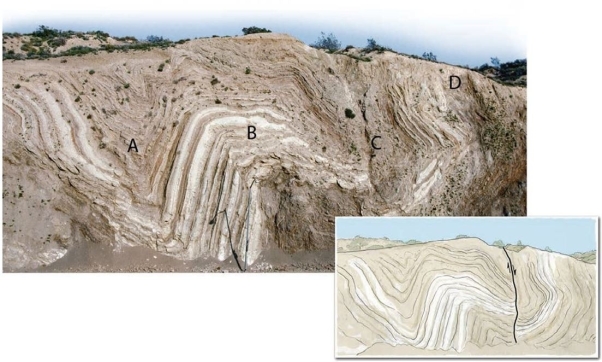
(73) Use the figure below to answer the following questions.
-The material in the figure exhibited_______ behavior when the folding occurred.
-The material in the figure exhibited_______ behavior when the folding occurred. (Multiple Choice)
4.8/5 (80)
(80) The higher the temperature, the more likely it is that a _______rock will deform in a manner.
(Multiple Choice)
4.8/5 (78)
(78) You are walking on the beach along the south- coast of Alaska. You see rocks cut by numerous faults that consist of basalt with evidence of eruption in the ocean, deep- water chert, mudstone, and sandstones with abundant volcanic material. What tectonic setting would you assign to these rocks?
(Multiple Choice)
4.9/5 (76)
(76) The Himalayas and Tibet are the archetypical example of an_______ mountain belt.
(Multiple Choice)
4.7/5 (82)
(82) The west coast of California is underlain by rocks that represent_______ .
(Multiple Choice)
4.9/5 (76)
(76) Monoclines, anticlines, synclines and domes are all examples of_______ .
(Multiple Choice)
4.9/5 (80)
(80) 
Mountain building uplifts rocks against the force of gravity raising their potential energy, which requires work by the earth system. Based on the relative motion of fault blocks, what type of fault would you expect to require more energy than the others?
(Multiple Choice)
4.9/5 (80)
(80) Use the figure below to answer the following questions.
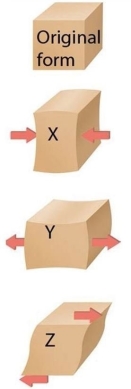 -In the figure, the stress on block 'X' is_______ .
 (Multiple Choice)
4.8/5 (73)
(73) What is the major difference between a subduction zone and a collisional mountain chain?
(Multiple Choice)
4.8/5 (81)
(81) 
Filters
- Essay(0)
- Multiple Choice(0)
- Short Answer(0)
- True False(0)
- Matching(0)