



 Chat with AI
Exam 17: Analysis of Financial Statements

Exam 1: Accounting in Business233 Questions
Exam 2: Analyzing and Recording Transactions200 Questions
Exam 3: Adjusting Accounts and Preparing Financial Statements161 Questions
Exam 4: Completing the Accounting Cycle106 Questions
Exam 5: Accounting for Merchandising Operations131 Questions
Exam 6: Inventories and Cost of Sales133 Questions
Exam 7: Accounting Information Systems112 Questions
Exam 8: Cash and Internal Controls131 Questions
Exam 9: Accounting for Receivables117 Questions
Exam 10: Plant Assets, Natural Resources, and Intangibles161 Questions
Exam 11: Current Liabilities and Payroll Accounting149 Questions
Exam 12: Accounting for Partnerships136 Questions
Exam 13: Accounting for Corporations205 Questions
Exam 14: Long-Term Liabilities187 Questions
Exam 15: Investments and International Operations188 Questions
Exam 16: Reporting the Statement of Cash Flows194 Questions
Exam 17: Analysis of Financial Statements194 Questions
Exam 18: Managerial Accounting Concepts and Principles205 Questions
Exam 19: Job Order Cost Accounting164 Questions
Exam 20: Process Cost Accounting179 Questions
Exam 21: Cost-Volume-Profit Analysis167 Questions
Exam 22: Master Budgets and Planning177 Questions
Exam 23: Flexible Budgets and Standard Costs177 Questions
Exam 24: Performance Measurement and Responsibility Accounting162 Questions
Exam 25: Capital Budgeting and Managerial Decisions158 Questions
Exam 26: Appendix B: Time Value of Money27 Questions
Exam 27: Appendix C: Activity-Based Costing50 Questions
Select questions type


The evaluation of company performance and financial condition includes evaluation of (1)past and current performance, (2)current financial position,and (3)future performance and risk.
(True/False)
4.9/5  (77)
(77) Comparative financial statements in which each individual financial statement amount is expressed as a percentage of a base amount are called:
(Multiple Choice)
4.8/5 (74)
(74) Refer to the following selected financial information from McCormik,LLC.Compute the company's acid-test ratio for Year 2. 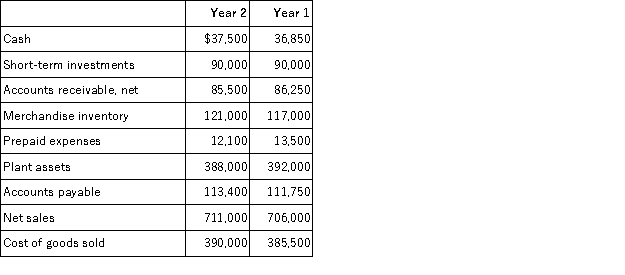
(Multiple Choice)
4.8/5 (73)
(73) Net sales divided by Average accounts receivable,net is the:
(Multiple Choice)
4.9/5 (85)
(85) How long a company holds inventory before selling it can be measured by dividing cost of goods sold by the average inventory balance to determine the:
(Multiple Choice)
5.0/5 (70)
(70) Vertical analysis is used to reveal patterns in data covering two or more successive periods.
(True/False)
4.8/5 (87)
(87) ______________________ ratios include the price-earnings ratio and dividend yield.
(Essay)
4.8/5 (62)
(62) Comparative financial statements are reports that show financial amounts in side by side columns on a single statement for analysis purposes.
(True/False)
4.8/5 (77)
(77) The base amount for a common-size balance sheet is usually total assets.
(True/False)
4.7/5 (79)
(79) A rough guideline states that for a company with no discounts offered,days' sales uncollected should not exceed 1 1/3 times the days in its credit period.
(True/False)
4.9/5 (77)
(77) If a company is comparing its financial condition or performance to a base amount,it is using vertical analysis.
(True/False)
4.9/5 (68)
(68) Which of the following items is not likely an extraordinary item?
(Multiple Choice)
4.9/5 (86)
(86) The market price of Horokhiv Corporation's common stock at the start of 2014 was $47.50 and it declared and paid cash dividends of $3.28 per share.The Dividend yield ratio is:
(Multiple Choice)
4.8/5 (74)
(74) A good financial statement analysis report often includes the following sections: executive summary,analysis overview,evidential matter,assumptions,key factors,and inferences.
(True/False)
4.9/5 (85)
(85) The comparison of a company's financial condition and performance across time is known as:
(Multiple Choice)
4.9/5 (81)
(81) Refer to the following selected financial information from McCormik,LLC.Compute the company's current ratio for Year 2. 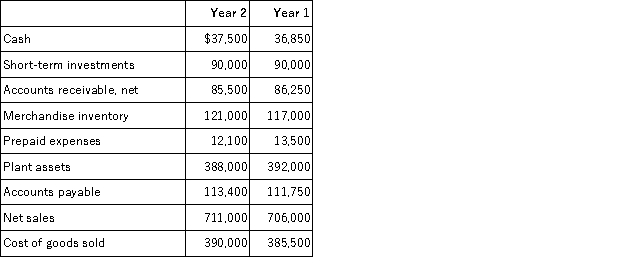
(Multiple Choice)
4.9/5 (92)
(92) Working capital is computed as current liabilities minus current assets.
(True/False)
4.9/5 (75)
(75) A company's calendar-year financial data are shown below.The company had total assets of $339,000 and total equity of $144,400 for the prior year.No additional shares of common stock were issued during the year.The December 31 market price per share is $49.50.Cash dividends of $19,500 were paid during the year.Calculate the following ratios for the company:
(a)profit margin ratio
(b)gross margin ratio
(c)return on total assets
(d)return on common stockholders' equity
(e)book value per common share
(f)basic earnings per share
(g)price earnings ratio
(h)dividend yield. 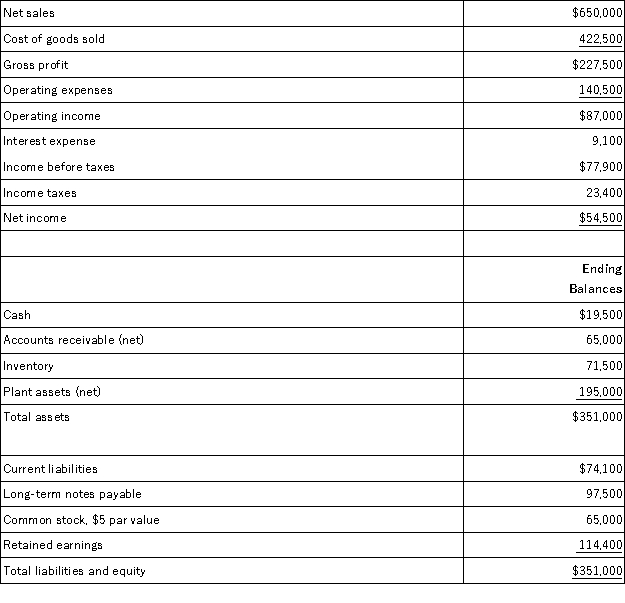
(Essay)
4.9/5 (64)
(64) 
Filters
- Essay(0)
- Multiple Choice(0)
- Short Answer(0)
- True False(0)
- Matching(0)