



 Chat with AI
Exam 7: Dysrhythmia Interpretation and Management

Exam 1: Overview of Critical Care Nursing24 Questions
Exam 2: Patient and Family Response to the Critical Care Experience28 Questions
Exam 3: Ethical and Legal Issues in Critical Care Nursing23 Questions
Exam 4: End-of-Life Care and Palliative Care in Critical Care Settings26 Questions
Exam 5: Comfort and Sedation33 Questions
Exam 6: Nutritional Support30 Questions
Exam 7: Dysrhythmia Interpretation and Management59 Questions
Exam 8: Hemodynamic Monitoring35 Questions
Exam 9: Ventilatory Assistance36 Questions
Exam 10: Rapid Response Teams and Code Management31 Questions
Exam 11: Organ Donation35 Questions
Exam 12: Shock,Sepsis,and Multiple Organ Dysfunction Syndrome34 Questions
Exam 13: Cardiovascular Alterations37 Questions
Exam 14: Nervous System Alterations35 Questions
Exam 15: Acute Respiratory Failure36 Questions
Exam 16: Acute Kidney Injury50 Questions
Exam 17: Hematological and Immune Disorders56 Questions
Exam 18: Gastrointestinal Alterations52 Questions
Exam 19: Endocrine Alterations35 Questions
Exam 20: Trauma and Surgical Management31 Questions
Exam 21: Burns31 Questions
Select questions type


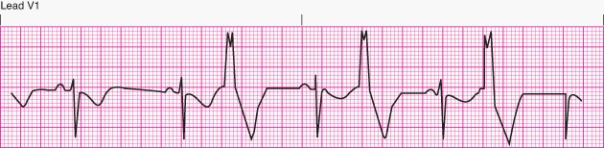
The patient is having premature ventricular contractions (PVCs).The nurse's greatest concern should be:
(Multiple Choice)
5.0/5  (66)
(66) Sinus bradycardia is a symptom of which of the following? (Select all that apply.)
(Multiple Choice)
4.8/5 (88)
(88) 
The patient is alert and talking when the nurse notices the following rhythm.The patient's blood pressure is 90/44 mm Hg.The nurse should
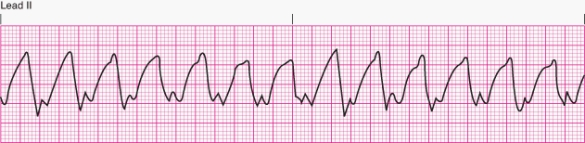
(Multiple Choice)
4.9/5 (82)
(82) The normal rate for the SA node when the patient is at rest is
(Multiple Choice)
5.0/5 (59)
(59) Which of the following are common causes of sinus tachycardia? (Select all that apply.)
(Multiple Choice)
4.7/5 (74)
(74) The patient's heart rate is 165 beats per minute.The cardiac monitor shows a rapid rate with narrow QRS complexes.The P waves cannot be seen,but the rhythm is regular.The patient's blood pressure has dropped from 124/62 mm Hg to 78/30 mm Hg.The patient's skin is cold and diaphoretic,and the patient is complaining of nausea.The nurse prepares the patient for
(Multiple Choice)
4.9/5 (77)
(77) The patient's heart rhythm shows an inverted P wave with a PR interval of 0.06 seconds.The heart rate is 54 beats per minute.The nurse recognizes the rhythm is due to the
(Multiple Choice)
4.9/5 (70)
(70) The patient has a permanent pacemaker in place with a demand rate set at 60 beats/min.The cardiac monitor is showing a heart rate of 44 beats/min with no pacemaker spikes.The nurse recognizes this as:
(Multiple Choice)
4.9/5 (61)
(61) The nurse is caring for a patient who has atrial fibrillation.Sequelae that place the patient at greater risk for mortality/morbidity include which of the following? (Select all that apply.)
(Multiple Choice)
4.9/5 (63)
(63) 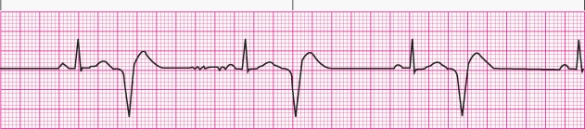
The nurse notes the following rhythm on the heart monitor.The patient is unresponsive and not breathing.The nurse should

(Multiple Choice)
4.9/5 (82)
(82) 
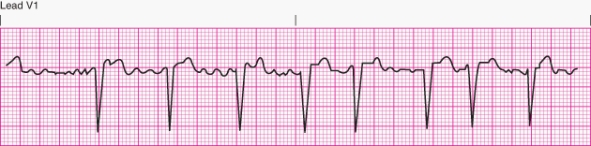
The patient is scheduled to have a permanent pacemaker implanted.The patient asks the nurse,"How long will the battery in this thing last?" The nurse should solve,
(Multiple Choice)
4.8/5 (62)
(62) The patient is in chronic junctional escape rhythm with no atrial activity noted.Studies have demonstrated normal AV node function.This patient may be a candidate for which type of pacing?
(Multiple Choice)
4.8/5 (85)
(85) The nurse is calculating the rate for a regular rhythm.There are 20 small boxes between each P wave and 20 small boxes between each R wave.What is the ventricular rate?
(Multiple Choice)
4.9/5 (69)
(69) The nurse is talking with the patient when the monitor alarms and shows a wavy baseline without a PQRST complex.The nurse should
(Multiple Choice)
4.9/5 (74)
(74) 
Filters
- Essay(0)
- Multiple Choice(0)
- Short Answer(0)
- True False(0)
- Matching(0)