



 Chat with AI
Exam 14: Valuation: Market-Based Approaches

Exam 1: Overview of Financial Reporting, Financial Statement Analysis, and Valuation99 Questions
Exam 2: Asset and Liability Valuation and Income Measurement78 Questions
Exam 3: Income Flows Versus Cash Flows: Understanding the Statement of Cash Flows86 Questions
Exam 4: Profitability Analysis95 Questions
Exam 5: Risk Analysis81 Questions
Exam 6: Financing Activities64 Questions
Exam 7: Investing Activities99 Questions
Exam 8: Operating Activities88 Questions
Exam 9: Accounting Quality63 Questions
Exam 10: Forecasting Financial Statements62 Questions
Exam 11: Risk-Adjusted Expected Rates of Return and the Dividends Valuation Approach52 Questions
Exam 12: Valuation: Cash-Flow-Based Approaches64 Questions
Exam 13: Valuation: Earnings-Based Approaches67 Questions
Exam 14: Valuation: Market-Based Approaches64 Questions
Select questions type


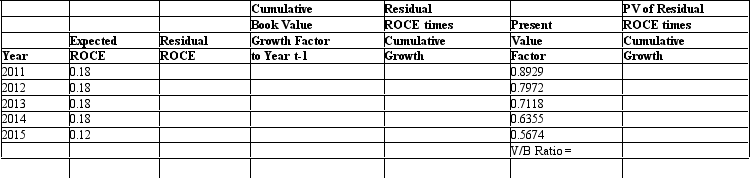
Assume an analyst is evaluating a firm with $1,000 of book value of common equity and a cost of equity capital equal to 12 percent. Assume that the analyst forecasts that the firm will earn ROCE of 18 percent until year 2015, when the firm will start earning ROCE equal to 12 percent. The company pays no dividends and will not engage in any stock transactions. Use this information to complete the following table and calculate the firm's value-to-book ratio.
(Essay)
4.9/5  (81)
(81) What does a price differential measure? How does a price differential relate to risk?
(Essay)
4.8/5 (85)
(85) Companies value-to-book and market-to-book ratios may differ due to accounting reasons. An example of an accounting reason that would create a difference is
(Multiple Choice)
4.7/5 (78)
(78) All of the following are economic factors that can cause a firm's price-earnings ratio to be higher than that of other firms in the same industry except:
(Multiple Choice)
4.8/5 (76)
(76) 
Filters
- Essay(0)
- Multiple Choice(0)
- Short Answer(0)
- True False(0)
- Matching(0)