



 Chat with AI
Exam 6: Financing Activities

Exam 1: Overview of Financial Reporting, Financial Statement Analysis, and Valuation99 Questions
Exam 2: Asset and Liability Valuation and Income Measurement78 Questions
Exam 3: Income Flows Versus Cash Flows: Understanding the Statement of Cash Flows86 Questions
Exam 4: Profitability Analysis95 Questions
Exam 5: Risk Analysis81 Questions
Exam 6: Financing Activities64 Questions
Exam 7: Investing Activities99 Questions
Exam 8: Operating Activities88 Questions
Exam 9: Accounting Quality63 Questions
Exam 10: Forecasting Financial Statements62 Questions
Exam 11: Risk-Adjusted Expected Rates of Return and the Dividends Valuation Approach52 Questions
Exam 12: Valuation: Cash-Flow-Based Approaches64 Questions
Exam 13: Valuation: Earnings-Based Approaches67 Questions
Exam 14: Valuation: Market-Based Approaches64 Questions
Select questions type


Assume that you are currently negotiating a lease transaction in the role of the lessee. Discuss whether you would rather structure the lease as an operating lease or a capital lease and why. In addition, provide the conditions that would require that the lease be accounted for as a capital lease.
Normally most managers would probably want to structure a lessee transaction as an operating lease in order to keep the asset and liability off the balance sheet. In addition, if structured properly an operating lease would shift expense recognition later, as opposed to earlier with a capital lease.
(Essay)
4.7/5  (81)
(81) Under the fair value method of accounting for stock options, firms must value stock options on the
(Multiple Choice)
5.0/5 (74)
(74) Assume that a start-up manufacturing company raises capital through a series of equity issues.
Required:
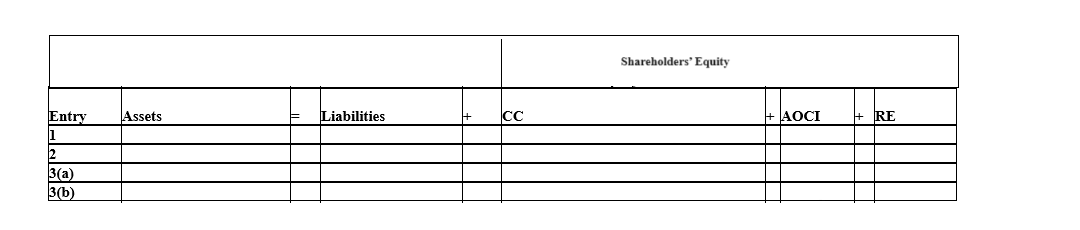
a. Using the financial statement template below, summarize the financial statement effects of the following transactions.
(1) Issues 80,000 shares of $1 par value common stock for $10 per share.
(2) Receives land in exchange for 8,000 shares of $1 par common stock when the common stock is trading in the market at $20 per share. The land has no readily determinable market value.
(3) (a) Receives subscriptions for the issue of 30,000 shares of $1 par value common. The share issue price is $20, of which 30 percent is received as a down payment.
(3) (b) Subsequently, the remaining 70 percent is received from the transaction in 3(a).
 Journal entry (optional):
b. In each case, how does the company measure the transaction? What measurement
attribute is used?
Journal entry (optional):
b. In each case, how does the company measure the transaction? What measurement
attribute is used? (Essay)
4.8/5 (82)
(82) In the chart below, assign the directional effect (I = increase, D = decrease, or NE = no effect) of each of the following four transactions on the components of the book value of common shareholders' equity.
a. Treasury stock acquired (company uses the cost method).
b. Treasury stock in transaction a. reissued at an amount greater than original acquisition
price.
c. Treasury stock in transaction a. reissued at an amount less than the original acquisition
price.
d. Restricted stock issued (grant date).
Item a. b. c. d Common Stock Additional Paid-In Capital Deferred Compensation Retained Earrings Treasury Stock at Cost Total Common Shareholders' Equity
(Essay)
4.8/5 (68)
(68) 
Filters
- Essay(0)
- Multiple Choice(0)
- Short Answer(0)
- True False(0)
- Matching(0)