



 Chat with AI
Exam 5: The Behavior of Interest Rates

Exam 1: Why Study Money, banking, and Financial Markets104 Questions
Exam 2: An Overview of the Financial System132 Questions
Exam 3: What Is Money94 Questions
Exam 4: Understanding Interest Rates101 Questions
Exam 5: The Behavior of Interest Rates157 Questions
Exam 6: The Risk and Term Structure of Interest Rates113 Questions
Exam 7: The Stock Market, the Theory of Rational Expectations, and the Efficient Market Hypothesis94 Questions
Exam 8: An Economic Analysis of Financial Structure89 Questions
Exam 9: Financial Crises48 Questions
Exam 10: Banking and the Management of Financial Institutions147 Questions
Exam 11: Economic Analysis of Financial Regulation114 Questions
Exam 12: Banking Industry: Structure and Competition134 Questions
Exam 13: Central Banks and the Federal Reserve System71 Questions
Exam 14: The Money Supply Process225 Questions
Exam 15: Tools of Monetary Policy118 Questions
Exam 16: The Conduct of Monetary Policy: Strategy and Tactics105 Questions
Exam 17: The Foreign Exchange Market121 Questions
Exam 18: The International Financial System135 Questions
Exam 19: Quantity Theory,inflation and the Demand for Money112 Questions
Exam 20: The Is Curve130 Questions
Exam 21: The Monetary Policy and Aggregate Demand Curves27 Questions
Exam 22: Aggregate Demand and Supply Analysis82 Questions
Exam 23: Monetary Policy Theory48 Questions
Exam 24: The Role of Expectations in Monetary Policy26 Questions
Exam 25: Transmission Mechanisms of Monetary Policy36 Questions
Exam 26: The ISLM Model86 Questions
Select questions type


If there is an excess demand for money,individuals ________ bonds,causing interest rates to ________.
(Multiple Choice)
4.7/5  (88)
(88) Everything else held constant,when stock prices become ________ volatile,the demand curve for bonds shifts to the ________ and the interest rate ________.
(Multiple Choice)
5.0/5 (73)
(73) In the Keynesian liquidity preference framework,a rise in the price level causes the demand for money to ________ and the demand curve to shift to the ________,everything else held constant.
(Multiple Choice)
4.8/5 (66)
(66) A rise in the price level causes the demand for money to ________ and the interest rate to ________,everything else held constant.
(Multiple Choice)
4.9/5 (84)
(84) The reduction of brokerage commissions for trading common stocks that occurred in 1975 caused the demand for bonds to ________ and the demand curve to shift to the ________.
(Multiple Choice)
4.9/5 (76)
(76) When the inflation rate is expected to increase,the ________ for bonds falls,while the ________ curve shifts to the right,everything else held constant.
(Multiple Choice)
4.8/5 (89)
(89) In the bond market,the market equilibrium shows the market-clearing ________ and market-clearing ________.
(Multiple Choice)
4.7/5 (85)
(85) Holding the expected return on bonds constant,an increase in the expected return on common stocks would ________ the demand for bonds,shifting the demand curve to the ________.
(Multiple Choice)
4.8/5 (98)
(98) Everything else held constant,if interest rates are expected to fall in the future,the demand for long-term bonds today ________ and the demand curve shifts to the ________.
(Multiple Choice)
4.7/5 (84)
(84) When the expected inflation rate increases,the real cost of borrowing ________ and bond supply ________,everything else held constant.
(Multiple Choice)
5.0/5 (83)
(83) An increase in an asset's expected return relative to that of an alternative asset,holding everything else constant,________ the quantity demanded of the asset.
(Multiple Choice)
4.9/5 (78)
(78) When stock prices become more volatile,the ________ curve for gold shifts right and gold prices ________,everything else held constant.
(Multiple Choice)
4.9/5 (74)
(74) 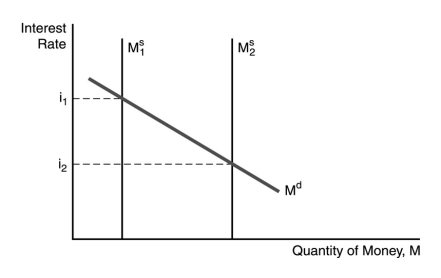 -In the figure above,the decrease in the interest rate from i1 to i2 can be explained by
 (Multiple Choice)
4.8/5 (77)
(77) If fluctuations in interest rates become smaller,then,other things equal,the demand for stocks ________ and the demand for long-term bonds ________.
(Multiple Choice)
4.9/5 (73)
(73) In the bond market,the bond demanders are the ________ and the bond suppliers are the ________.
(Multiple Choice)
4.9/5 (89)
(89) Of the four effects on interest rates from an increase in the money supply,the initial effect is,generally,the
(Multiple Choice)
4.8/5 (84)
(84) 
Filters
- Essay(0)
- Multiple Choice(0)
- Short Answer(0)
- True False(0)
- Matching(0)