



 Chat with AI
Exam 8: Return on Invested Capital and Profitability Analysis

Exam 1: Overview of Financial Statement Analysis76 Questions
Exam 2: Financial Reporting and Analysis72 Questions
Exam 3: Analyzing Financing Activities86 Questions
Exam 4: Analyzing Investing Activities67 Questions
Exam 5: Analyzing Investing Activities: Intercorporate Investments66 Questions
Exam 6: Analyzing Operating Activities83 Questions
Exam 7: Cash Flow Analysis82 Questions
Exam 8: Return on Invested Capital and Profitability Analysis76 Questions
Exam 9: Prospective Analysis66 Questions
Exam 10: Credit Analysis95 Questions
Exam 11: Equity Analysis and Valuation68 Questions
Select questions type


If future expected return on common stockholders' equity is less than expected required return by equity holders then the market value of a company's stock should be less than book value.

Free
(True/False)
4.9/5  (69)
(69) Correct Answer: Verified
True
If a company has rapidly growing earnings per share, their return on net operating assets must be increasing too.
Free
(True/False)
4.8/5 (87)
(87) Correct Answer:Verified
VerifiedFalse
Return on net operating assets will always be greater than or equal to the pretax return on equity.
Free
(True/False)
4.9/5 (77)
(77) Correct Answer:Verified
VerifiedFalse
Companies that have low net operating profit margins generally only earn a reasonable return on net operating assets if they can utilize their net operating assets very efficiently.
(True/False)
4.9/5 (80)
(80) If two companies both increase their net income by 25% over the prior year this means they have both been equally profitable this year.
(True/False)
4.9/5 (86)
(86) Current assets \ 4,650 \ 4,730 Long-term assets 7,120 6,450 Current liabilities 1,440 1,340 Long-term debt 3,830 3,760 Common equity 6,500 6,080 Operating income 2,140 Interest expense 240 Tax expense (40\%) 760 Net income 1,140
Assume all assets are operating assets; all current liabilities are operating liabilities.
-Return on net operating assets for 2006 is:
(Multiple Choice)
4.7/5 (71)
(71) Err Company has a major lawsuit against them for unsafe products. It recognizes a huge liability in 2004 of $300 million. The effect of this liability is to decrease stockholders' equity by 50%. In 2005, the effect of recognizing this liability, all else equal, is:
(Multiple Choice)
4.9/5 (73)
(73) When calculating return on net operating assets, deferred taxes should be deducted from the denominator.
(True/False)
4.9/5 (67)
(67) 
 Long-term debt 7,709 8,508 Long-tern obligations under capital leases 2,307 2,092 Deferred income taxes and other 463 400 Minority interest 1,025 331
Shareholders' equity:
Preferred stock ( par value; 100 shares authorized, none issued)
Common stock ( par value; 5,500 shares authorized, 2,285 and
2,293 issued and outstanding in X6 and X7, respectively) 228 229 Capital in excess of par value 547 545 Retained earnings 16,768 14,394 Foreign currency translation adjustment Total shareholders' equity Total liabilities and shareholders' equity
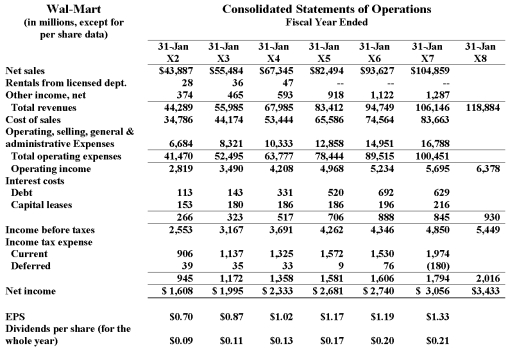
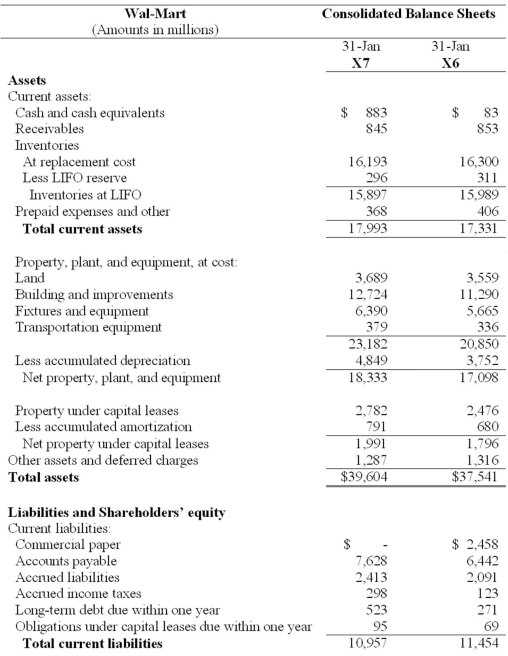
a. Calculate return on common equity (ROCE) for fiscal X4 and X7. Identify, as far as allowed by the data, components driving any changes in ROCE from X4 to X7. (If you want to give students more guidance then ask to disaggregate ROCE into net operating profit margin, net operating asset turnover and leverage.)
b. Compare and contrast the change in earnings per share to ROCE over this time period.
Long-term debt 7,709 8,508 Long-tern obligations under capital leases 2,307 2,092 Deferred income taxes and other 463 400 Minority interest 1,025 331
Shareholders' equity:
Preferred stock ( par value; 100 shares authorized, none issued)
Common stock ( par value; 5,500 shares authorized, 2,285 and
2,293 issued and outstanding in X6 and X7, respectively) 228 229 Capital in excess of par value 547 545 Retained earnings 16,768 14,394 Foreign currency translation adjustment Total shareholders' equity Total liabilities and shareholders' equity
a. Calculate return on common equity (ROCE) for fiscal X4 and X7. Identify, as far as allowed by the data, components driving any changes in ROCE from X4 to X7. (If you want to give students more guidance then ask to disaggregate ROCE into net operating profit margin, net operating asset turnover and leverage.)
b. Compare and contrast the change in earnings per share to ROCE over this time period. (Essay)
4.8/5 (84)
(84) Return on invested capital is a better measure of profitability than earnings as earnings numbers fail to reflect the capital needed to generate those earnings.
(True/False)
4.9/5 (96)
(96) Indicate the effect of the following transactions on:
i. Return on net operating assets (RNOA)
ii. Return on common shareholders' equity (ROCE)
iii. Earnings per share (basic)
Consider each transaction independently and explain your answer. Assume that ROCE is higher than RNOA.
1. Company issues more preferred stock and uses proceeds to reduce accounts payable.
2. Company has a stock split.
3. Company converts to just-in-time inventory system (JIT). This allows them to hold half the levels of inventory for the same amount of sales (sales themselves are not increased by this change to JIT).
(Essay)
4.8/5 (81)
(81) Which of the following will increase the sustainable equity growth of a company, all other things equal?
(Multiple Choice)
4.9/5 (74)
(74) Which of the following would explain an observed decrease in return on equity, all else equal?
(Multiple Choice)
4.9/5 (80)
(80) Which of the following ratios best measures the profitability of a company?
(Multiple Choice)
4.8/5 (88)
(88) a. Niglow Corporation produces metal castings. In the past year it earned a 10% return on its net operating assets base of $10 million. Niglow needs $10 million to expand its operations, and has the option of obtaining none, some, or all of the proceeds from the bank. Currently the company is all equity financed. It expects to be able to maintain its return on net operating assets after the expansion. The bank has indicated that the amount it will charge on the loan will be dependent upon the resultant debt/equity ratio. Specifically, the rates will be 8%, 9%, 10%, and 12% for debt-to- equity ratios less than or equal to 0.25, 0.5, 1.0, and over 1.0, respectively. Niglow's tax rate is 40%.
b. Calculate Niglow's return on common equity if the expansion is financed:
i. using all equity
ii. 50% debt, 50% equity
iii. all debt
c. What would Niglow's return on net operating assets need to be for the return on equity to be decreased by financing the expansion using all debt?
(Essay)
4.8/5 (82)
(82) Sustainable equity growth rate is a function of return on common stockholders' equity and the dividend payout ratio.
(True/False)
4.9/5 (82)
(82) Which of the following statements is correct concerning changes from year 1 to year 2 at Tricrop?
(Multiple Choice)
4.9/5 (83)
(83) Below is selected information from Tricrop. Net operating assets/common equity 1.37 1.53 Net operating profit margin 19\% 21\% Income tax rate 47\% 28\% Revenues/average net operating 0.81 0.61 assets EBIT/revenues 38\% 32\%
-Return on net operating assets for Year 1 is:
(Multiple Choice)
4.8/5 (70)
(70) Return on equity is the return stockholders have realized during the past year.
(True/False)
4.8/5 (72)
(72) 
Filters
- Essay(0)
- Multiple Choice(0)
- Short Answer(0)
- True False(0)
- Matching(0)