



 Chat with AI
Exam 13: Labor Markets

Exam 1: The Central Idea156 Questions
Exam 2: Observing and Explaining the Economy143 Questions
Exam 3: The Supply and Demand Model166 Questions
Exam 4: Subtleties of the Supply and Demand Model176 Questions
Exam 5: The Demand Curve and the Behavior of Consumers176 Questions
Exam 6: The Supply Curve and the Behavior of Firms179 Questions
Exam 7: The Efficiency of Markets163 Questions
Exam 8: Costs and the Changes at Firms Over Time191 Questions
Exam 9: The Rise and Fall of Industries139 Questions
Exam 10: Monopoly184 Questions
Exam 11: Product Differentiation, Monopolistic Competition, and Oligopoly169 Questions
Exam 12: Antitrust Policy and Regulation152 Questions
Exam 13: Labor Markets179 Questions
Exam 14: Taxes, Transfers, and Income Distribution179 Questions
Exam 15: Public Goods, Externalities, and Government Behavior197 Questions
Exam 16: Capital and Financial Markets188 Questions
Exam 17: Macroeconomics: the Big Picture159 Questions
Exam 18: Measuring the Production, Income, and Spending of Nations177 Questions
Exam 19: The Spending Allocation Model166 Questions
Exam 20: Unemployment and Employment212 Questions
Exam 21: Productivity and Economic Growth162 Questions
Exam 22: Money and Inflation153 Questions
Exam 23: The Nature and Causes of Economic Fluctuations185 Questions
Exam 24: The Economic Fluctuations Model205 Questions
Exam 25: Using the Economic Fluctuations Model176 Questions
Exam 26: Fiscal Policy138 Questions
Exam 27: Monetary Policy180 Questions
Exam 28: Economic Growth Around the World157 Questions
Exam 29: International Trade242 Questions
Exam 30: International Finance125 Questions
Select questions type


Discrimination in the labor market cannot be addressed by the standard tools of supply and demand.
(True/False)
4.9/5  (73)
(73) The measure of workers' pay is affected by the interval of time over which workers are paid.
(True/False)
4.9/5 (85)
(85) The claim that unions help improve productivity is the same as the claim that they
(Multiple Choice)
4.8/5 (79)
(79) If leisure is a normal good, then an increase in income will
(Multiple Choice)
4.9/5 (79)
(79) Weekly earnings for the average worker have increased at the same rate as hourly earnings.
(True/False)
4.8/5 (83)
(83) A piece-rate contract is a labor contract in which a worker is
(Multiple Choice)
4.8/5 (89)
(89) Exhibit 13-5 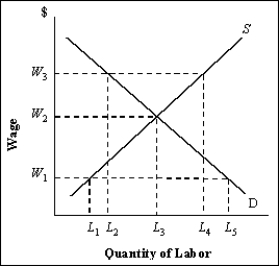 -Refer to Exhibit 13-5. If the wage is regulated at W3, then a labor
 (Multiple Choice)
4.8/5 (70)
(70) Since 1990, real wages in the United States have been declining.
(True/False)
4.8/5 (84)
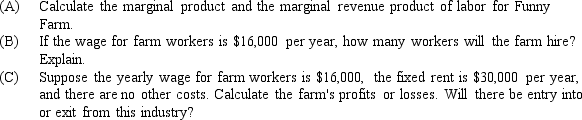
(84) Funny Farm is a 400-acre profit-maximizing farm that produces wheat. The wheat industry is competitive and the price of wheat is $5 per bushel. The relationship between the number of workers the farm hires and the production of wheat is shown in the table below. 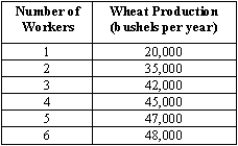
(Essay)
4.9/5 (81)
(81) Exhibit 13-5
-Refer to Exhibit 13-5. If this figure represents a low-skilled labor market, a minimum wage would be illustrated by
-Refer to Exhibit 13-5. If this figure represents a low-skilled labor market, a minimum wage would be illustrated by (Multiple Choice)
4.8/5 (82)
(82) What are the two effects that determine labor/leisure choice, and which one is weak in the short run but stronger in the long run?
(Essay)
4.9/5 (81)
(81) Discrimination is so costly that it is not a problem in capitalist systems.
(True/False)
4.9/5 (76)
(76) Unions can cause their wages to be high and nonunion wages to be low by
(Multiple Choice)
4.8/5 (77)
(77) Since 1950, the ratio of working women to the female population--the female labor participation rate--as increased steadily over time. How can you explain the fact that more and more women are working outside the home while paying others to babysit their children at home?
(Essay)
4.8/5 (74)
(74) People often complain that sanitation workers are overpaid based on their level of education. Use the idea of compensating differentials to explain why sanitation workers' wages are relatively high.
(Essay)
4.8/5 (68)
(68) Bilateral monopoly occurs when monopolies in two different industries try to enter each other's industries.
(True/False)
4.8/5 (84)
(84) 
Filters
- Essay(0)
- Multiple Choice(0)
- Short Answer(0)
- True False(0)
- Matching(0)