



 Chat with AI
Exam 15: Public Goods, Externalities, and Government Behavior

Exam 1: The Central Idea156 Questions
Exam 2: Observing and Explaining the Economy143 Questions
Exam 3: The Supply and Demand Model166 Questions
Exam 4: Subtleties of the Supply and Demand Model176 Questions
Exam 5: The Demand Curve and the Behavior of Consumers176 Questions
Exam 6: The Supply Curve and the Behavior of Firms179 Questions
Exam 7: The Efficiency of Markets163 Questions
Exam 8: Costs and the Changes at Firms Over Time191 Questions
Exam 9: The Rise and Fall of Industries139 Questions
Exam 10: Monopoly184 Questions
Exam 11: Product Differentiation, Monopolistic Competition, and Oligopoly169 Questions
Exam 12: Antitrust Policy and Regulation152 Questions
Exam 13: Labor Markets179 Questions
Exam 14: Taxes, Transfers, and Income Distribution179 Questions
Exam 15: Public Goods, Externalities, and Government Behavior197 Questions
Exam 16: Capital and Financial Markets188 Questions
Exam 17: Macroeconomics: the Big Picture159 Questions
Exam 18: Measuring the Production, Income, and Spending of Nations177 Questions
Exam 19: The Spending Allocation Model166 Questions
Exam 20: Unemployment and Employment212 Questions
Exam 21: Productivity and Economic Growth162 Questions
Exam 22: Money and Inflation153 Questions
Exam 23: The Nature and Causes of Economic Fluctuations185 Questions
Exam 24: The Economic Fluctuations Model205 Questions
Exam 25: Using the Economic Fluctuations Model176 Questions
Exam 26: Fiscal Policy138 Questions
Exam 27: Monetary Policy180 Questions
Exam 28: Economic Growth Around the World157 Questions
Exam 29: International Trade242 Questions
Exam 30: International Finance125 Questions
Select questions type


On which of the following goods or services would the imposition of a government subsidy most likely result in more efficient allocation of our nation's resources?
(Multiple Choice)
4.7/5  (89)
(89) Tradable permits are a new idea but are likely to be an increasingly common method of reducing pollution in the future.
(True/False)
4.9/5 (68)
(68) With tradable permits, the total amount of pollution in the economy is
(Multiple Choice)
4.9/5 (70)
(70) Use the following set of preferences (table below) for Jon, Jeff, and Amy on travel options to show the paradox of voting. 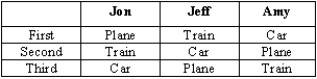
(Essay)
4.9/5 (75)
(75) Goods that exhibit nonrivalry in consumption and nonexcludability create a(n)
(Multiple Choice)
4.8/5 (78)
(78) Externalities have become international in recent years, paralleling the growth of international trade and finance.
(True/False)
4.8/5 (87)
(87) One possible reason for government inefficiency is that there is no profit motive in government to discipline government managers and employees.
(True/False)
4.9/5 (80)
(80) A public good exhibits nonrivalry in consumption and is nonexcludable.
(True/False)
4.8/5 (74)
(74) When the government uses a subsidy in the case of a positive externality, it sets the subsidy equal to the
(Multiple Choice)
4.9/5 (75)
(75) How is technology changing the public good features of television broadcasting?
(Essay)
4.7/5 (83)
(83) A user fee can be used to solve the free-rider problem if the good is totally nonexcludable.
(True/False)
4.8/5 (88)
(88) Radio and television broadcasting services in the United States partially avoid a free-rider problem by
(Multiple Choice)
4.8/5 (89)
(89) If burning coal creates a pollution externality, the government may impose a
(Multiple Choice)
5.0/5 (81)
(81) If a good incurs a negative externality, then the socially desirable output level can be reached by
(Multiple Choice)
5.0/5 (86)
(86) One form of government intervention to solve externalities is
(Multiple Choice)
4.8/5 (74)
(74) Exhibit 15-2 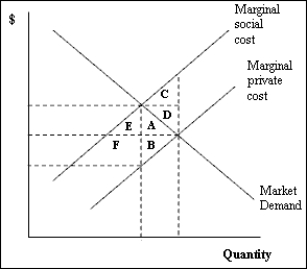 -In the case of negative externalities, a competitive market may not generate an efficient amount of production.
 (True/False)
4.8/5 (84)
(84) A subsidy on a good with a positive externality reduces the marginal social benefits.
(True/False)
4.9/5 (70)
(70) Unlike command and control, taxes and subsidies allow firms to
(Multiple Choice)
4.9/5 (79)
(79) 
Filters
- Essay(0)
- Multiple Choice(0)
- Short Answer(0)
- True False(0)
- Matching(0)