



 Chat with AI
Exam 18: Measuring the Production, Income, and Spending of Nations

Exam 1: The Central Idea156 Questions
Exam 2: Observing and Explaining the Economy143 Questions
Exam 3: The Supply and Demand Model166 Questions
Exam 4: Subtleties of the Supply and Demand Model176 Questions
Exam 5: The Demand Curve and the Behavior of Consumers176 Questions
Exam 6: The Supply Curve and the Behavior of Firms179 Questions
Exam 7: The Efficiency of Markets163 Questions
Exam 8: Costs and the Changes at Firms Over Time191 Questions
Exam 9: The Rise and Fall of Industries139 Questions
Exam 10: Monopoly184 Questions
Exam 11: Product Differentiation, Monopolistic Competition, and Oligopoly169 Questions
Exam 12: Antitrust Policy and Regulation152 Questions
Exam 13: Labor Markets179 Questions
Exam 14: Taxes, Transfers, and Income Distribution179 Questions
Exam 15: Public Goods, Externalities, and Government Behavior197 Questions
Exam 16: Capital and Financial Markets188 Questions
Exam 17: Macroeconomics: the Big Picture159 Questions
Exam 18: Measuring the Production, Income, and Spending of Nations177 Questions
Exam 19: The Spending Allocation Model166 Questions
Exam 20: Unemployment and Employment212 Questions
Exam 21: Productivity and Economic Growth162 Questions
Exam 22: Money and Inflation153 Questions
Exam 23: The Nature and Causes of Economic Fluctuations185 Questions
Exam 24: The Economic Fluctuations Model205 Questions
Exam 25: Using the Economic Fluctuations Model176 Questions
Exam 26: Fiscal Policy138 Questions
Exam 27: Monetary Policy180 Questions
Exam 28: Economic Growth Around the World157 Questions
Exam 29: International Trade242 Questions
Exam 30: International Finance125 Questions
Select questions type


Explain how each of the following transactions would affect GDP for the current year. Which spending categories are affected?

(Essay)
4.8/5  (85)
(85) In which spending category would you enter the following transaction? A restaurant purchases fresh fish at the local fish market that it plans to sell as one of its nightly specials.
(Multiple Choice)
4.7/5 (65)
(65) The difference between investment, the purchases of final goods by firms, and depreciation is called net investment.
(True/False)
4.7/5 (83)
(83) Exhibit 18-3 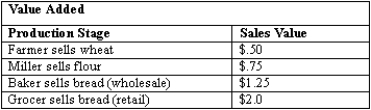 -According to the data in Exhibit 18-3, the contribution to GDP from the production of a loaf of bread is
 (Multiple Choice)
4.9/5 (71)
(71) Which of the following statements is true concerning the GDP deflator and the CPI as measures of inflation?
(Multiple Choice)
5.0/5 (78)
(78) In 2015, consumption was roughly ____ of GDP in the United States.
(Multiple Choice)
4.8/5 (91)
(91) There is no correlation between the decline in certain forms of pollution over the past 40 years and the increase in real GDP per capita.
(True/False)
4.9/5 (82)
(82) Expenditure on ____ is spending that is not included in GDP.
(Multiple Choice)
4.8/5 (74)
(74) In which spending category would you enter the following transaction? Ford sells a Thunderbird from its inventory to an individual.
(Multiple Choice)
4.9/5 (78)
(78) Why do economists believe that the CPI overstates the rate of inflation? Is this an important problem?
(Essay)
4.7/5 (73)
(73) For the hypothetical economy described in the table below, what were investment, consumption, and GDP in period 1? And for period 2? 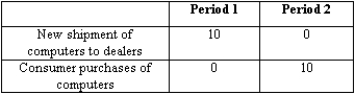
(Essay)
4.8/5 (81)
(81) In the process of calculating the production of the economy of the United States, which of the following must be taken into account?
(Multiple Choice)
4.7/5 (75)
(75) 
Suppose that real GDP grew faster than nominal GDP between year 1 and year 2. What must have happened to prices on average?
(Essay)
4.8/5 (84)
(84) What was the approximate level of GDP production in the United States in 2015?
(Multiple Choice)
4.7/5 (88)
(88) 
Filters
- Essay(0)
- Multiple Choice(0)
- Short Answer(0)
- True False(0)
- Matching(0)