



 Chat with AI
Exam 22: Money and Inflation

Exam 1: The Central Idea156 Questions
Exam 2: Observing and Explaining the Economy143 Questions
Exam 3: The Supply and Demand Model166 Questions
Exam 4: Subtleties of the Supply and Demand Model176 Questions
Exam 5: The Demand Curve and the Behavior of Consumers176 Questions
Exam 6: The Supply Curve and the Behavior of Firms179 Questions
Exam 7: The Efficiency of Markets163 Questions
Exam 8: Costs and the Changes at Firms Over Time191 Questions
Exam 9: The Rise and Fall of Industries139 Questions
Exam 10: Monopoly184 Questions
Exam 11: Product Differentiation, Monopolistic Competition, and Oligopoly169 Questions
Exam 12: Antitrust Policy and Regulation152 Questions
Exam 13: Labor Markets179 Questions
Exam 14: Taxes, Transfers, and Income Distribution179 Questions
Exam 15: Public Goods, Externalities, and Government Behavior197 Questions
Exam 16: Capital and Financial Markets188 Questions
Exam 17: Macroeconomics: the Big Picture159 Questions
Exam 18: Measuring the Production, Income, and Spending of Nations177 Questions
Exam 19: The Spending Allocation Model166 Questions
Exam 20: Unemployment and Employment212 Questions
Exam 21: Productivity and Economic Growth162 Questions
Exam 22: Money and Inflation153 Questions
Exam 23: The Nature and Causes of Economic Fluctuations185 Questions
Exam 24: The Economic Fluctuations Model205 Questions
Exam 25: Using the Economic Fluctuations Model176 Questions
Exam 26: Fiscal Policy138 Questions
Exam 27: Monetary Policy180 Questions
Exam 28: Economic Growth Around the World157 Questions
Exam 29: International Trade242 Questions
Exam 30: International Finance125 Questions
Select questions type


Suppose people are holding $100 million of currency, total deposits in the banking system are $2,000 million, and bank reserves are $400 million. In this case,
(Multiple Choice)
4.7/5  (85)
(85) Which of the following would increase the value of the money supply?
(Multiple Choice)
4.9/5 (79)
(79) Suppose the balance sheet for Bank ABC is as given below, where numbers are in thousands of dollars. Assume that reserves are 10 percent of deposits and that people hold no currency. 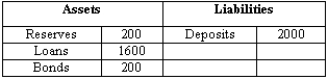

(Essay)
4.8/5 (91)
(91) Exhibit 22-1  -According to the data in Exhibit 22-1, the amount of deposits Bank INF holds at the Fed equals
 (Multiple Choice)
4.8/5 (79)
(79) To look for evidence concerning whether higher money growth leads to higher inflation, one should, according to the quantity equation, examine periods of time when
(Multiple Choice)
4.8/5 (72)
(72) If the Fed sells $15 million worth of government bonds to Bank A, then initially
(Multiple Choice)
4.9/5 (70)
(70) If a country's currency is on a gold standard, does that mean there can be no inflation? Explain.
(Essay)
4.8/5 (85)
(85) The Federal Reserve System is divided into 52 districts, 1 for each state, plus 1 for Washington, D.C., and 1 for Puerto Rico.
(True/False)
5.0/5 (80)
(80) For the period 1973 through 1991 the relationship between money and inflation did not hold for all seven of the largest developed countries.
(True/False)
4.9/5 (78)
(78) An economy that uses commodity money will not experience inflation.
(True/False)
4.8/5 (72)
(72) The FOMC implements monetary policy after obtaining the approval of the president.
(True/False)
4.9/5 (86)
(86) 
Filters
- Essay(0)
- Multiple Choice(0)
- Short Answer(0)
- True False(0)
- Matching(0)