



 Chat with AI
Exam 23: The Nature and Causes of Economic Fluctuations

Exam 1: The Central Idea156 Questions
Exam 2: Observing and Explaining the Economy143 Questions
Exam 3: The Supply and Demand Model166 Questions
Exam 4: Subtleties of the Supply and Demand Model176 Questions
Exam 5: The Demand Curve and the Behavior of Consumers176 Questions
Exam 6: The Supply Curve and the Behavior of Firms179 Questions
Exam 7: The Efficiency of Markets163 Questions
Exam 8: Costs and the Changes at Firms Over Time191 Questions
Exam 9: The Rise and Fall of Industries139 Questions
Exam 10: Monopoly184 Questions
Exam 11: Product Differentiation, Monopolistic Competition, and Oligopoly169 Questions
Exam 12: Antitrust Policy and Regulation152 Questions
Exam 13: Labor Markets179 Questions
Exam 14: Taxes, Transfers, and Income Distribution179 Questions
Exam 15: Public Goods, Externalities, and Government Behavior197 Questions
Exam 16: Capital and Financial Markets188 Questions
Exam 17: Macroeconomics: the Big Picture159 Questions
Exam 18: Measuring the Production, Income, and Spending of Nations177 Questions
Exam 19: The Spending Allocation Model166 Questions
Exam 20: Unemployment and Employment212 Questions
Exam 21: Productivity and Economic Growth162 Questions
Exam 22: Money and Inflation153 Questions
Exam 23: The Nature and Causes of Economic Fluctuations185 Questions
Exam 24: The Economic Fluctuations Model205 Questions
Exam 25: Using the Economic Fluctuations Model176 Questions
Exam 26: Fiscal Policy138 Questions
Exam 27: Monetary Policy180 Questions
Exam 28: Economic Growth Around the World157 Questions
Exam 29: International Trade242 Questions
Exam 30: International Finance125 Questions
Select questions type


Exhibit 23-5 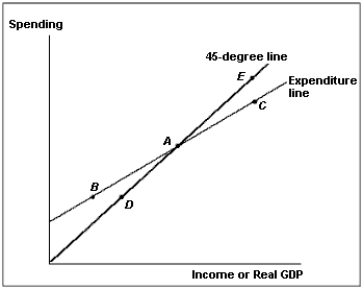 -If output was at the level corresponding to point E in Exhibit 23-5, then
 (Multiple Choice)
4.9/5  (83)
(83) Which of the following would a real business cycle theorist emphasize as a primary cause of economic fluctuations?
(Multiple Choice)
4.8/5 (84)
(84) The rational expectations assumption implies that anticipated tax changes have no impact on consumption at all.
(True/False)
4.9/5 (71)
(71) According to the spending balance model, a change in spending causes a change in income, which causes further changes in spending and income.
(True/False)
4.9/5 (80)
(80) Spending balance occurs when people consume according to the consumption function.
(True/False)
4.8/5 (68)
(68) Which of the following is true about the marginal propensity to consume and the marginal propensity to import?
(Multiple Choice)
4.9/5 (77)
(77) If the economy is growing along the same path as potential GDP, the expenditure line will not shift over time.
(True/False)
4.8/5 (90)
(90) A macroeconomic theory that stresses the fact that shifts in potential GDP are a primary cause of fluctuations in real GDP is known as
(Multiple Choice)
4.8/5 (82)
(82) Which of the following would not shift the expenditure line?
(Multiple Choice)
4.8/5 (84)
(84) Because it represents a completely separate section of the economy, government purchases do not often affect the other elements of aggregate demand: consumption, investment, and net exports.
(True/False)
4.9/5 (74)
(74) Exhibit 23-2 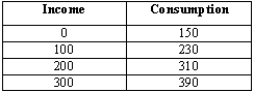 -Given the data in Exhibit 23-2, what is the level of consumption if income increases to 400?
 (Multiple Choice)
4.7/5 (86)
(86) 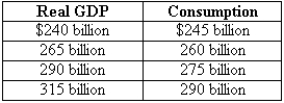 -Refer to the data in Exhibit 23-3.

The forward-looking model predicts that the marginal propensity to consume is constant over time.
(True/False)
4.8/5 (75)
(75) 
Filters
- Essay(0)
- Multiple Choice(0)
- Short Answer(0)
- True False(0)
- Matching(0)