



 Chat with AI
Exam 28: Economic Growth Around the World

Exam 1: The Central Idea156 Questions
Exam 2: Observing and Explaining the Economy143 Questions
Exam 3: The Supply and Demand Model166 Questions
Exam 4: Subtleties of the Supply and Demand Model176 Questions
Exam 5: The Demand Curve and the Behavior of Consumers176 Questions
Exam 6: The Supply Curve and the Behavior of Firms179 Questions
Exam 7: The Efficiency of Markets163 Questions
Exam 8: Costs and the Changes at Firms Over Time191 Questions
Exam 9: The Rise and Fall of Industries139 Questions
Exam 10: Monopoly184 Questions
Exam 11: Product Differentiation, Monopolistic Competition, and Oligopoly169 Questions
Exam 12: Antitrust Policy and Regulation152 Questions
Exam 13: Labor Markets179 Questions
Exam 14: Taxes, Transfers, and Income Distribution179 Questions
Exam 15: Public Goods, Externalities, and Government Behavior197 Questions
Exam 16: Capital and Financial Markets188 Questions
Exam 17: Macroeconomics: the Big Picture159 Questions
Exam 18: Measuring the Production, Income, and Spending of Nations177 Questions
Exam 19: The Spending Allocation Model166 Questions
Exam 20: Unemployment and Employment212 Questions
Exam 21: Productivity and Economic Growth162 Questions
Exam 22: Money and Inflation153 Questions
Exam 23: The Nature and Causes of Economic Fluctuations185 Questions
Exam 24: The Economic Fluctuations Model205 Questions
Exam 25: Using the Economic Fluctuations Model176 Questions
Exam 26: Fiscal Policy138 Questions
Exam 27: Monetary Policy180 Questions
Exam 28: Economic Growth Around the World157 Questions
Exam 29: International Trade242 Questions
Exam 30: International Finance125 Questions
Select questions type


Countries lacking an adequate endowment of natural resources have tended to remain poor.
(True/False)
4.7/5  (83)
(83) Data from the most advanced economies support the catch-up theory.
(True/False)
4.7/5 (87)
(87) All of the following are part of the "Emerging Africa" except
(Multiple Choice)
4.9/5 (66)
(66) One of the 16 indicators used by the Millennium Challenge Corporation (MCC) to determine which countries obtain American foreign aid is Open Trade Policy, which refers to the accessibility of work visas that the country offers to foreigners.
(True/False)
4.9/5 (90)
(90) A line showing the inverse relationship between the level of productivity and the growth rate of productivity is referred to as the
(Multiple Choice)
4.8/5 (82)
(82) For the majority of people in the world, per capita income is
(Multiple Choice)
4.7/5 (74)
(74) In terms of the catch-up line for advanced countries from 1960 to 2005, Japan is an example of a country that was richer and therefore grew less rapidly.
(True/False)
4.8/5 (86)
(86) Is the world distribution of income per capita skewed (that is, highly unequal)? Explain.
(Essay)
5.0/5 (80)
(80) A major institution of the international monetary system is the IMF. What does IMF stand for?
(Multiple Choice)
4.8/5 (71)
(71) Two important facts about economic growth to remember are that large and persistent economic growth
(Multiple Choice)
4.9/5 (87)
(87) The first of the United Nations Millennium Development Goals was to
(Multiple Choice)
4.8/5 (86)
(86) Which of the following was missing in countries that missed out on the Industrial Revolution?
(Multiple Choice)
4.9/5 (81)
(81) Which of the following is true about the World Bank and the International Monetary Fund (IMF)?
(Multiple Choice)
4.8/5 (80)
(80) The table below shows the level of GDP per capita in 1900 for four regions of the world, as well as their growth rates between 1900 and 1938. Plot this table to determine whether catch-up is likely to occur among these regions. Does growth theory explain the growth experience of these regions between 1900 and 1938? 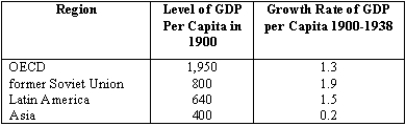
(Essay)
4.7/5 (79)
(79) For the most advanced countries, there is an inverse relationship between the growth rate and the productivity level.
(True/False)
4.9/5 (88)
(88) 
Filters
- Essay(0)
- Multiple Choice(0)
- Short Answer(0)
- True False(0)
- Matching(0)