



 Chat with AI
Exam 3: Decision Analysis

Exam 1: Introduction to Quantitative Analysis96 Questions
Exam 2: Probability Concepts and Applications155 Questions
Exam 3: Decision Analysis128 Questions
Exam 4: Regression Models129 Questions
Exam 5: Forecasting138 Questions
Exam 6: Inventory Control Models147 Questions
Exam 7: Linear Programming Models: Graphical and Computer Methods141 Questions
Exam 8: Linear Programming Applications89 Questions
Exam 9: Transportation, Assignment, and Network Models112 Questions
Exam 10: Integer Programming, Goal Programming, and Nonlinear Programming86 Questions
Exam 11: Project Management142 Questions
Exam 12: Waiting Lines and Queuing Theory Models127 Questions
Exam 13: Simulation Modeling94 Questions
Exam 14: Markov Analysis103 Questions
Exam 15: Statistical Quality Control96 Questions
Exam 16: Analytic Hierarchy Process66 Questions
Exam 17: Dynamic Programming86 Questions
Exam 18: Decision Theory and the Normal Distribution62 Questions
Exam 19: Game Theory59 Questions
Exam 20: Mathematical Tools: Determinants and Matrices104 Questions
Exam 21: Calculus-Based Optimization39 Questions
Exam 22: Linear Programming: The Simplex Method98 Questions
Exam 23: Transportation, Assignment, and Network Algorithms120 Questions
Select questions type


What is the difference between the Expected Monetary Value and Expected Value with Perfect Information?
(Essay)
4.8/5  (83)
(83) A utility curve showing utility increasing at an increasing rate as the monetary value increases represents
(Multiple Choice)
4.8/5 (67)
(67) Any problem that can be represented in a decision tree can be easily portrayed in a decision table.
(True/False)
4.7/5 (80)
(80) The following is a payoff table giving costs for various situations. 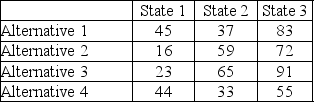 What are the regret values for Alternative 3 as read from State 1 to State 3?
 (Multiple Choice)
4.8/5 (73)
(73) Utility theory provides a decision criterion that is superior to the EMV or EOL in that it may allow the decision maker to incorporate her own attitudes toward risk.
(True/False)
4.8/5 (80)
(80) Mark M.Upp has just been fired as the university book store manager for setting prices too low (only 20 percent above suggested retail).He is considering opening a competing bookstore near the campus, and he has begun an analysis of the situation.There are two possible sites under consideration.One is relatively small, while the other is large.If he opens at Site 1 and demand is good, he will generate a profit of $50,000.If demand is low, he will lose $10,000.If he opens at Site 2 and demand is high he will generate a profit of $80,000, but he will lose $30,000 if demand is low.He also has decided that he will open at one of these sites.He believes that there is a 50 percent chance that demand will be high.He assigns the following utilities to the different profits:
U(50,000)= ? U(-10,000)= 0.22
U(80,000)= 1 U(-30,000)= 0
For what value of utility for $50,000, U(50000), will Mark be indifferent between the two alternatives?
(Essay)
4.8/5 (81)
(81) Bayes' theorem enables decision makers to revise probabilities based on
(Multiple Choice)
4.9/5 (80)
(80) 
Filters
- Essay(0)
- Multiple Choice(0)
- Short Answer(0)
- True False(0)
- Matching(0)