



 Chat with AI
Exam 4: Applications of Demand and Supply

Exam 1: Economics: the Study of Choice149 Questions
Exam 3: Demand and Supply253 Questions
Exam 4: Applications of Demand and Supply117 Questions
Exam 5: Macroeconomics: the Big Picture146 Questions
Exam 6: Measuring Total Output and Income162 Questions
Exam 7: Aggregate Demand and Aggregate Supply166 Questions
Exam 8: Economic Growth135 Questions
Exam 9: The Nature and Creation of Money223 Questions
Exam 10: Financial Markets and the Economy175 Questions
Exam 11: Monetary Policy and the Fed176 Questions
Exam 12: Government and Fiscal Policy181 Questions
Exam 13: Consumption and the Aggregate Expenditures Model219 Questions
Exam 14: Investment and Economic Activity138 Questions
Exam 15: Net Exports and International Finance198 Questions
Exam 16: Inflation and Unemployment138 Questions
Exam 17: A Brief History of Macroeconomic Thought and Policy122 Questions
Exam 18: Inequality, Poverty, and Discrimination142 Questions
Exam 19: Economic Development112 Questions
Exam 20: Socialist Economies in Transition135 Questions
Select questions type


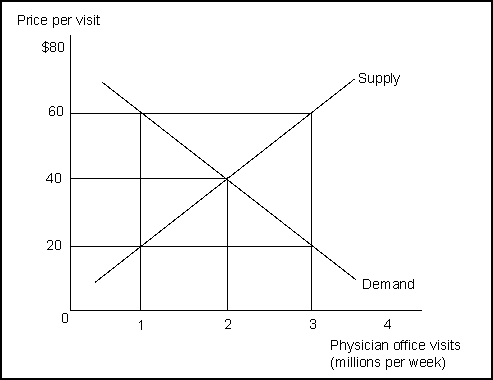 -(Exhibit: Third-party payers) At a price of $60 with a third party payer, the total cost of health-care services compared to the price that would prevail if there were no third-party payers has:
 (Multiple Choice)
4.8/5  (66)
(66) Eliminating third-party payer systems is most likely to ________ the quantity of health care ________.
(Multiple Choice)
4.8/5 (85)
(85) According to the textbook, which of the following are suggestions to limit health-care spending?
(Multiple Choice)
4.8/5 (65)
(65) According to the textbook, much of the discussion about the health-care "problem" in the United States has focused on:
(Multiple Choice)
4.7/5 (84)
(84) Which of the following would lead to an increase in the supply of health care?
(Multiple Choice)
5.0/5 (73)
(73) The individual mandate provision of the Affordable Care Act of 2010 requires:
(Multiple Choice)
4.8/5 (71)
(71) Third-party payments have led to an increase in the price and quantity of health care in the United States.
(True/False)
4.7/5 (80)
(80) Increased spending on consumer goods such as refrigerators, TV sets, and other items of furniture is considered desirable. Why, then, is there so much concern, even frustration, about the dramatic increase in health-care expenditures?
(Essay)
4.8/5 (76)
(76) 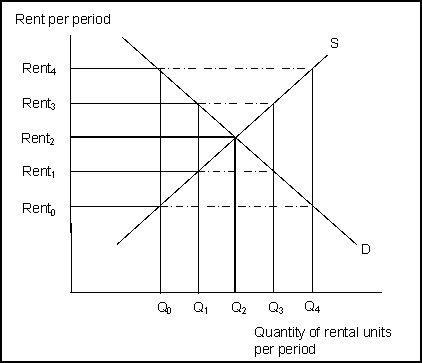 -(Exhibit: Rent Controls) If rent controls are set at Rent0:
 (Multiple Choice)
4.9/5 (69)
(69) Rent controls set a price ceiling below the equilibrium price and therefore:
(Multiple Choice)
4.9/5 (85)
(85) An arrangement in which consumers choose their health-care services while other institutions pay a share of the cost of those services is called a(n) ________ payer system.
(Multiple Choice)
4.8/5 (74)
(74) Technological improvements in the health care industry have contributed to the increase in health care costs.
(True/False)
4.8/5 (72)
(72) The Energy Policy Act of 2005 called for _____ production of ethanol using _____:
(Multiple Choice)
4.9/5 (81)
(81)
-(Exhibit: Third-Party Payers) Suppose insurance lowers the price consumers pay to $20 per visit. Compared to the situation without insurance, this would:
-(Exhibit: Third-Party Payers) Suppose insurance lowers the price consumers pay to $20 per visit. Compared to the situation without insurance, this would: (Multiple Choice)
4.9/5 (78)
(78) 
Filters
- Essay(0)
- Multiple Choice(0)
- Short Answer(0)
- True False(0)
- Matching(0)