



 Chat with AI
Exam 5: Macroeconomics: the Big Picture

Exam 1: Economics: the Study of Choice149 Questions
Exam 3: Demand and Supply253 Questions
Exam 4: Applications of Demand and Supply117 Questions
Exam 5: Macroeconomics: the Big Picture146 Questions
Exam 6: Measuring Total Output and Income162 Questions
Exam 7: Aggregate Demand and Aggregate Supply166 Questions
Exam 8: Economic Growth135 Questions
Exam 9: The Nature and Creation of Money223 Questions
Exam 10: Financial Markets and the Economy175 Questions
Exam 11: Monetary Policy and the Fed176 Questions
Exam 12: Government and Fiscal Policy181 Questions
Exam 13: Consumption and the Aggregate Expenditures Model219 Questions
Exam 14: Investment and Economic Activity138 Questions
Exam 15: Net Exports and International Finance198 Questions
Exam 16: Inflation and Unemployment138 Questions
Exam 17: A Brief History of Macroeconomic Thought and Policy122 Questions
Exam 18: Inequality, Poverty, and Discrimination142 Questions
Exam 19: Economic Development112 Questions
Exam 20: Socialist Economies in Transition135 Questions
Select questions type


Which of the following is an example of structural unemployment?
(Multiple Choice)
4.8/5  (83)
(83) If the CPI is 120 in 2005 and 150 in 2006, what is the rate of inflation over this period?
(Multiple Choice)
4.9/5 (78)
(78) If the real GDP in 2003 is $12,400 billion and the implicit price deflator is 1.4, what is the approximate value of nominal GDP in 2003?
(Multiple Choice)
4.8/5 (96)
(96) Which of the following is true of a price index that uses a fixed market basket?
(Multiple Choice)
4.8/5 (63)
(63) Which of the following individuals benefits from inflation?
(Multiple Choice)
4.8/5 (76)
(76) Which of the following is NOT a consequence of unanticipated inflation?
(Multiple Choice)
4.9/5 (89)
(89) Both unexpected inflation and unexpected deflation create uncertainty about the future.
(True/False)
4.9/5 (86)
(86) During the financial crisis of 2008, the net exports and government purchases of the U.S. rose.
(True/False)
4.7/5 (75)
(75) Figure 5-1 shows the path of real GDP growth over time. Use the figure to answer questions . 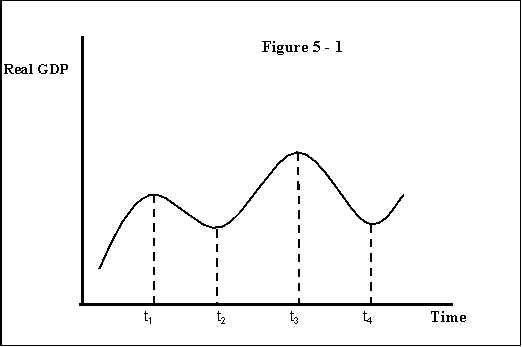 -Refer to Figure 5-1. The trough of the business cycle occurs:
 (Multiple Choice)
4.7/5 (75)
(75) The main cause of hyperinflation is an unanticipated increase in oil prices.
(True/False)
4.9/5 (73)
(73) A country's frictional unemployment rate is 3%, the natural unemployment rate is 5.5%, and the cyclical unemployment rate is 2.4%. The structural unemployment rate is _____ and the unemployment rate is _____.
(Multiple Choice)
4.8/5 (89)
(89) Table 5-6 shows an assistant professor's salary and the respective price indexes for the years 1967 and 1997. Use the table to answer questions .
Table 5-6
 -Refer to Table 5-6. What has happened to an assistant professor's salary between 1967 and 1997?
 (Multiple Choice)
4.7/5 (79)
(79) Which of the following is the most broad-based price index available?
(Multiple Choice)
4.7/5 (94)
(94) If the nominal GDP in 2002 is $8,000 billion and the implicit price deflator is 1.4, what is the approximate value of real GDP in 2002?
(Multiple Choice)
4.9/5 (91)
(91) According to the Bureau of Labor Statistics, a person who is not working and is not looking for work is:
(Multiple Choice)
5.0/5 (84)
(84) Deflation occurs when the rate of inflation falls over a period of time.
(True/False)
5.0/5 (91)
(91) The economy in a particular country is booming. Real GDP is growing at a rate of 6% per year, well above the average growth rate. Under these circumstances, which of the following types of unemployment is most likely to be the lowest?
(Multiple Choice)
4.9/5 (79)
(79) 
Filters
- Essay(0)
- Multiple Choice(0)
- Short Answer(0)
- True False(0)
- Matching(0)