



 Chat with AI
Exam 8: Economic Growth

Exam 1: Economics: the Study of Choice149 Questions
Exam 3: Demand and Supply253 Questions
Exam 4: Applications of Demand and Supply117 Questions
Exam 5: Macroeconomics: the Big Picture146 Questions
Exam 6: Measuring Total Output and Income162 Questions
Exam 7: Aggregate Demand and Aggregate Supply166 Questions
Exam 8: Economic Growth135 Questions
Exam 9: The Nature and Creation of Money223 Questions
Exam 10: Financial Markets and the Economy175 Questions
Exam 11: Monetary Policy and the Fed176 Questions
Exam 12: Government and Fiscal Policy181 Questions
Exam 13: Consumption and the Aggregate Expenditures Model219 Questions
Exam 14: Investment and Economic Activity138 Questions
Exam 15: Net Exports and International Finance198 Questions
Exam 16: Inflation and Unemployment138 Questions
Exam 17: A Brief History of Macroeconomic Thought and Policy122 Questions
Exam 18: Inequality, Poverty, and Discrimination142 Questions
Exam 19: Economic Development112 Questions
Exam 20: Socialist Economies in Transition135 Questions
Select questions type


Shifts to the right in the long-run aggregate supply curve are the result of
(Multiple Choice)
4.9/5  (69)
(69) Which of the following must also shift if the long-run aggregate supply curve shifts?
(Multiple Choice)
4.7/5 (85)
(85) Economic growth can be modeled as
I. an outward shift of the economy's production possibilities curve.
II. a rightward shift of the economy's long-run aggregate supply curve.
III. a rightward shift of the labor demand and the labor supply curves.
IV. a downward shift of the economy's aggregate production function.
(Multiple Choice)
4.9/5 (79)
(79) Suppose a country's potential level of real GDP grows at a rate of 6% per year. Use the rule of 72 to calculate how long it takes for the country's potential output to double.
(Multiple Choice)
4.7/5 (74)
(74) A change in the availability of natural resources will shift the aggregate production function.
(True/False)
4.8/5 (79)
(79) If real GDP grows at 3% and population grows at 1.2%, then real GDP per capita grows by 4.2%.
(True/False)
5.0/5 (75)
(75)  -Refer to Figure 8-1. A movement from F to B
The skills, training, and education possessed by workers contribute to economic growth
(Multiple Choice)
4.8/5 (79)
(79) Define economic growth. Why is it described as a process rather than an event?
(Short Answer)
4.8/5 (82)
(82) Suppose that real GDP per capita of a rich country is $40,000. Real GDP per capita in a poor country is $10,000. Suppose that rate of growth of GDP per capita in the rich country is 3.6% per year and in the poor country is 7.2% per year. Using the rule of 72, calculate how many years it will take for real GDP per capita in the poor country to catch up with GDP per capita in the rich country?
(Multiple Choice)
4.9/5 (76)
(76) Figure 8-3 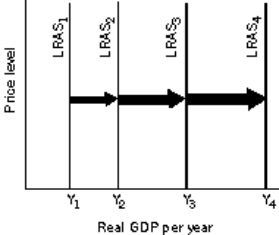 -Refer to Figure 8-3. Exponential economic growth can be depicted by
 (Multiple Choice)
4.7/5 (88)
(88) During the industrial revolution, the United States saw increases in the demand for labor and increases in the supply of labor. The increase in real wages rose during this period is consistent with which of the following statements?
(Multiple Choice)
4.9/5 (82)
(82) Figure 8-6  -Refer to Figure 8-6. Assume that the economy is initially in long-run equilibrium. What happens if investment spending increases?
 (Multiple Choice)
4.8/5 (81)
(81) A change in the supply of labor will shift the long-run aggregate supply curve.
(True/False)
4.9/5 (86)
(86) According to the rule of 72, a 12% annual increase in real GDP would lead to a doubling of real GDP in 8 years.
(True/False)
4.8/5 (92)
(92) Economic growth is defined in terms of changes in the economy's level of goods and services produced from one period to the next.
(True/False)
4.9/5 (84)
(84) 
Filters
- Essay(0)
- Multiple Choice(0)
- Short Answer(0)
- True False(0)
- Matching(0)