



 Chat with AI
Exam 14: Investment and Economic Activity

Exam 1: Economics: the Study of Choice149 Questions
Exam 3: Demand and Supply253 Questions
Exam 4: Applications of Demand and Supply117 Questions
Exam 5: Macroeconomics: the Big Picture146 Questions
Exam 6: Measuring Total Output and Income162 Questions
Exam 7: Aggregate Demand and Aggregate Supply166 Questions
Exam 8: Economic Growth135 Questions
Exam 9: The Nature and Creation of Money223 Questions
Exam 10: Financial Markets and the Economy175 Questions
Exam 11: Monetary Policy and the Fed176 Questions
Exam 12: Government and Fiscal Policy181 Questions
Exam 13: Consumption and the Aggregate Expenditures Model219 Questions
Exam 14: Investment and Economic Activity138 Questions
Exam 15: Net Exports and International Finance198 Questions
Exam 16: Inflation and Unemployment138 Questions
Exam 17: A Brief History of Macroeconomic Thought and Policy122 Questions
Exam 18: Inequality, Poverty, and Discrimination142 Questions
Exam 19: Economic Development112 Questions
Exam 20: Socialist Economies in Transition135 Questions
Select questions type


Which of the following will not a shift the investment demand curve?
(Multiple Choice)
4.7/5  (68)
(68) How does the quantity of capital already in use affect the level of investment?
I. A greater capital stock is likely to lead to more investment since there will be more capital to replace.
II. A greater capital stock is likely to lead to less investment because further increases in the demand for investment raise the cost of capital.
III. For a given desired level of capital stock, the amount of investment needed to reach that level will be lower when the current capital stock is higher.
IV. Investment means adding new capital; the existing stock of capital does not influence additions to capital.
(Multiple Choice)
4.8/5 (70)
(70) Over time, changes in investment
I. shift a nation's production possibilities curve outward.
II. shift the long-run aggregate supply curve to the right.
III. shift the short-run aggregate supply curve to the right.
IV. contribute to economic growth.
(Multiple Choice)
4.7/5 (95)
(95) A reduction in the interest rate, while stimulating investment in the short run, has little or no effect on economic growth in the long run.
(True/False)
4.9/5 (92)
(92) Assume that your firm has a potential investment project which generates a return of 15% and has a cost of $200,000. Assume further that your firm has $200,000 of retained earnings and that the market interest rate is 10%. In this case, your firm should
(Multiple Choice)
4.8/5 (80)
(80) Gross private domestic investment, the official government measure of investment, includes all of the following except
(Multiple Choice)
4.9/5 (85)
(85) All other things unchanged, an increase in taxes on profits earned by firms tends to
(Multiple Choice)
4.9/5 (81)
(81) Figure 14-1  -Refer to Figure 14-1. Suppose the economy is operating at point m on curve A. The decision to move to point p
I. requires a sacrifice of current consumption.
II. requires a sacrifice of future consumption.
III. adds to the economy's capital stock assuming depreciation remains at a level corresponding to point m.
IV. enables the economy to increase both its consumption and investment in the future.
-Refer to Figure 14-1. Suppose the economy is operating at point m on curve A. The decision to move to point p
I. requires a sacrifice of current consumption.
II. requires a sacrifice of future consumption.
III. adds to the economy's capital stock assuming depreciation remains at a level corresponding to point m.
IV. enables the economy to increase both its consumption and investment in the future. (Multiple Choice)
4.9/5 (68)
(68) Which of the following will shift the investment demand curve to the right?
(Multiple Choice)
4.8/5 (79)
(79) Figure 14-1
-Refer to Figure 14-1. Suppose the economy is operating on curve B and there is positive depreciation to its existing capital stock. The decision to produce at point r is likely to
I. shift the production possibilities curve slowly toward curve C.
II. shift the production possibilities curve slowly toward curve A.
III. reduce the economy's capital stock.
IV. result in a negative net private investment.
-Refer to Figure 14-1. Suppose the economy is operating on curve B and there is positive depreciation to its existing capital stock. The decision to produce at point r is likely to
I. shift the production possibilities curve slowly toward curve C.
II. shift the production possibilities curve slowly toward curve A.
III. reduce the economy's capital stock.
IV. result in a negative net private investment. (Multiple Choice)
4.9/5 (64)
(64) Which of the following is classified as spending on investment?
I. new residential construction
II. business spending on new equipment
III. business spending on structures such as office buildings
IV. purchase of government bonds
(Multiple Choice)
4.8/5 (81)
(81) Figure 14-6  -Refer to Figure 14-6. If the money supply is increased in Panel (a) from MS1 to MS2, then in Panel (b), the quantity of investment demanded
 (Multiple Choice)
4.9/5 (86)
(86) Table 14-2
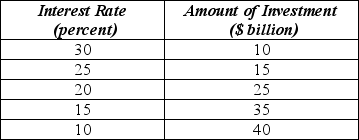 -Refer to Table 14-2. If the interest rate falls from 20% to 15%, what is the change in the amount of investment?
 (Multiple Choice)
4.9/5 (76)
(76) In the last 80 years, the United States recorded a negative net private domestic investment during three periods. Which of the following are examples of two such periods?
(Multiple Choice)
4.8/5 (84)
(84) If the Fed wishes to reduce aggregate demand, it will conduct an open market
(Multiple Choice)
4.9/5 (77)
(77) 
Filters
- Essay(0)
- Multiple Choice(0)
- Short Answer(0)
- True False(0)
- Matching(0)