



 Chat with AI
Exam 17: Externalities and the Environment

Exam 1: What Is Economics479 Questions
Exam 2: The Economic Problem439 Questions
Exam 3: Demand and Supply515 Questions
Exam 4: Elasticity533 Questions
Exam 5: Efficiency and Equity449 Questions
Exam 6: Government Actions in Markets410 Questions
Exam 7: Global Markets in Action200 Questions
Exam 8: Utility and Demand364 Questions
Exam 9: Possibilities, Preferences, and Choices464 Questions
Exam 10: Organizing Production385 Questions
Exam 11: Output and Costs494 Questions
Exam 12: Perfect Competition487 Questions
Exam 13: Monopoly606 Questions
Exam 14: Monopolistic Competition320 Questions
Exam 15: Oligopoly280 Questions
Exam 16: Public Choices and Public Goods356 Questions
Exam 17: Externalities and the Environment284 Questions
Exam 18: Markets for Factors of Production382 Questions
Exam 19: Economic Inequality354 Questions
Exam 20: Uncertainty and Information233 Questions
Exam 21: Extension A: Review11 Questions
Exam 22: Extension B: Review25 Questions
Exam 23: Extension C: Review14 Questions
Exam 24: Extension D: Review38 Questions
Exam 25: Extension E: Review11 Questions
Exam 26: Extension F: Review18 Questions
Select questions type


A private cost is a cost of production that is borne by the
(Multiple Choice)
5.0/5  (81)
(81) The Atlantic City Expressway is a highway that runs from outside Philadelphia to Atlantic City, New Jersey. It is notoriously congested during the summer weekends when many people are driving to the beach about the same time. The marginal private cost for a driver of driving on the Expressway includes I. the cost of gasoline.
II) the cost of increasing congestion for everyone else.
(Multiple Choice)
5.0/5 (91)
(91) 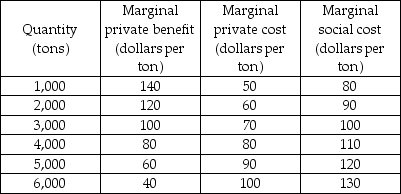 -The above table shows the marginal benefits and costs from production of fertilizer. There are no external benefits. If the market is perfectly competitive and unregulated, the equilibrium output will be
 (Multiple Choice)
5.0/5 (84)
(84) The cost of producing one more unit of a good or service that is paid by the producer
(Multiple Choice)
4.9/5 (75)
(75)  -The table above describes the market for paper. The production of paper produces pollution. There are no external benefits. What amount of tax per ton of paper is necessary to produce the efficient quantity of paper?
 (Multiple Choice)
4.8/5 (90)
(90)  -In the figure above showing the costs and benefits of paper production, there is an
 (Multiple Choice)
4.9/5 (79)
(79) Keeping in mind the Coase theorem, in the figure above, if the residents of the town own the lake, the market does what?
(Multiple Choice)
4.8/5 (86)
(86) When external costs are present and the government imposes a tax equal to the marginal external cost, then
(Multiple Choice)
4.8/5 (84)
(84) When producers are hard to monitor and marginal costs differ across producers, ________ are an effective method to achieve efficient use of a ________.
(Multiple Choice)
4.8/5 (74)
(74)  -In the figure above, if the market is unregulated,
A common resource is used efficiently if marginal social benefit equals marginal social cost.
(True/False)
4.8/5 (75)
(75)  -The above figure shows the marginal social benefit, marginal private cost and marginal social cost of producing steel. There is a marginal external ________ of ________ per ton.
 (Multiple Choice)
4.8/5 (79)
(79) Resources are efficiently utilized when production is such that marginal social benefit
(Multiple Choice)
4.8/5 (86)
(86)  -The figure above shows the costs associated with producing paper. When paper is produced, there is some pollution runoff into a lake. If paper production is 4 tons per week, the outcome is ________.
 (Multiple Choice)
4.8/5 (82)
(82) With marketable permits to pollute, efficiency can be obtained if
(Multiple Choice)
4.9/5 (86)
(86) Keeping in mind the Coase theorem, in the figure above, if the pesticide factories own the lake, the market does what?
(Multiple Choice)
4.7/5 (76)
(76) To achieve the efficient amount of use of a common resource, the use should be such that ________ equals ________.
(Multiple Choice)
4.9/5 (79)
(79) For a common resource, the marginal private benefit of the resource is greater than the marginal social benefit.
(True/False)
4.9/5 (74)
(74)  -The figure above provides information for a factory that produces chemicals that pollute a waterway. The waterway is used by water skiers. The efficient quantity of chemicals to produce is ________ tons of chemicals a week.
 (Multiple Choice)
4.8/5 (78)
(78) 
Filters
- Essay(0)
- Multiple Choice(0)
- Short Answer(0)
- True False(0)
- Matching(0)