



 Chat with AI
Exam 18: Markets for Factors of Production

Exam 1: What Is Economics479 Questions
Exam 2: The Economic Problem439 Questions
Exam 3: Demand and Supply515 Questions
Exam 4: Elasticity533 Questions
Exam 5: Efficiency and Equity449 Questions
Exam 6: Government Actions in Markets410 Questions
Exam 7: Global Markets in Action200 Questions
Exam 8: Utility and Demand364 Questions
Exam 9: Possibilities, Preferences, and Choices464 Questions
Exam 10: Organizing Production385 Questions
Exam 11: Output and Costs494 Questions
Exam 12: Perfect Competition487 Questions
Exam 13: Monopoly606 Questions
Exam 14: Monopolistic Competition320 Questions
Exam 15: Oligopoly280 Questions
Exam 16: Public Choices and Public Goods356 Questions
Exam 17: Externalities and the Environment284 Questions
Exam 18: Markets for Factors of Production382 Questions
Exam 19: Economic Inequality354 Questions
Exam 20: Uncertainty and Information233 Questions
Exam 21: Extension A: Review11 Questions
Exam 22: Extension B: Review25 Questions
Exam 23: Extension C: Review14 Questions
Exam 24: Extension D: Review38 Questions
Exam 25: Extension E: Review11 Questions
Exam 26: Extension F: Review18 Questions
Select questions type


An investment pays $100 at the end of each of the three next years. No additional payments will ever be made. If the annual interest rate is 5 percent, the present value of the investment is approximately
(Multiple Choice)
4.8/5  (87)
(87) According to a 1963 edition of the Effingham Daily News, Illinois Consolidated Telephone Co. switched from the switchboard system to the dial system at 12:01 a.m. Sunday, Aug. 18, 1963. Thirty miles of cable supported the new high-tech system. It took four weeks to lay the telephone lines that allowed Effingham residents to directly connect to each other through the telephone. How does the switch from the switchboard system to the dial system impact the labor market for switchboard operators?
(Multiple Choice)
4.7/5 (76)
(76) With respect to labor supply, the income effect leads a person to want to work more in order to raise his or her income.
(True/False)
4.9/5 (69)
(69) What factors shift the demand for labor curve? Briefly describe the effect of each.
(Essay)
4.7/5 (77)
(77) Discounting is converting a future amount of money to a present value.
(True/False)
4.9/5 (81)
(81) Which of the following would unions be most likely to support?
(Multiple Choice)
4.8/5 (77)
(77) A firm that can sell its output for $40 per unit. When it increases its labor force from 4 workers to 5 workers its output increases from 15 to 17 units. The value of marginal product of the 5th worker is
(Multiple Choice)
4.9/5 (74)
(74) 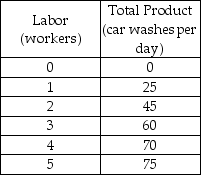 -Winnie's Car Wash is a perfectly competitive firm. The table above shows Winnie's total product schedule. If the price of a car wash is $5, what is the value of marginal product of the 4th worker?
 (Multiple Choice)
4.8/5 (91)
(91) Pennsylvania's largest grower of fresh-to-market tomatoes announced in March 2009 he will no longer produce the crop because he can't find enough workers to harvest it. Though his tomato pickers made an average of $16.59 per hour last year, he said the relatively high wage is not enough to attract local labor to work the fields. In the market for tomato workers, what is true?
(Multiple Choice)
4.7/5 (75)
(75) If a firm finds that, at its current level of employment, VMP < W, then it has
(Multiple Choice)
5.0/5 (82)
(82) If a nonrenewable natural resource's price is expected to increase at a rate faster than the interest rate, then the supply today will
(Multiple Choice)
4.8/5 (78)
(78) The price of an nonrenewable resource is expected to rise at a rate equal to the
(Multiple Choice)
4.7/5 (87)
(87) An advertisement campaign that successfully convinces consumers to buy union-made products has the direct effect of shifting the
(Multiple Choice)
4.8/5 (81)
(81)  -The above figure shows the market for labor. The employer is a monopsony. The firm will not hire 800 hours of labor because at that point
 (Multiple Choice)
4.8/5 (59)
(59) 
Filters
- Essay(0)
- Multiple Choice(0)
- Short Answer(0)
- True False(0)
- Matching(0)