



 Chat with AI
Exam 9: Possibilities, Preferences, and Choices

Exam 1: What Is Economics479 Questions
Exam 2: The Economic Problem439 Questions
Exam 3: Demand and Supply515 Questions
Exam 4: Elasticity533 Questions
Exam 5: Efficiency and Equity449 Questions
Exam 6: Government Actions in Markets410 Questions
Exam 7: Global Markets in Action200 Questions
Exam 8: Utility and Demand364 Questions
Exam 9: Possibilities, Preferences, and Choices464 Questions
Exam 10: Organizing Production385 Questions
Exam 11: Output and Costs494 Questions
Exam 12: Perfect Competition487 Questions
Exam 13: Monopoly606 Questions
Exam 14: Monopolistic Competition320 Questions
Exam 15: Oligopoly280 Questions
Exam 16: Public Choices and Public Goods356 Questions
Exam 17: Externalities and the Environment284 Questions
Exam 18: Markets for Factors of Production382 Questions
Exam 19: Economic Inequality354 Questions
Exam 20: Uncertainty and Information233 Questions
Exam 21: Extension A: Review11 Questions
Exam 22: Extension B: Review25 Questions
Exam 23: Extension C: Review14 Questions
Exam 24: Extension D: Review38 Questions
Exam 25: Extension E: Review11 Questions
Exam 26: Extension F: Review18 Questions
Select questions type


 -The above figure shows Katie's consumption possibilities. The relative price of a movie ticket is
 (Multiple Choice)
4.8/5  (85)
(85) 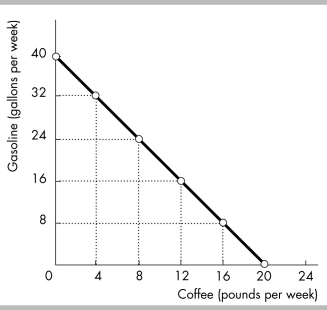 -The figure above shows Sam's budget line. The magnitude of the slope of Sam's budget line is equal to the
 (Multiple Choice)
4.9/5 (77)
(77) "Consumption possibilities are limited by total utility." True or false? Explain.
(True/False)
4.8/5 (84)
(84) Real income is equal to ________ and a relative price is given by ________.
(Multiple Choice)
4.9/5 (93)
(93) 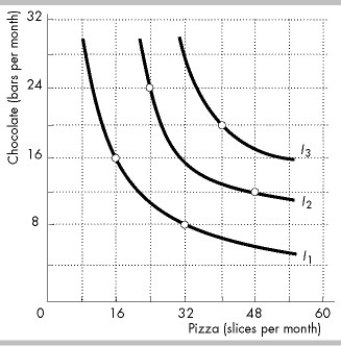 -The indifference curves in the figure above (I1, I2, and I3) reflect Peter's consumption preferences. Which of the following combinations of goods does Peter prefer the most?
 (Multiple Choice)
4.8/5 (83)
(83) Junkfood Jill spends all of her income on jellybeans and Jolt cola. Suppose that Jill's income is $30, the price of a bag of jellybeans is $6, and the price of a bottle of Jolt cola is $2. Which of the following combinations of jellybeans and Jolt cola lies inside of Jill's budget line?
(Multiple Choice)
5.0/5 (87)
(87) 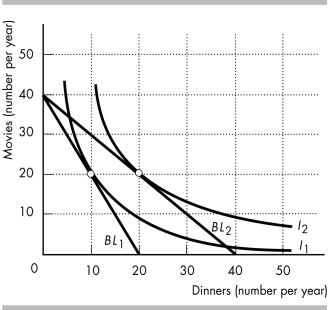 -The marginal rate of substitution is the rate at which a person is willing to substitute one good for another good while remaining on the same indifference curve.
 (True/False)
5.0/5 (69)
(69) The variables that determine a household's budget line are
(Multiple Choice)
4.9/5 (85)
(85) What information do you need to draw your budget line? What is your budget line? What does it show for any pair of goods?
(Essay)
4.8/5 (83)
(83) Larry spends all his $800 monthly income on pizza and gasoline. The price of pizza is $4 a slice, and the price of gasoline is $2 per gallon. If Larry buys 150 slices of pizza per month, his budget constraint will allow him to buy ________ gallons of gas per month.
(Multiple Choice)
4.8/5 (85)
(85) Ron spends $150 on movie tickets and pizza. The price of a pizza is $10 and a movie ticket is $7.50. With the quantity of movies measured along the vertical axis, the slope of Ron's budget line (with movies on the vertical axis) is ________ per pizza
(Multiple Choice)
4.8/5 (70)
(70) 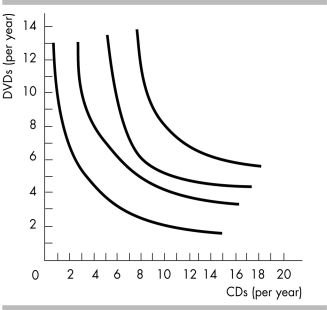 -Record companies, faced with the growing competitions from digital music download services, lower the price of a music CD from $18.00 to $13.50. The price of a DVD is $18. Olivia's income is $216 a year and she spends all of it on music CDs and movies on DVDs.
a) What is Olivia's real income in terms of CDs? What is her real income in terms of DVDs?
b) What is the relative price of a CD in terms of DVDs? What is the opportunity cost of a DVD?
c) Calculate the equation for Olivia's budget line. Place the quantity of DVDs on the left side of the equation.
d) Draw a graph of Olivia's budget line (with CDs on the horizontal axis). What is the slope of Olivia's budget line? What determines its magnitude?
The figure above illustrates Olivia's preferences.
e) Given the price of a CD, the price of a DVD, and Olivia's income, what quantities of CDs and DVDs does Olivia buy? Explain your solution.
f) What is Olivia's marginal rate of substitution at the point at which she consumes? Explain.
g) Determine how many CDs Olivia buys if the price of a CD is $18 and there is no change in the price of DVD nor in Olivia's income. Derive Olivia's demand curve for CDs for the price change from $18 to $13.50 per CD.
-Record companies, faced with the growing competitions from digital music download services, lower the price of a music CD from $18.00 to $13.50. The price of a DVD is $18. Olivia's income is $216 a year and she spends all of it on music CDs and movies on DVDs.
a) What is Olivia's real income in terms of CDs? What is her real income in terms of DVDs?
b) What is the relative price of a CD in terms of DVDs? What is the opportunity cost of a DVD?
c) Calculate the equation for Olivia's budget line. Place the quantity of DVDs on the left side of the equation.
d) Draw a graph of Olivia's budget line (with CDs on the horizontal axis). What is the slope of Olivia's budget line? What determines its magnitude?
The figure above illustrates Olivia's preferences.
e) Given the price of a CD, the price of a DVD, and Olivia's income, what quantities of CDs and DVDs does Olivia buy? Explain your solution.
f) What is Olivia's marginal rate of substitution at the point at which she consumes? Explain.
g) Determine how many CDs Olivia buys if the price of a CD is $18 and there is no change in the price of DVD nor in Olivia's income. Derive Olivia's demand curve for CDs for the price change from $18 to $13.50 per CD. (Essay)
4.7/5 (80)
(80) If the price of a good rises and the consumer's budget remains the same, what happens to the consumer's consumption possibilities?
(Essay)
4.8/5 (67)
(67) 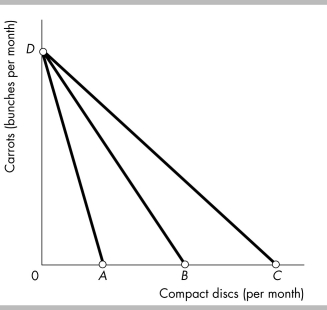 -In the figure above, suppose the original budget line is BD. A rise in the price of a compact disc will
 (Multiple Choice)
4.8/5 (75)
(75)  -According to the budget line in the above figure, which of the following combinations is unaffordable?
 (Multiple Choice)
4.9/5 (78)
(78) Larry spends all his $800 monthly income on pizza and milk. The price of pizza is $4 a slice, and the price of milk is $2 per quart. Larry's real monthly income in terms of pizza is
(Multiple Choice)
4.8/5 (84)
(84) For goods and services that are perfect substitutes, the consumer's indifference curves are ________ lines.
(Multiple Choice)
4.8/5 (78)
(78) Describe the consumer equilibrium in the indifference curve/budget line model.
(Essay)
4.9/5 (75)
(75) 
Filters
- Essay(0)
- Multiple Choice(0)
- Short Answer(0)
- True False(0)
- Matching(0)