



 Chat with AI
Exam 2: The Key Principles of Economics

Exam 1: Introduction: What Is Economics163 Questions
Exam 2: The Key Principles of Economics199 Questions
Exam 3: Exchange and Markets136 Questions
Exam 4: Demand, supply, and Market Equilibrium280 Questions
Exam 5: Elasticity: a Measure of Responsiveness173 Questions
Exam 6: Market Efficiency and Government Intervention120 Questions
Exam 7: Consumer Choice: Utility Theory and Insights From Neuroscience116 Questions
Exam 8: Production Technology and Cost163 Questions
Exam 9: Perfect Competition165 Questions
Exam 10: Monopoly and Price Discrimination128 Questions
Exam 11: Market Entry and Monopolistic Competition114 Questions
Exam 12: Oligopoly and Strategic Behavior125 Questions
Exam 13: Controlling Market Power: Antitrust and Regulation84 Questions
Exam 14: Imperfect Information: Adverse Selection and Moral Hazard98 Questions
Exam 15: Public Goods and Public Choice97 Questions
Exam 16: External Costs and Environmental Policy109 Questions
Exam 17: The Labor Market and the Distribution of Income178 Questions
Exam 18: International Trade and Public Policy229 Questions
Select questions type


You have an hour between your economics and math classes.What is the opportunity cost of that time if you use it to do math homework?
(Multiple Choice)
5.0/5  (74)
(74) In order to go to college,James incurs an opportunity cost even though all he gave up was a full time job as a clerk at Wally World.
(True/False)
4.8/5 (96)
(96) Opportunity cost is the difference between the benefit and cost of some action.
(True/False)
4.9/5 (80)
(80) The government uses the buying power of wages rather than face value or nominal value in reporting changes in "real wages" in the economy.
(True/False)
4.8/5 (73)
(73)  Figure 2.4
-Joe runs a business and needs to decide how many hours to stay open.Figure 2.4 illustrates his marginal benefit of staying open for each additional hour.Suppose that we observe Joe staying open 4 hours per day.If he is following the marginal principle,what must his marginal cost be?
Figure 2.4
-Joe runs a business and needs to decide how many hours to stay open.Figure 2.4 illustrates his marginal benefit of staying open for each additional hour.Suppose that we observe Joe staying open 4 hours per day.If he is following the marginal principle,what must his marginal cost be? (Multiple Choice)
4.8/5 (81)
(81)  Table 2.3
-The firm depicted in Table 2.3 is facing diminishing returns because:
Table 2.3
-The firm depicted in Table 2.3 is facing diminishing returns because: (Multiple Choice)
4.9/5 (75)
(75) 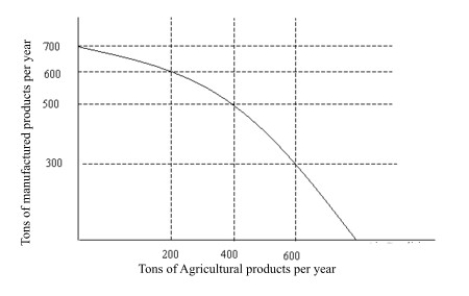 Figure 2.1
-On the production possibilities curve in Figure 2.1 the gain from decreasing manufacturing production from 700 tons to 500 tons is:
Figure 2.1
-On the production possibilities curve in Figure 2.1 the gain from decreasing manufacturing production from 700 tons to 500 tons is: (Multiple Choice)
4.8/5 (67)
(67) Figure 2.1
-Referring to Figure 2.1,if you increase the production of farm goods,what other area is affected?
Figure 2.1
-Referring to Figure 2.1,if you increase the production of farm goods,what other area is affected? (Multiple Choice)
4.9/5 (67)
(67) 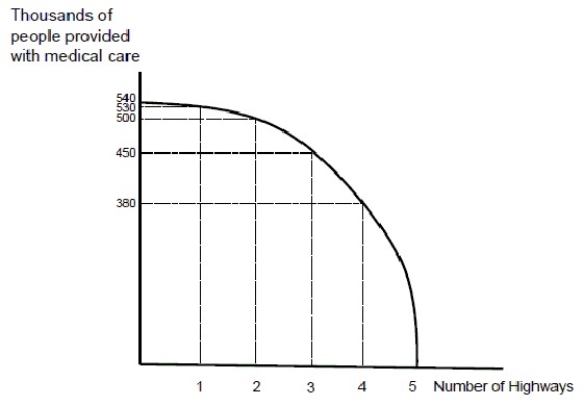 Figure 2.2
-Figure 2.2 presents a production possibilities curve for a country that can either produce highways or provide people with medical care in a given year.The figure shows that the production possibilities curve is:
Figure 2.2
-Figure 2.2 presents a production possibilities curve for a country that can either produce highways or provide people with medical care in a given year.The figure shows that the production possibilities curve is: (Multiple Choice)
4.7/5 (79)
(79) 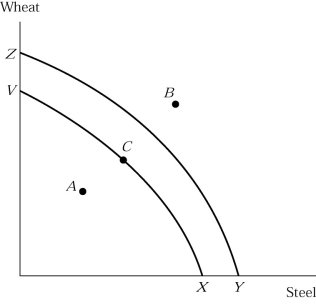 Figure 2.3
-In Figure 2.3,point A:
A "market" is an arrangement that enables people to exchange goods and services.
(True/False)
4.9/5 (78)
(78) The notion of opportunity cost allows the measurement of tradeoffs.
(True/False)
5.0/5 (72)
(72) Suppose prices increase by 3% per year.What nominal percentage return on your savings account would you require to get a 3% real return?
(Multiple Choice)
4.9/5 (76)
(76) Increase the level of an activity if its marginal benefit exceeds its marginal cost;reduce the level of an activity if its marginal cost exceeds its marginal benefit.This is known as the ________.
(Essay)
4.7/5 (69)
(69) By making acquisitions,resources are used that could have been used to ________.
(Essay)
4.8/5 (85)
(85) 
Filters
- Essay(0)
- Multiple Choice(0)
- Short Answer(0)
- True False(0)
- Matching(0)