



 Chat with AI
Exam 7: Global Markets in Action

Exam 1: What Is Economics205 Questions
Exam 2: The Economic Problem145 Questions
Exam 3: Demand and Supply188 Questions
Exam 4: Elasticity166 Questions
Exam 5: Efficiency and Equity123 Questions
Exam 6: Government Actions in Markets125 Questions
Exam 7: Global Markets in Action135 Questions
Exam 8: Utility and Demand116 Questions
Exam 9: Possibilities, preferences, and Choices120 Questions
Exam 10: Output and Costs145 Questions
Exam 11: Perfect Competition114 Questions
Exam 12: Monopoly114 Questions
Exam 13: Monopolistic Competition136 Questions
Exam 14: Oligopoly100 Questions
Exam 15: Externalities114 Questions
Exam 16: Public Goods and Common Resources96 Questions
Exam 17: Markets for Factors of Production122 Questions
Exam 18: Economic Inequality115 Questions
Select questions type


Increasing a tariff ________ the domestic quantity consumed of the good and ________ the domestic production of the good.
(Multiple Choice)
4.9/5  (88)
(88) A country opens up to trade.In an import industry,surplus is redistributed from
(Multiple Choice)
4.9/5 (84)
(84) Refer to the figure below to answer the following questions. 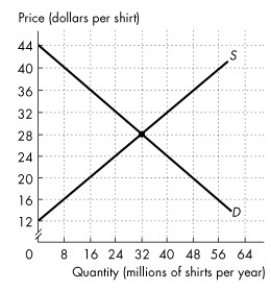 Figure 7.2.1
The figure shows the market for shirts in Canada,where D is the domestic demand curve and S is the domestic supply curve.The world price is $20 per shirt.
-In Figure 7.2.1,if the economy moves from no trade to international trade,consumer surplus in Canada ________ by ________.
Figure 7.2.1
The figure shows the market for shirts in Canada,where D is the domestic demand curve and S is the domestic supply curve.The world price is $20 per shirt.
-In Figure 7.2.1,if the economy moves from no trade to international trade,consumer surplus in Canada ________ by ________. (Multiple Choice)
4.8/5 (89)
(89) Canada produces both lumber and wine.Canada exports lumber and imports wine.The rest of the world imports Canadian lumber and exports wine to Canada.If Canada did not trade with the rest of the world,then the equilibrium price of lumber would be ________ in Canada than the rest of the world,and the equilibrium price of wine would be ________ in Canada than the rest of the world.
(Multiple Choice)
4.8/5 (82)
(82) Refer to the figure below to answer the following questions. 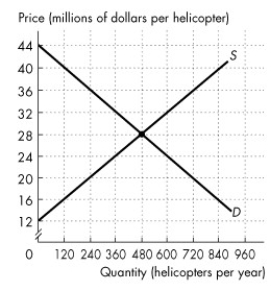 Figure 7.1.2
The figure shows the market for helicopters in Canada,where D is the domestic demand curve and S is the domestic supply curve.The world price is $36 million per helicopter.
-In Figure 7.1.2,with international trade,________ helicopters per year are produced in Canada.
Figure 7.1.2
The figure shows the market for helicopters in Canada,where D is the domestic demand curve and S is the domestic supply curve.The world price is $36 million per helicopter.
-In Figure 7.1.2,with international trade,________ helicopters per year are produced in Canada. (Multiple Choice)
4.9/5 (73)
(73) Suppose that the world price of eggs is $1 a dozen,Canada does not trade internationally,and the equilibrium price of eggs in Canada is $3 a dozen.Then Canada begins to trade internationally. Canadian farmers produce ________ eggs.Canada ________ eggs.
(Multiple Choice)
4.9/5 (88)
(88) When Canada exports a good,the ________ in Canada's consumer surplus is ________ the increase in Canada's producer surplus.
(Multiple Choice)
5.0/5 (64)
(64) If a quota is set at the same quantity of imports that results from a tariff,
(Multiple Choice)
4.9/5 (83)
(83) A country opens up to trade and becomes an importer of some good.Consumer surplus on that good ________,and producer surplus on that good ________.
(Multiple Choice)
5.0/5 (91)
(91) A country moves from a situation of no trade to a situation where a good is exported.In the exporting country the price of the good ________,and producer surplus ________.
(Multiple Choice)
4.8/5 (84)
(84) Refer to the figure below to answer the following questions. 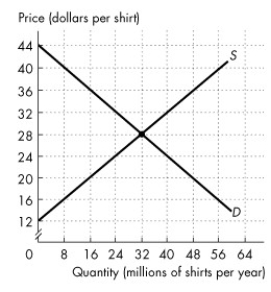 Figure 7.3.1
The figure shows the market for shirts in Canada,where D is the domestic demand curve and S is the domestic supply curve.The world price is $20 per shirt.Canada imposes a tariff on imported shirts of $4 per shirt.
-Refer to Figure 7.3.1.The deadweight loss from the tariff is
Figure 7.3.1
The figure shows the market for shirts in Canada,where D is the domestic demand curve and S is the domestic supply curve.The world price is $20 per shirt.Canada imposes a tariff on imported shirts of $4 per shirt.
-Refer to Figure 7.3.1.The deadweight loss from the tariff is (Multiple Choice)
4.9/5 (72)
(72) In one year,Brazil exported more than 1.8 billion kilograms of coffee to the rest of the world.We can conclude that
(Multiple Choice)
4.9/5 (75)
(75) Refer to the figure below to answer the following questions. Figure 7.3.1
The figure shows the market for shirts in Canada,where D is the domestic demand curve and S is the domestic supply curve.The world price is $20 per shirt.Canada imposes a tariff on imported shirts of $4 per shirt.
-Refer to Figure 7.3.1.With the tariff,Canada imports ________ million shirts per year.
Figure 7.3.1
The figure shows the market for shirts in Canada,where D is the domestic demand curve and S is the domestic supply curve.The world price is $20 per shirt.Canada imposes a tariff on imported shirts of $4 per shirt.
-Refer to Figure 7.3.1.With the tariff,Canada imports ________ million shirts per year. (Multiple Choice)
4.9/5 (99)
(99) Refer to the figure below to answer the following questions. Figure 7.3.1
The figure shows the market for shirts in Canada,where D is the domestic demand curve and S is the domestic supply curve.The world price is $20 per shirt.Canada imposes a tariff on imported shirts of $4 per shirt.
-Refer to Figure 7.3.1.With the tariff,Canadians buy ________ million shirts per year.
Figure 7.3.1
The figure shows the market for shirts in Canada,where D is the domestic demand curve and S is the domestic supply curve.The world price is $20 per shirt.Canada imposes a tariff on imported shirts of $4 per shirt.
-Refer to Figure 7.3.1.With the tariff,Canadians buy ________ million shirts per year. (Multiple Choice)
4.9/5 (86)
(86) Compared to the situation before international trade,after Canada imports a good,production in Canada ________ and consumption in Canada ________.
(Multiple Choice)
4.8/5 (82)
(82) In the exporting industries of poorer countries,free trade ________ the demand for labour in these industries and ________ the wages paid in these industries.
(Multiple Choice)
4.9/5 (79)
(79) 
Filters
- Essay(0)
- Multiple Choice(0)
- Short Answer(0)
- True False(0)
- Matching(0)