



 Chat with AI
Exam 12: Monopoly

Exam 1: What Is Economics205 Questions
Exam 2: The Economic Problem145 Questions
Exam 3: Demand and Supply188 Questions
Exam 4: Elasticity166 Questions
Exam 5: Efficiency and Equity123 Questions
Exam 6: Government Actions in Markets125 Questions
Exam 7: Global Markets in Action135 Questions
Exam 8: Utility and Demand116 Questions
Exam 9: Possibilities, preferences, and Choices120 Questions
Exam 10: Output and Costs145 Questions
Exam 11: Perfect Competition114 Questions
Exam 12: Monopoly114 Questions
Exam 13: Monopolistic Competition136 Questions
Exam 14: Oligopoly100 Questions
Exam 15: Externalities114 Questions
Exam 16: Public Goods and Common Resources96 Questions
Exam 17: Markets for Factors of Production122 Questions
Exam 18: Economic Inequality115 Questions
Select questions type


To increase sales from 7 units to 8 units,a single-price monopolist cuts the price from $7 per unit to $6 per unit.What is marginal revenue from selling the 8th unit?
(Multiple Choice)
4.8/5  (79)
(79) Which of the following is true for a perfect price-discriminating monopoly?
(Multiple Choice)
4.8/5 (77)
(77) Use the figure below to answer the following questions.  Figure 12.3.4
-Consider the natural monopoly depicted in Figure 12.3.4.Total surplus is at a maximum when quantity is
Figure 12.3.4
-Consider the natural monopoly depicted in Figure 12.3.4.Total surplus is at a maximum when quantity is (Multiple Choice)
4.9/5 (80)
(80) Which one of the following is an example of a natural barrier to entry of new firms into an industry?
(Multiple Choice)
4.8/5 (73)
(73) Use the table below to answer the following questions.
Table 12.4.1  -Refer to Table 12.4.1.If a perfect price-discriminating monopoly faces the demand schedule shown in Table 12.4.1 and if marginal cost is constant at $3,output is
 (Multiple Choice)
4.8/5 (84)
(84) Use the figure below to answer the following questions.  Figure 12.4.6
-Prime Pharmaceuticals has developed a new asthma medicine,for which it has a patent.An inhaler can be produced at a constant marginal cost of $2 per inhaler.The demand curve,marginal revenue curve,and marginal cost curve for this new asthma inhaler are shown in Figure 12.4.6.The patent gives Prime Pharmaceuticals a monopoly for its new inhaler.If Prime Pharmaceuticals can perfectly price discriminate,then it
Figure 12.4.6
-Prime Pharmaceuticals has developed a new asthma medicine,for which it has a patent.An inhaler can be produced at a constant marginal cost of $2 per inhaler.The demand curve,marginal revenue curve,and marginal cost curve for this new asthma inhaler are shown in Figure 12.4.6.The patent gives Prime Pharmaceuticals a monopoly for its new inhaler.If Prime Pharmaceuticals can perfectly price discriminate,then it (Multiple Choice)
4.9/5 (70)
(70) Use the figure below to answer the following questions.  Figure 12.2.2
-When the single-price monopoly illustrated in Figure 12.2.2 is maximizing profit,it produces
Figure 12.2.2
-When the single-price monopoly illustrated in Figure 12.2.2 is maximizing profit,it produces (Multiple Choice)
4.8/5 (76)
(76) Use the figure below to answer the following questions. Figure 12.4.6
-Prime Pharmaceuticals has developed a new asthma inhaler,for which it has a patent.An inhaler can be produced at a constant marginal cost of $2 per inhaler.The demand curve,marginal revenue curve,and marginal cost curve for this new asthma inhaler are shown in Figure 12.4.6.The patent gives Prime Pharmaceuticals a monopoly for its new inhaler.If Prime Pharmaceuticals can perfectly price discriminate,producer surplus is
Figure 12.4.6
-Prime Pharmaceuticals has developed a new asthma inhaler,for which it has a patent.An inhaler can be produced at a constant marginal cost of $2 per inhaler.The demand curve,marginal revenue curve,and marginal cost curve for this new asthma inhaler are shown in Figure 12.4.6.The patent gives Prime Pharmaceuticals a monopoly for its new inhaler.If Prime Pharmaceuticals can perfectly price discriminate,producer surplus is (Multiple Choice)
4.9/5 (70)
(70) Use the figure below to answer the following question. 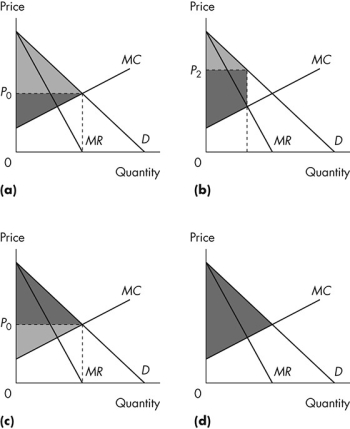 Figure 12.4.4
-Refer to Figure 12.4.4.The light grey area shows consumer surplus and the dark grey area shows producer surplus.Which graph illustrates a perfect price-discriminating monopoly?
Figure 12.4.4
-Refer to Figure 12.4.4.The light grey area shows consumer surplus and the dark grey area shows producer surplus.Which graph illustrates a perfect price-discriminating monopoly? (Multiple Choice)
4.8/5 (77)
(77) Which of the following is a characteristic of a single-price monopoly?
(Multiple Choice)
4.7/5 (78)
(78) Use the figure below to answer the following questions.  Figure 12.3.3
-Consider Figure 12.3.3.What is the redistribution of surplus from consumers to the producer with a single-price monopoly,as compared to a perfectly competitive market?
Figure 12.3.3
-Consider Figure 12.3.3.What is the redistribution of surplus from consumers to the producer with a single-price monopoly,as compared to a perfectly competitive market? (Multiple Choice)
4.8/5 (77)
(77) Regulation of a natural monopoly will maximize the sum of consumer surplus and producer surplus if the firm is regulated with
(Multiple Choice)
4.8/5 (90)
(90) Rate of return regulation can end up serving the self-interest of the firm if
(Multiple Choice)
4.8/5 (90)
(90) Use the figure below to answer the following questions.  Figure 12.4.2
-Refer to Figure 12.4.2.Assume this monopoly practises perfect price discrimination.Choose the correct statement.
Figure 12.4.2
-Refer to Figure 12.4.2.Assume this monopoly practises perfect price discrimination.Choose the correct statement. (Multiple Choice)
4.9/5 (77)
(77) 
Filters
- Essay(0)
- Multiple Choice(0)
- Short Answer(0)
- True False(0)
- Matching(0)