



 Chat with AI
Exam 18: Economic Inequality

Exam 1: What Is Economics205 Questions
Exam 2: The Economic Problem145 Questions
Exam 3: Demand and Supply188 Questions
Exam 4: Elasticity166 Questions
Exam 5: Efficiency and Equity123 Questions
Exam 6: Government Actions in Markets125 Questions
Exam 7: Global Markets in Action135 Questions
Exam 8: Utility and Demand116 Questions
Exam 9: Possibilities, preferences, and Choices120 Questions
Exam 10: Output and Costs145 Questions
Exam 11: Perfect Competition114 Questions
Exam 12: Monopoly114 Questions
Exam 13: Monopolistic Competition136 Questions
Exam 14: Oligopoly100 Questions
Exam 15: Externalities114 Questions
Exam 16: Public Goods and Common Resources96 Questions
Exam 17: Markets for Factors of Production122 Questions
Exam 18: Economic Inequality115 Questions
Select questions type


The Gini ratio in Brazil was over 0.6 in 1990 and fell to 0.5 in 2010.This change means that between 1990 and 2010,income inequality ________ and the Lorenz curve moved ________ the 45-degree line.
(Multiple Choice)
4.8/5  (78)
(78) Use the figure below to answer the following questions. 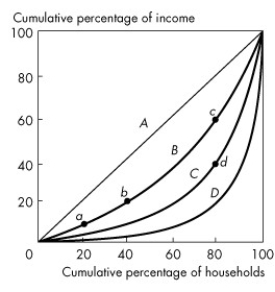 Figure 18.1.2
-Refer to Figure 18.1.2.What is curve A called?
Figure 18.1.2
-Refer to Figure 18.1.2.What is curve A called? (Multiple Choice)
4.7/5 (72)
(72) Income maintenance programs include all of the following programs except
(Multiple Choice)
4.9/5 (87)
(87) Comparing the distribution of income after taxes and benefits to the distribution of market income,the distribution of income after taxes and benefits is ________ the distribution of market income.
(Multiple Choice)
4.9/5 (77)
(77) Use the figure below to answer the following questions. 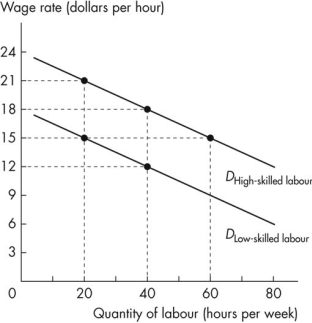 Figure 18.3.2
-Refer to Figure 18.3.2.At an employment level of 20 hours per week,firms are willing to pay
Figure 18.3.2
-Refer to Figure 18.3.2.At an employment level of 20 hours per week,firms are willing to pay (Multiple Choice)
4.8/5 (83)
(83) The wealthiest 10 percent of Canadian families own approximately
(Multiple Choice)
4.8/5 (74)
(74) Use the figure below to answer the following questions. Figure 18.3.2
-Refer to Figure 18.3.2.At a wage rate of $15,an employer would hire
Figure 18.3.2
-Refer to Figure 18.3.2.At a wage rate of $15,an employer would hire (Multiple Choice)
4.8/5 (87)
(87) Technological change ________ the demand for high-skilled workers and ________ the demand for low-skilled workers.As a result,income inequality ________.
(Multiple Choice)
4.9/5 (75)
(75) In 2015,the middle 20 percent of households received what percentage of total Canadian after-tax income?
(Multiple Choice)
4.8/5 (71)
(71) Use the figure below to answer the following questions. Figure 18.3.2
-Refer to Figure 18.3.2.At an employment level of 40 hours per week,the difference in the value of marginal product of high-skilled workers and low-skilled workers is
Figure 18.3.2
-Refer to Figure 18.3.2.At an employment level of 40 hours per week,the difference in the value of marginal product of high-skilled workers and low-skilled workers is (Multiple Choice)
4.9/5 (79)
(79) Which of the following three statements is true? Human capital
(Multiple Choice)
4.9/5 (73)
(73) In 2015,the mode income received by 10.8 percent of households in Canada was between
(Multiple Choice)
4.8/5 (71)
(71) Use the figure below to answer the following questions. Figure 18.1.2
-Which point in Figure 18.1.2 indicates that the richest 20 percent of families earn 40 percent of the income?
Figure 18.1.2
-Which point in Figure 18.1.2 indicates that the richest 20 percent of families earn 40 percent of the income? (Multiple Choice)
4.9/5 (94)
(94) Which one of the following reduces the inequality of income or wealth relative to the market distribution?
(Multiple Choice)
4.8/5 (74)
(74) Information technologies are ________ for low-skilled labour and ________ for high-skilled labour.
(Multiple Choice)
4.9/5 (77)
(77) Use the figure below to answer the following questions. 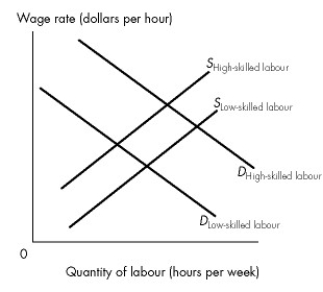 Figure 18.3.1
-Refer to Figure 18.3.1.The vertical distance between the demand curves of the high-skilled and low-skilled workers is
Figure 18.3.1
-Refer to Figure 18.3.1.The vertical distance between the demand curves of the high-skilled and low-skilled workers is (Multiple Choice)
4.8/5 (91)
(91) 
Filters
- Essay(0)
- Multiple Choice(0)
- Short Answer(0)
- True False(0)
- Matching(0)