



 Chat with AI
Exam 8: International Trade

Exam 1: First Principles199 Questions
Exam 2: Economic Models: Trade-Offs and Trade299 Questions
Exam 4: Consumer and Producer Surplus229 Questions
Exam 3: Supply and Demand265 Questions
Exam 5: Price Controls and Quotas: Meddling With Markets216 Questions
Exam 6: Elasticity226 Questions
Exam 7: Taxes286 Questions
Exam 8: International Trade260 Questions
Exam 9: Decision Making by Individuals and Firms186 Questions
Exam 10: The Rational Consumer182 Questions
Exam 11: Behind the Supply Curve: Inputs and Costs317 Questions
Exam 12: Perfect Competition and the Supply Curve341 Questions
Exam 13: Monopoly317 Questions
Exam 14: Oligopoly271 Questions
Exam 15: Monopolistic Competition and Product Differentiation245 Questions
Exam 16: Externalities193 Questions
Exam 17: Public Goods and Common Resources208 Questions
Exam 18: The Economics of the Welfare State126 Questions
Exam 19: Factor Markets and the Distribution of Income316 Questions
Exam 20: Uncertainty, Risk, and Private Information192 Questions
Exam 21: Graphs in Economics60 Questions
Exam 22: Consumer Preferences and Consumer Choice135 Questions
Select questions type


Use the following to answer question:  -(Figure: The Market for Tea in Sri Lanka)Use Figure: The Market for Tea in Sri Lanka.In autarky,the price is P1,consumer surplus equals _____ and producer surplus equals _____.
 (Multiple Choice)
4.9/5  (73)
(73) Assume that the United States imposes an import quota on Scottish wool suits.Relative to the equilibrium price that would prevail in the absence of quotas,the equilibrium price of suits in the United States will most likely _____ and the equilibrium price of suits in Scotland will most likely _____.
(Multiple Choice)
4.9/5 (81)
(81) Since labor is relatively scarce in Canada,free trade should cause the wages paid to Canadian labor to rise.
(True/False)
4.9/5 (74)
(74) In which area does the United States significantly limit imports?
(Multiple Choice)
4.9/5 (88)
(88) If the United States placed larger tariffs on all textiles,domestic _____ surplus would _____.
(Multiple Choice)
4.8/5 (88)
(88) France and England both produce wine and cloth with constant opportunity costs.France can produce 150 barrels of wine if it produces no cloth or 100 bolts of cloth if it produces no wine.England can produce 50 barrels of wine if it produces no cloth or 150 bolts of cloth if it produces no wine.When international trade takes place,each country specializes completely in the production of the good in which it has a comparative advantage: 1 barrel of wine exchanges for 1 bolt of cloth and France exports 50 units of wine.We can conclude that France produces _____ units of wine and _____ units of cloth and that France consumes _____ units of wine and _____ units of cloth.
(Multiple Choice)
5.0/5 (87)
(87) United States follows a policy of free trade,which is especially apparent for sugar and textiles,in which all restrictions on international trade have been removed.
(True/False)
4.8/5 (91)
(91) When an economy moves from autarky to free international trade,for industries in the export sector,consumer surplus _____,producer surplus _____,and the economy as a whole _____.
(Multiple Choice)
4.7/5 (87)
(87) Use the following to answer question:  -(Figure: The Production Possibilities for Two Countries)Use Figure: The Production Possibilities for Two Countries.Malaysia has an absolute advantage in producing:
 (Multiple Choice)
4.9/5 (86)
(86) Use the following to answer question:
-(Figure: The Production Possibilities for Two Countries)Use Figure: The Production Possibilities for Two Countries.The opportunity cost of producing 1 microchip in Indonesia is _____ tire(s).
-(Figure: The Production Possibilities for Two Countries)Use Figure: The Production Possibilities for Two Countries.The opportunity cost of producing 1 microchip in Indonesia is _____ tire(s). (Multiple Choice)
4.7/5 (76)
(76) The United States can produce wine domestically,but it can also import wine if the world price is lower than the domestic price.If the United States imports wine,consumer surplus will _____ by _____ the _____ in producer surplus;total surplus will _____.
(Multiple Choice)
4.8/5 (89)
(89) Japan's comparative advantage in automobiles can be attributed to:
(Multiple Choice)
4.8/5 (74)
(74) Mexico is relatively labor-abundant when compared with the United States.Therefore,Mexico has a comparative advantage in _____ compared with the United States.
(Multiple Choice)
4.8/5 (71)
(71) A tariff imposed on U.S.imports into Japan tends to _____ U.S.producers and _____ Japanese producers.
(Multiple Choice)
4.8/5 (66)
(66) Use the following to answer question:  -(Table: Production Possibilities for Machinery and Petroleum)Use Table: Production Possibilities for Machinery and Petroleum.In the United States the opportunity cost of producing 40 units of machinery is _____ units of petroleum.
 (Multiple Choice)
4.8/5 (88)
(88) Which statement does NOT describe a source of comparative advantage?
(Multiple Choice)
4.8/5 (89)
(89) Use the following to answer question: 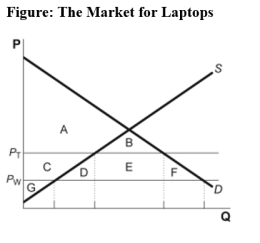 -(Figure: The Market for Laptops)Use Figure: The Market for Laptops.Assume that S and D are the domestic supply and demand curves and the world price is PW.Identify the area of government tax revenue when a tariff raises the domestic price from the world price to PT.
 (Multiple Choice)
4.8/5 (77)
(77) Use the following to answer question:
-(Figure: The Production Possibilities for Two Countries)Use Figure: The Production Possibilities for Two Countries.If Malaysia specializes completely in the production of the good of its comparative advantage,it will produce:
-(Figure: The Production Possibilities for Two Countries)Use Figure: The Production Possibilities for Two Countries.If Malaysia specializes completely in the production of the good of its comparative advantage,it will produce: (Multiple Choice)
4.9/5 (75)
(75) Use the following to answer question:
-(Table: Production Possibilities for Machinery and Petroleum)Use Table: Production Possibilities for Machinery and Petroleum.The opportunity cost in Mexico of producing 105 units of petroleum is _____ units of machinery.
-(Table: Production Possibilities for Machinery and Petroleum)Use Table: Production Possibilities for Machinery and Petroleum.The opportunity cost in Mexico of producing 105 units of petroleum is _____ units of machinery. (Multiple Choice)
4.8/5 (79)
(79) Use the following to answer question:  -(Figure: The Market for Oranges in South Africa)Use Figure: The Market for Oranges in South Africa.In autarky,the price of oranges in South Africa is P1.When the economy is opened to trade,the price falls to PW and consumer surplus will _____ to area _____.
 (Multiple Choice)
4.8/5 (63)
(63) 
Filters
- Essay(0)
- Multiple Choice(0)
- Short Answer(0)
- True False(0)
- Matching(0)