



 Chat with AI
Exam 11: Resource Markets

Exam 1: The Art and Science of Economic Analysis162 Questions
Exam 1: Appendix--Understanding Graphs71 Questions
Exam 2: Economic Tools and Economics Systems211 Questions
Exam 3: Economic Decision Makers207 Questions
Exam 4: Demand, Supply, and Markets245 Questions
Exam 5: Elasticity of Demand and Supply244 Questions
Exam 5: Appendix--Price Elasticity and Tax Incidence32 Questions
Exam 6: Consumer Choice and Demand171 Questions
Exam 6: Appendix--Indifference Curves and Utility Maximization107 Questions
Exam 7: Production and Cost in the Firm218 Questions
Exam 8: A--Perfect Competition250 Questions
Exam 8: B--Perfect Competition25 Questions
Exam 9: A--Monopoly249 Questions
Exam 9: B--Monopoly18 Questions
Exam 10: Monopolistic Competition and Oligopoly233 Questions
Exam 11: Resource Markets219 Questions
Exam 12: Labor Markets and Labor Unions218 Questions
Exam 13: Capital, Interest, and Corporate Finance190 Questions
Exam 14: Transaction Costs, Imperfect Information, and Behavioral Economics187 Questions
Exam 15: Economic Regulation and Antitrust Policy179 Questions
Exam 16: Public Goods and Public Choice143 Questions
Exam 17: Externalities and the Environment203 Questions
Exam 18: Income Distribution and Poverty130 Questions
Exam 19: International Trade172 Questions
Exam 20: International Finance226 Questions
Exam 21: Economic Development97 Questions
Select questions type


If 15 workers produce 100 license plates, 16 workers produce 120 license plates, and 17 workers produce 130 license plates, then
(Multiple Choice)
4.9/5  (72)
(72) An increase in the price of a resource will cause a rightward shift of its supply curve.
(True/False)
5.0/5 (63)
(63) The smaller the quantity and quality of complementary resources used in production,
(Multiple Choice)
4.8/5 (86)
(86) Exhibit 11-9 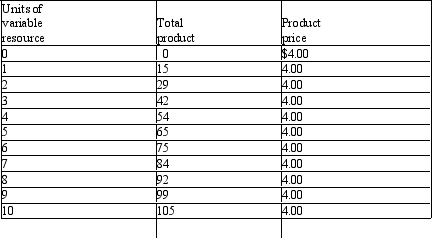 In Exhibit 11-9, what is the marginal revenue product of the fifth unit of the variable resource?
 (Multiple Choice)
4.7/5 (76)
(76) The resource market is different from the product market because
(Multiple Choice)
4.7/5 (72)
(72) The marginal revenue product curve represents a firm's demand curve for a resource.
(True/False)
5.0/5 (83)
(83) If a firm is hiring in a perfectly competitive labor market, the firm's marginal labor cost (or marginal resource cost)curve slopes downward.
(True/False)
4.8/5 (91)
(91) Ten cases of spring water are sold for $6 each, and the marginal product of the last unit of labor is 5.If the price of a case increases from $6 to $8, then the marginal revenue product of the last unit of labor would
(Multiple Choice)
4.9/5 (75)
(75) Exhibit 11-9
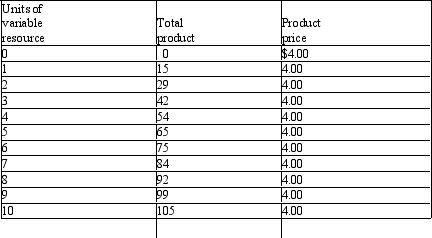 In Exhibit 11-9, marginal revenue product begins to decline with the second worker hired.
 (True/False)
4.8/5 (76)
(76) Exhibit 11-3  In Exhibit 11-3, opportunity cost in equilibrium equals
 (Multiple Choice)
4.7/5 (74)
(74) Gooey Flakes is the only ready-to-eat cereal that has chocolate syrup injected into each flake.The machine that injects the syrup into the flakes can do nothing else.Which of the following is true?
(Multiple Choice)
4.8/5 (87)
(87) Exhibit 11-2  In Exhibit 11-2, opportunity cost at equilibrium equals
 (Multiple Choice)
4.9/5 (66)
(66) A curve that shows the cost to the firm of hiring an additional unit of a resource is known as a
(Multiple Choice)
4.8/5 (79)
(79) Both sugar and fructose can be used in the production of candy.If the price of sugar increases,
(Multiple Choice)
4.8/5 (82)
(82) Suppose the marginal product of the second worker hired by a firm is 3, and the price of the last unit produced is $7.Which of the following is true of the marginal revenue product of the second worker?
(Multiple Choice)
4.8/5 (84)
(84) If MRPlabor/MRClabor > MRPcapital/MRCcapital, then the firm should
(Multiple Choice)
4.8/5 (86)
(86) Exhibit 11-6 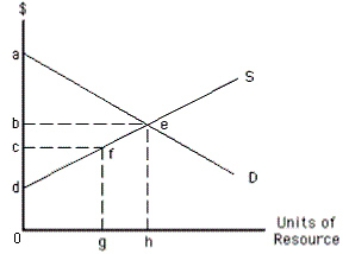 In Exhibit 11-6, opportunity cost in equilibrium is represented by area
 (Multiple Choice)
4.9/5 (75)
(75) 
Filters
- Essay(0)
- Multiple Choice(0)
- Short Answer(0)
- True False(0)
- Matching(0)